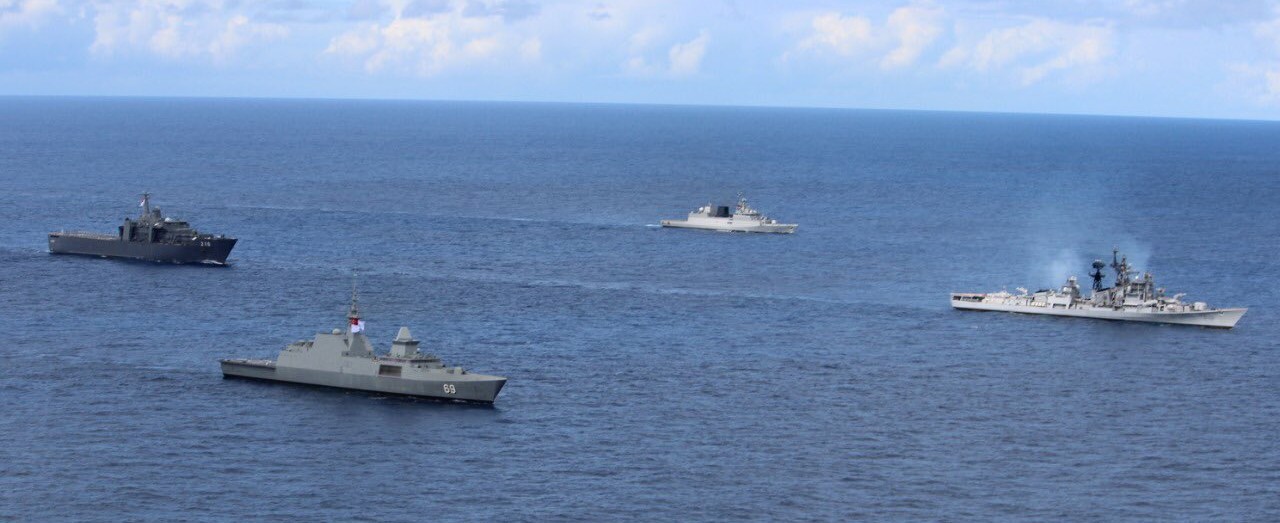
 Indian and Singaporean warships. (File photo)
— By Huma Siddique
New Delhi: The second Asean-India Maritime Exercise is set to put an increasingly important question at the center of the Indo-Pacific: how can countries that depend on the sea for trade, energy, food and security work together when the maritime environment is becoming more contested?
The answer will begin taking shape when India and the 11 Asean member states gather for AIME 2026 in waters off the Philippines from September 28 to October 2.
The Philippines and India are co-hosting the exercise, with Subic, Zambales, serving as the main venue. Final preparations were discussed during the AIME 2026 Final Planning Conference in Pasay City, where Philippine and Indian naval officials worked through the arrangements for the multinational drill.
The participating countries are India, the Philippines, Brunei Darussalam, Cambodia, Indonesia, Laos, Malaysia, Myanmar, Singapore, Thailand, Timor-Leste and Vietnam.
On paper, AIME is a naval exercise. In practice, however, its significance goes well beyond ships conducting manoeuvres at sea. It comes at a time when the South China Sea remains one of Asia’s most sensitive strategic flashpoints, maritime encounters between rival claimants are becoming more frequent, and major powers are competing for influence across the Indo-Pacific.
For ASEAN and India, the challenge is to strengthen maritime cooperation without turning the region into a collection of rival military camps. That balancing act is what makes AIME 2026 particularly important.
More than a naval drill
The theme of the exercise, “Anchored in Trust, United at Sea,” captures the central objective. Modern navies need to be able to communicate and coordinate with one another quickly, particularly when operating in crowded and increasingly complicated waters. A misunderstanding between two ships can become a diplomatic incident. A collision or unsafe manoeuvre involving military vessels can escalate even faster.
They allow sailors and commanders from different countries to become familiar with each other’s procedures, communication methods and operational practices. They also create professional relationships that can become important when an actual maritime emergency occurs. That is particularly relevant in Southeast Asia, where naval and coast guard vessels from different countries routinely operate in overlapping areas.
The Philippine Navy has emphasized that the exercise is intended to improve maritime security cooperation, coordination and interoperability. Indian officials have similarly stressed the importance of working collectively to maintain a free, open and inclusive Indo-Pacific.
The message is therefore not simply that participating countries are preparing to fight together. It is that they want to become better at operating together.
Why the timing matters
AIME 2026 arrives during a period of heightened geopolitical competition in the Indo-Pacific. The South China Sea remains at the heart of many of the region’s security concerns. China claims extensive areas of the sea, while the Philippines, Vietnam, Malaysia and Brunei have overlapping maritime claims in different areas.
The Philippines has been involved in repeated confrontations with Chinese vessels, particularly around disputed maritime features. These encounters have included collisions, water-cannon incidents, dangerous manoeuvres and competing accusations over which country’s vessels were operating lawfully.
At the same time, China is not the only factor reshaping the strategic environment. The United States has strengthened its alliances and partnerships in the Indo-Pacific. Japan and Australia have expanded their security cooperation with regional countries. India has increased its naval presence and defence engagement with Southeast Asia. European countries have also shown greater interest in maritime security and freedom of navigation.
Asean countries consequently find themselves operating in an environment where strategic competition is becoming harder to ignore. Yet most of them do not want Southeast Asia to become the frontline of a new Cold War. AIME offers a different model: practical cooperation without a formal military alliance.
The importance of all 11 Asean members
The second AIME is also notable because it brings together the full ASEAN membership. Timor-Leste became ASEAN’s 11th member in October 2025, meaning AIME 2026 is taking place with a larger ASEAN than the organization had when the first exercise was held in 2023. The expanded participation gives the exercise additional political weight.
The ASEAN countries do not share identical views on China, the South China Sea or the role of outside powers. Some have direct territorial disputes with Beijing. Others have substantial economic relationships with China and prefer a less confrontational approach. Some are also developing closer security relationships with India, Japan, Australia and the United States.
A joint ASEAN-India exercise does not erase those differences. What it does is create a common space where countries with different strategic calculations can cooperate on practical maritime issues. That is very much in line with the ASEAN approach.
ASEAN has traditionally preferred dialogue, consensus and gradual confidence-building over rigid military alignments. AIME fits comfortably within that tradition.
India has its own strategic reasons
For India, the exercise is an important extension of its engagement with Southeast Asia. New Delhi’s “Act East” policy has placed Asean at the center of India’s broader Indo-Pacific strategy. India’s geographical position makes the maritime connection obvious: the Indian Ocean links India to the Malacca Strait and onward to the South China Sea and the Pacific.
The security of those waterways matters to India because its economy depends heavily on international maritime trade. But there is another strategic consideration.
India’s relationship with China has become significantly more complicated since the deadly 2020 border confrontation in the Galwan Valley. Although the Himalayan border and the South China Sea are geographically separate, the broader strategic competition between the two Asian powers extends across multiple domains.
India has therefore sought stronger relationships with countries across the Indo-Pacific. Asean is particularly important because it occupies the geographic and strategic space connecting the Indian and Pacific oceans.
For India, closer naval cooperation with Asean provides greater familiarity with Southeast Asian maritime environments while strengthening diplomatic and security relationships with countries that are themselves trying to preserve strategic autonomy.
Why the Philippines is a significant host
The Philippines adds another layer of importance to the exercise. The country sits at the intersection of major maritime routes linking the South China Sea with the Pacific. It is also one of the most active Southeast Asian claimants in challenging China’s maritime activities.
Subic itself has a long military and strategic history. The former US naval facility at Subic Bay was once one of the largest American military installations overseas. Today, the area remains strategically valuable because of its deep-water facilities and location on the western side of Luzon.
Conducting a multinational naval exercise their sends a strong message about the Philippines’ growing role in regional maritime security , but Manila has also been careful to frame its maritime partnerships in terms of international law, regional stability and cooperation rather than confrontation. That distinction will matter during AIME.
Unclos is the legal foundation
Behind much of the region’s maritime diplomacy is a document that does not receive nearly as much attention as warships or military alliances: the United Nations Convention on the Law of the Sea, or Unclos. Unclos is effectively the rulebook for much of the world’s oceans.
It establishes maritime zones, defines the rights of coastal states and sets out rules relating to navigation, resources and activities at sea. One of its most important concepts is the exclusive economic zone, or EEZ.
An EEZ can extend up to 200 nautical miles from a coastal state’s baseline. Within that zone, the coastal state has specific rights over natural resources and certain economic activities. But an EEZ is not the same as territorial waters. Other states continue to enjoy important freedoms, including navigation and overflight, subject to the convention’s rules. That distinction is particularly important in the South China Sea.
Many disputes in the region are not simply arguments about who owns an island. They also involve questions about maritime zones, fishing rights, energy resources, military activities and navigation.
Unclos provides the internationally recognized legal framework through which those questions are supposed to be addressed. For Asean and India, therefore, maritime cooperation is closely connected to the preservation of a rules-based maritime order.
Why Unclos matters to AIME
A naval exercise cannot resolve a territorial dispute. But it can reinforce the habits of behavior that help prevent disputes from becoming dangerous confrontations. That includes understanding maritime law, respecting navigational rights, communicating clearly and exercising restraint during encounters.
The Asean-India partnership has repeatedly identified Unclos as a foundation for maritime cooperation. The two sides have also emphasized freedom of navigation and overflight, peaceful settlement of disputes and respect for international law. This is particularly significant for the Philippines, which has consistently highlighted UNCLOS in its position on the South China Sea.
The 2016 arbitral ruling in the Philippines’ case against China was issued under the Unclos framework. The tribunal rejected China’s claim to historic rights over resources within the so-called nine-dash line where those rights exceeded what Unclos permits.
China has rejected the ruling. The disagreement remains unresolved. That makes the wider principle of adherence to international maritime law even more significant.
The exercise is also about the blue economy
It would be a mistake to view Asean-India maritime cooperation entirely through a military lens. The sea is an economic lifeline for both sides.
Shipping carries the overwhelming majority of international trade. Southeast Asian economies depend heavily on ports, fisheries, offshore resources and maritime transport. India is similarly dependent on secure sea lanes for its energy supplies and international commerce. That is why the Asean-India maritime agenda includes the blue economy.
The concept covers sustainable use of marine resources, fisheries, marine biodiversity, renewable energy, maritime infrastructure and environmentally responsible shipping. The partnership also addresses marine pollution, marine debris, illegal fishing and disaster response.
In other words, keeping the sea secure is not only about preventing military conflict. It is also about ensuring that fishermen can work safely, ships can move goods, coastal communities can survive, and countries can develop marine resources without destroying the ecosystems on which those economies depend.
Learning from the first AIME
The 2026 exercise builds on the inaugural Asean-India Maritime Exercise held in 2023. That first exercise was co-hosted by India and Singapore and involved naval forces from India and several Asean countries. It included a harbor phase followed by activities at sea in the South China Sea.
The participating forces conducted manoeuvres, communication drills, helicopter cross-deck operations and other activities designed to improve interoperability.
There was also an important confidence-building component. Navies practiced procedures for dealing with encounters and maritime security situations rather than simply focusing on combat operations. That experience provided a foundation for the second exercise.
AIME 2026 is therefore not starting from scratch. It is an attempt to turn an initial experiment in ASEAN-India naval cooperation into a more established mechanism.
AIME and the Asean-India relationship
The exercise also fits into a much larger relationship. Asean and India elevated their ties to a comprehensive strategic partnership in 2022. Since then, cooperation has expanded across defence, trade, connectivity, technology, education, disaster management and maritime affairs.
The decision to designate 2026 as the Asean-India Year of Maritime Cooperation gives this year’s exercise particular significance. It means AIME is not an isolated naval event. It is part of a broader effort to make maritime cooperation one of the defining areas of the Asean-India relationship.
That includes improving maritime security while also expanding cooperation in areas such as environmental protection, marine resources, connectivity and disaster response. The exercise is therefore one piece of a much larger strategic picture.
What message does it send to China?
This is perhaps the most sensitive question surrounding AIME 2026. The participating governments are unlikely to describe the exercise as a response to China. And formally, it is not an anti-China exercise.
China is an important economic partner for Asean, and several Asean countries have no interest in turning their relationships with Beijing into open confrontation. But strategic signals do not always require explicit declarations.
When India and all 11 Asean countries conduct a major maritime exercise in the Philippines, in a region where China has extensive and disputed maritime claims, Beijing will inevitably take notice. The exercise demonstrates that Southeast Asian countries have alternatives for security cooperation. It also shows that India is prepared to play a larger role in Southeast Asian maritime affairs.
At the same time, the exercise avoids the formal alliance structure that might make ASEAN countries uncomfortable. That is an important distinction. The message is less “choose sides” and more “build the capacity to protect your interests.”
Deterrence without escalation
There is a paradox at the heart of maritime exercises. Military cooperation can increase deterrence, but it can also be perceived as provocative if handled carelessly. AIME’s emphasis on interoperability, communication and confidence-building helps address that dilemma. Countries that know how to communicate with one another are less likely to misunderstand one another. Countries that regularly train together are more likely to understand how their counterparts behave at sea. And countries that have established military-to-military relationships have more channels available when something goes wrong.
That makes exercises like AIME relevant even in situations where the participating navies never have to use force. Their greatest success may be an incident that never happens.
Overall implications
The Indo-Pacific is becoming more militarized, but that does not necessarily mean conflict is inevitable. The region’s future will depend partly on whether countries can build mechanisms that allow them to compete without constantly risking escalation. AIME 2026 is one such mechanism.
It strengthens India’s ties with Southeast Asia. It gives Asean navies an opportunity to improve their ability to operate together. It supports the Philippines’ maritime diplomacy. It reinforces the importance of international maritime law and Unclos. And it demonstrates that maritime security can include everything from naval cooperation and search-and-rescue operations to environmental protection and the blue economy.
Most importantly, it strengthens the habit of cooperation. That may sound less dramatic than a new warship or missile system, but it is precisely what a complicated maritime region needs.
The South China Sea will not become less contested simply because sailors from India and Asean countries train together. China’s maritime claims will not disappear. Nor will strategic competition between major powers. But stronger communication, greater interoperability and a shared commitment to international rules can reduce the chances that a routine encounter at sea becomes a major crisis. That is ultimately why AIME 2026 matters.
It is not just about what the participating navies will do during the few days of the exercise. It is about whether countries across the Indo-Pacific can build enough trust to keep their increasingly crowded seas stable. And in a region where so much of the economy, security and future prosperity depends on those waters, that is a strategic objective worth pursuing.
(The author is a senior journalist, who looks after the defence and strategic affairs developments. She is known for her reporting and writing on India’s defence sector, military modernization, aerospace, national security , diplomacy and strategic affairs.)
Follow us on social media for quick updates, new photos, videos, and more.
X: https://x.com/indiasentinels
Facebook: https://facebook.com/indiasentinels
Instagram: https://instagram.com/indiasentinels
YouTube: https://youtube.com/indiasentinels
© India Sentinels 2026-27