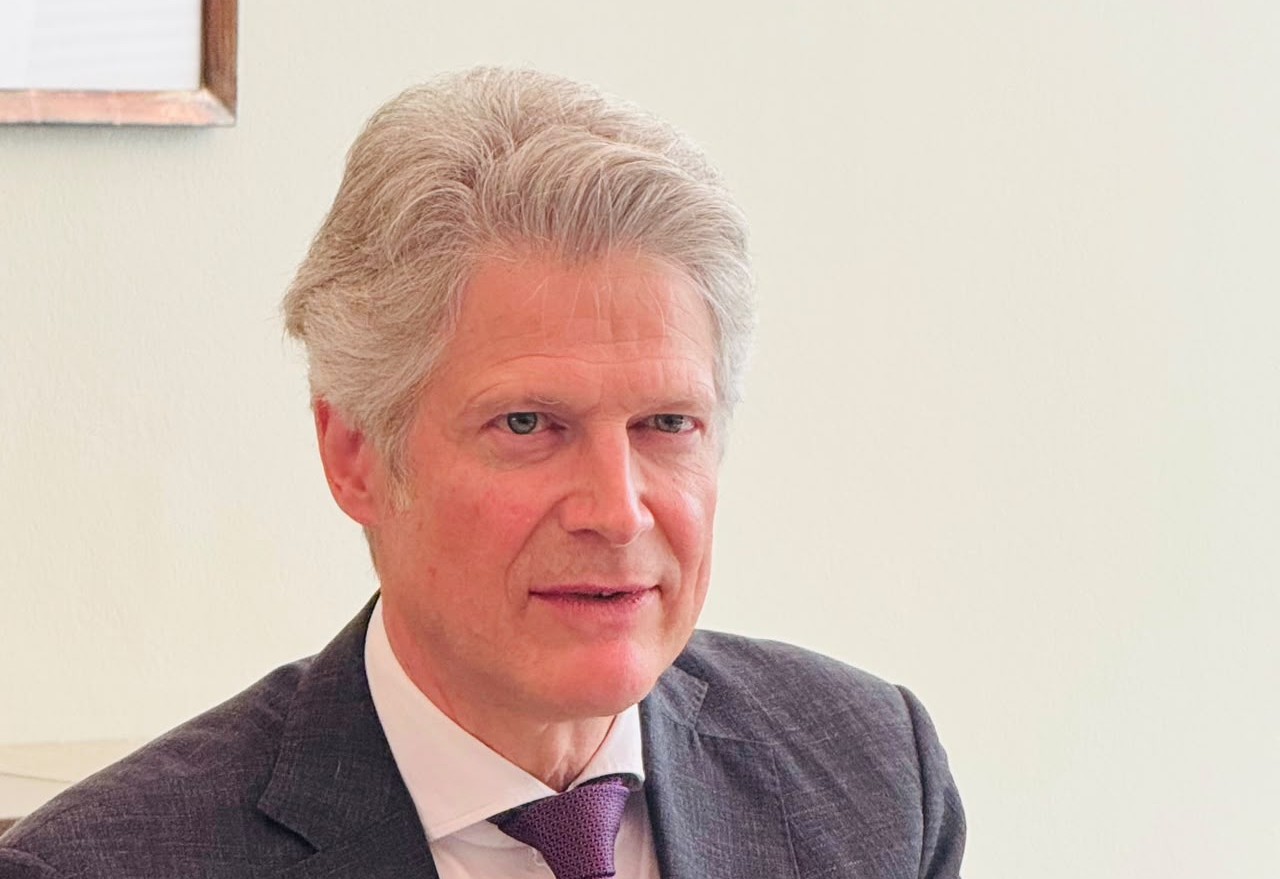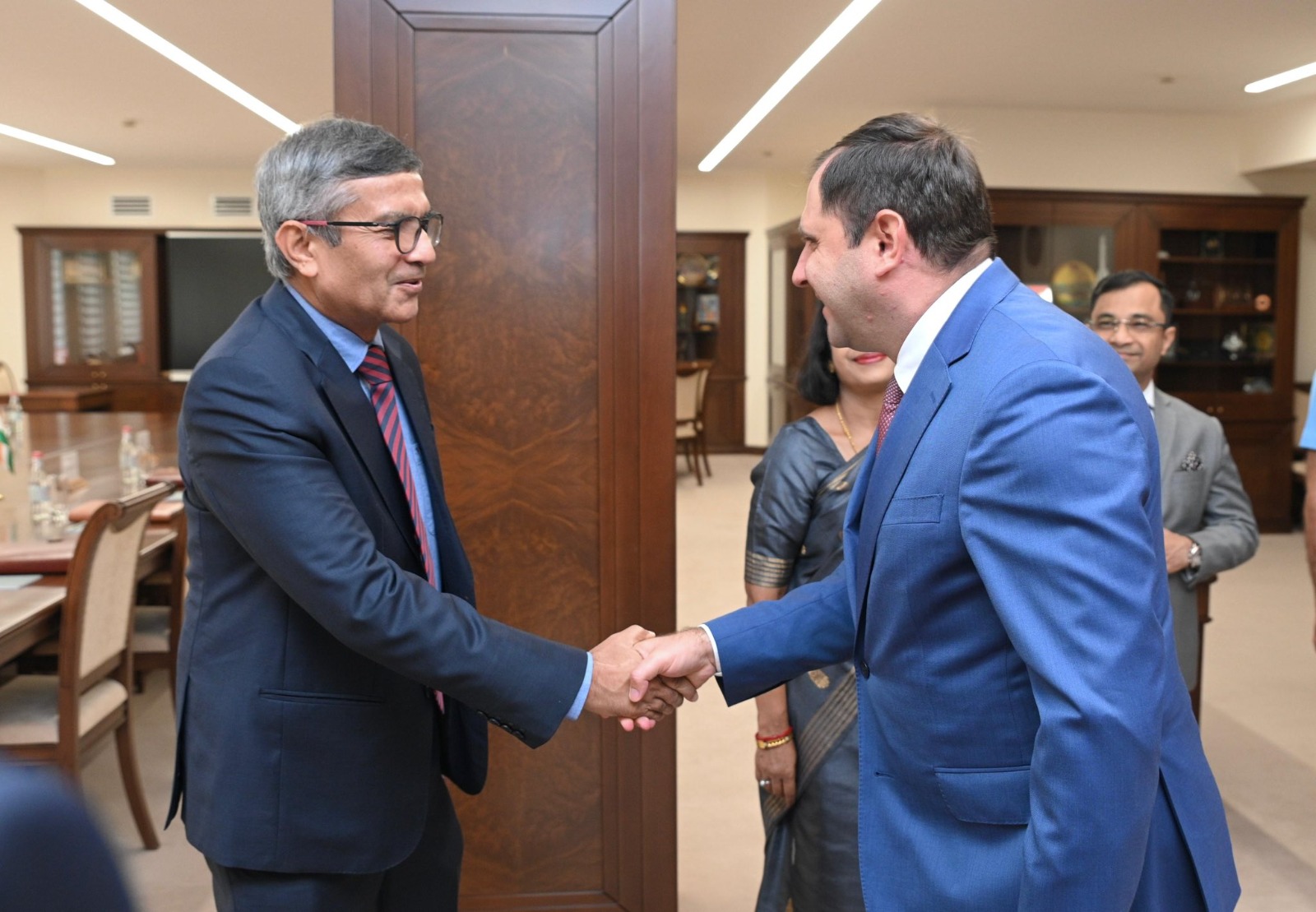
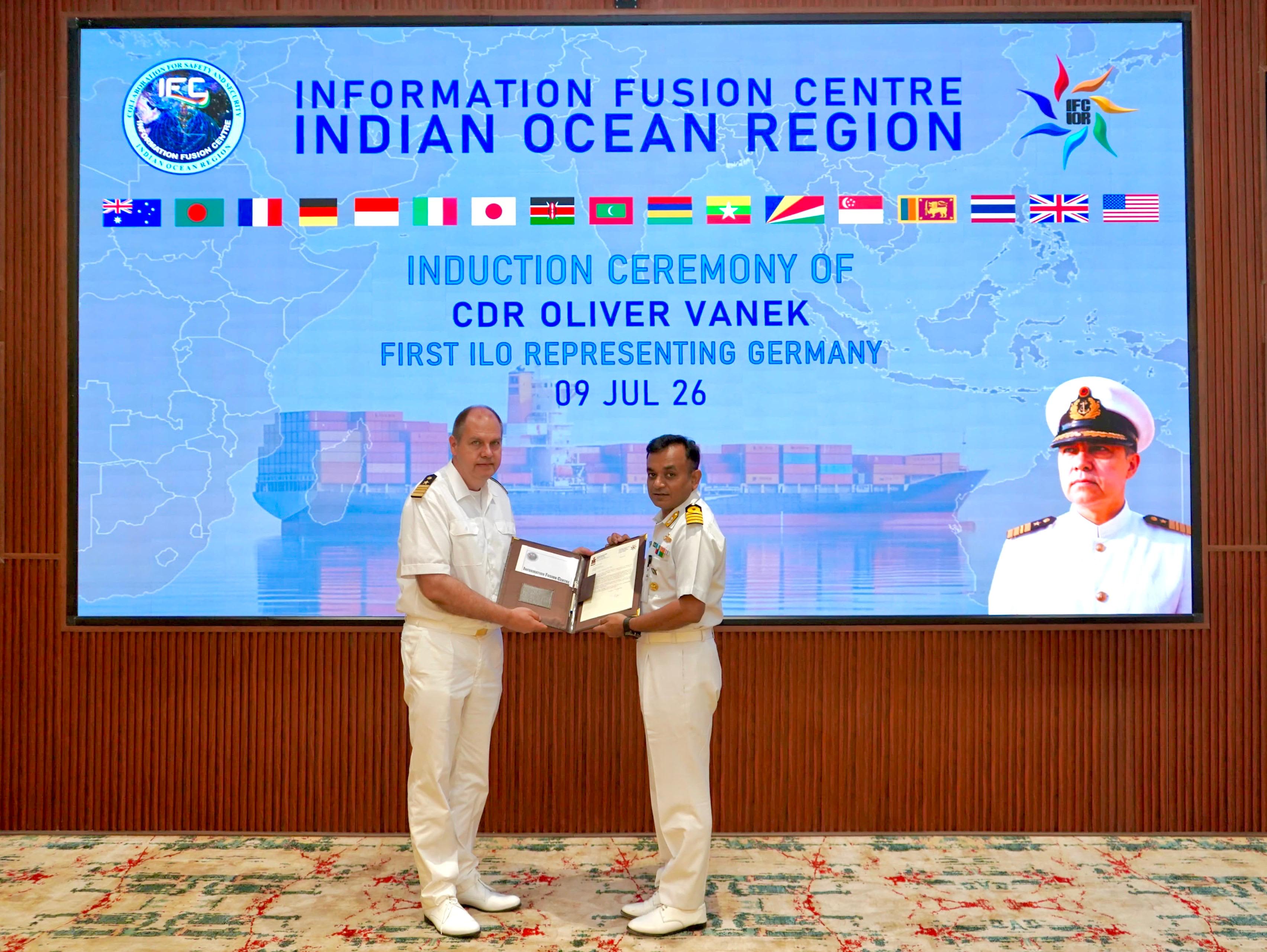
 Commander Oliver Vanek joins IFC-IOR as German ILO. (Photo: IFC-IOR)
New Delhi: Germany has stationed its first international liaison officer at the Indian Navy’s Information Fusion Centre – Indian Ocean Region (IFC-IOR) in Gurugram, formalising Berlin’s place in the multinational maritime security network India has built over the past seven years – and adding fresh momentum to a defence partnership already being reshaped by a prospective multibillion-dollar submarine programme.
Commander Oliver Vanek took up the post on Thursday, thus becoming the centre’s 17th resident liaison officer and the first to represent Germany. Colonel Klaus Willi Merkel, Germany’s defence attaché to India, attended the induction, according to a statement issued by the IFC-IOR.
A Navy official said the addition was expected to sharpen collaborative monitoring of maritime activity, tighten information exchange and support ongoing regional security initiatives across the Indian Ocean region (IOR). The centre itself noted that Germany’s induction brings the perspective of a major European maritime power into what has become a crowded, consequential international framework.
Steadily widening network
The INavy set up the IFC-IOR in December 2018 at Gurugram, Haryana, to build a shared, real-time picture of shipping movements, piracy, illegal fishing, trafficking and other maritime hazards across one of the world’s busiest trade corridors – a stretch of ocean carrying more than four-fifths of global seaborne trade. What started as a facility with a handful of resident representatives has grown steadily since: Australia was among the earliest to post an officer, followed over the years by France, Japan, the United States, the United Kingdom, Italy, Kenya and several Indian Ocean littoral states, including Sri Lanka, Mauritius, Seychelles, Bangladesh, Myanmar, Thailand, Singapore and the Maldives.
Read also: Indonesia stations first liaison officer at India’s IFC-IOR as Modi begins Jakarta visit
Germany’s arrival takes the tally of resident liaison officers to 17, coming just days after Indonesia posted its own first officer to the centre on July 1, ahead of Prime Minister Narendra Modi’s visit to Jakarta. The centre also maintains working-level information-sharing arrangements with dozens of other countries and multinational bodies, though only a select group of partners have chosen to place officers physically on the ground in Gurugram – a distinction the Navy regards as marking a deeper tier of operational trust.
Broader defence upswing
The posting comes at a moment when India-Germany defence ties are moving faster than at almost any point in the relationship’s history.Friedrich Merz’s, visit to New Delhi in January – his first as Germany’s chancellor – produced 19 memorandums of understanding spanning defence co-production, critical technology, semiconductors and green energy, alongside a joint statement committing both governments to deepen strategic cooperation.
Behind that visit sits a submarine programme that has become the centrepiece of the relationship: a proposed $8–10 billion contract under which Germany’s Thyssenkrupp Marine Systems would partner India’s Mazagon Dock Shipbuilders to build six air-independent-propulsion submarines at Mumbai under the Navy’s Project-75(I) programme, with a full transfer of design and production know-how attached.
The defence minister, Rajnath Singh, travelled to Kiel in April to inspect the Thyssenkrupp facility alongside his German counterpart, Boris Pistorius – a visit widely read as a signal that the two sides were closing in on final terms. Should the deal go through, it would rank among the largest defence-industrial projects New Delhi has ever undertaken, and could see India shelve a separate plan to acquire three additional French Scorpene-class boats.
Set against that backdrop, Vanek’s appointment is a modest but pointed step: a permanent German presence inside an Indian-run intelligence hub, just as the two navies weigh decades of shared submarine production. Officials on the Indian side framed the move as reinforcing a joint commitment to a free, open and stable Indian Ocean Region – language New Delhi has leaned on repeatedly in its outreach to Indo-Pacific partners wary of China’s expanding naval footprint.
For Berlin, whose defence-industrial policy has shifted sharply since Russia’s invasion of Ukraine triggered a broader rearmament drive, the Gurugram posting also offers a foothold in a theatre where Germany has historically had little direct naval presence. Whether that foothold grows into something more substantial will likely depend on how quickly – and on what terms – the submarine negotiations are eventually closed.