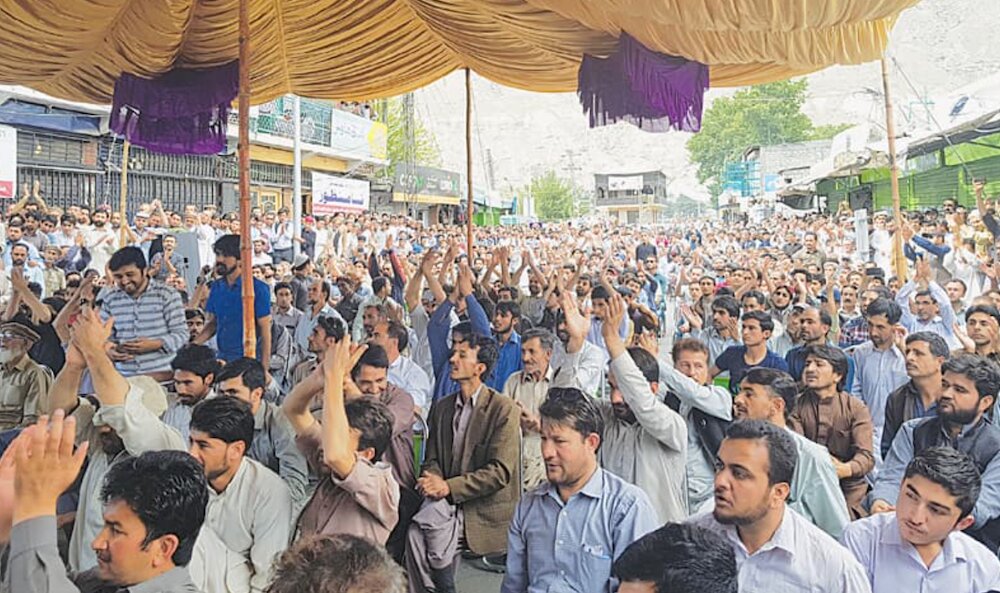
 People seen protesting against the Pakistani government in Skardu, Gilgit-Baltistan. (Representative photo via Facebook)
New Delhi: India on Friday lodged a sharp diplomatic protest against Pakistan’s decision to hold assembly election in Gilgit-Baltistan on Sunday. New Delhi firmly reiterated that the region is an integral part of Indian territory and warned Islamabad against any attempt to alter the status of lands under its illegal occupation.
The Ministry of External Affairs (MEA) categorically rejected Pakistan’s move to organize what it has styled a “general election” in Gilgit-Baltistan – a region that New Delhi recognizes as forming part of the union territory of Ladakh. The MEA underscored that the union territories of Jammu & Kashmir and Ladakh, which include Gilgit-Baltistan, had legally acceded to India in 1947, making them “integral and inalienable” parts of the country – a status that no unilateral Pakistani action can alter.
“The entire union territories of Jammu & Kashmir and Ladakh, including the so-called Gilgit-Baltistan, are integral and inalienable parts of India,” the MEA said in its statement, adding that the accession of Jammu & Kashmir to India was “complete, legal and irrevocable”.
The protest comes just days before voters in the Pakistan-administered region are scheduled to elect members to a local assembly – an exercise India has consistently opposed over the years on the clear grounds that Pakistan holds no legal authority to carry out political or administrative acts in territories it occupies by force.
The MEA was careful not to directly engage with Pakistan’s internal electoral process, but made its position unambiguous: any such exercise conducted in territories under Pakistan’s control carries no legal validity whatsoever from India’s standpoint. The ministry also reiterated New Delhi’s longstanding position that Pakistan continues to illegally occupy parts of the former princely state of Jammu & Kashmir.
Human rights abuses flagged
Beyond objecting to the planned polls, India used the occasion to shine a light on what it described as a much deeper crisis in Gilgit-Baltistan and other Pakistan-occupied territories – one that elections cannot paper over.
The MEA alleged that residents living under Pakistan’s control continue to endure political repression, severe restrictions on civil liberties, and systematic economic exploitation. The ministry made clear that organizing elections does nothing to address, let alone resolve, concerns about human rights, political freedoms, and the economic welfare of people in the region.
This reflects a calculated shift in India’s diplomatic posture in recent years. New Delhi has increasingly chosen to spotlight governance failures and human rights abuses in Pakistan-occupied territories – effectively turning the tables on Islamabad, which has long tried to internationalise the situation in Jammu & Kashmir. Earlier this week, India rejected references to J&K in a joint communiqué issued by Pakistan and the European Union, asserting that external parties have no standing to comment on what are, unambiguously, internal Indian matters.
A dispute rooted in 1947
Gilgit-Baltistan occupies the northernmost reaches of the former princely state of Jammu & Kashmir and has remained under Pakistan’s control since the first India-Pakistan war of 1947–48. Its strategic significance is considerable: the region shares borders with China, Afghanistan, and India, and serves as the northern gateway of the China-Pakistan Economic Corridor (CPEC).
India has long objected to the construction of infrastructure projects, administrative reorganization, and electoral exercises that Pakistan has periodically attempted in the region, arguing that each such move is a calculated effort to manufacture an illusion of legitimacy over territory that Pakistan holds illegally.
Successive governments in New Delhi have taken a consistent line – that any unilateral effort to change the character or status of these territories is legally untenable and will not be recognized. India has also repeatedly demanded that Pakistan vacate all areas under its occupation.
Reiterating that position on Friday, the MEA said India categorically rejects every effort to engineer material changes in territories under Pakistani control, stressing that no such action can alter the ground reality of India’s sovereign claim over the region.
The latest diplomatic protest is set to deepen the already considerable tension between the two neighbours, whose relations remain seriously strained over Pakistan-sponsored cross-border terrorism, territorial disputes, and the unresolved question of Jammu & Kashmir.
Follow us on social media for quick updates, new photos, videos, and more.
X: https://x.com/indiasentinels
Facebook: https://facebook.com/indiasentinels
Instagram: https://instagram.com/indiasentinels
YouTube: https://youtube.com/indiasentinels
© India Sentinels 2026-27