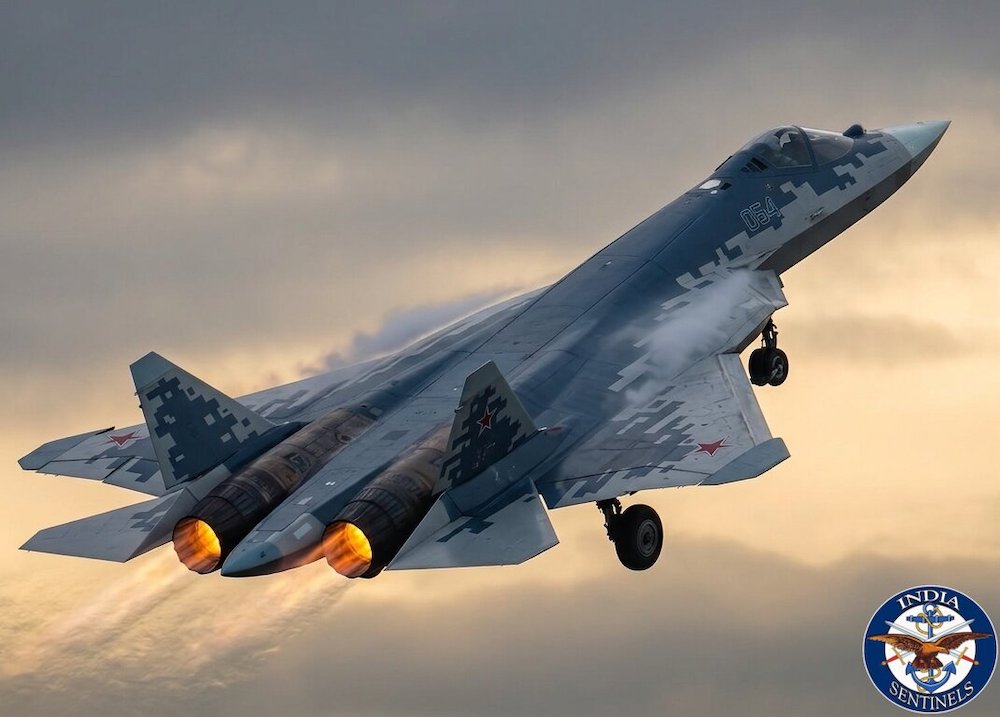
 Illustration of a Russian Su-57 for representation. (© India Sentinels 2026–27)
New Delhi: Russia’s president, Vladimir Putin, has formally signalled Moscow’s readiness to supply India with the Sukhoi-57 (Su-57), its most advanced fifth-generation stealth fighter. With his remarks, he revived a defence conversation that New Delhi walked away from in 2018. Putin made the offer at the St Petersburg International Economic Forum (SPIEF), while parallel talks on civilian aircraft – potentially involving up to 200 planes – pointed to a broader deepening of aviation ties between the two countries.
“Regarding aviation hardware, India traditionally purchases our aircraft and helicopters. I know that the pilots are satisfied with this equipment. The Su-57 is an excellent, modern aircraft, perhaps the most advanced in the world at the moment, and the most effective,” Putin said at SPIEF on Friday.
Referring to the shelved joint development programme, he added: “We originally proposed to launch this project jointly. However, it did not materialize at the time, so we developed it on our own. Now, we are fully ready to supply it, including this specific aircraft.” Putin also noted that the twin-seat variant of the Su-57 could double as an airborne command post, and said Russia was simultaneously pushing ahead with cooperation on naval hardware, submarines, and surface vessels.
Read also: Rolls-Royce offers India new engine for AMCA project, pitches full tech transfer
FGFA backstory
India and Russia had launched the fifth-generation fighter aircraft (FGFA) programme in 2007 under an inter-governmental agreement, with a formal design contract signed in 2010. The Indian Air Force (IAF) ultimately recommended withdrawal in 2018, and New Delhi formally exited, having invested approximately ₹1,483 crore in the preliminary design phase. The IAF’s principal objections centred on the aircraft’s limited stealth coverage – restricted to a frontal 60-degree arc – as well as the absence of true supercruize capability and concerns over restricted technology transfer. Continuing the programme would have required a commitment of roughly $35 billion for 127 aircraft, with unit costs estimated at $150–200 million.
The Su-57 is a twin-engine multirole fighter capable of speeds exceeding Mach 2, with a range of approximately 3,500 kilometres and a service ceiling of 20,000 metres. It carries an N036 Byelka active electronically scanned array (AESA) radar, three-dimensional thrust-vectoring engines, and an integrated electronic warfare suite, with internal weapons bays designed to preserve its reduced radar cross-section. The aircraft entered limited service with the Russian Aerospace Forces (RuAF) in 2020. A more powerful next-generation engine – the Izdeliye 30 – is under development but has yet to enter serial production.
After dropping out of the FGFA programme, India started pursuing its own homegrown fifth-generation fighter under the advanced medium combat aircraft (AMCA) programme. Since the first fighter from the AMCA project is expected to enter service in the mid-2030s, the Indian Air Force is reportedly mulling to buy a few squadron of Su-57 as a stop-gap arrangement.
Read also: For AMCA project, MoD issues proposal requests to three private parties bypassing HAL
Civilian aircraft
On the civilian side, Vadim Badekha, the chief of United Aircraft Corporation (UAC), told TASS on the sidelines of SPIEF that UAC had signed a bilateral agreement with Hindustan Aeronautics Limited (HAL) for licensed production of the Sukhoi SJ-100 “Superjet” for the Indian civil aviation market. He said Indian airlines had expressed demand for between 100 and 200 aircraft, covering both the SJ-100 and the Ilyushin IL-114-300 turboprop.
Badekha said the first SJ-100 produced in India could roll off the line within three years, with a production rate of 20–40 units per year described as “a good pace”. He put the overall potential of the Indian and nearby markets at 200–300 aircraft. UAC, which operates under Russia’s state-run Rostec conglomerate, also signed a preliminary agreement with the Indian private firm Flamingo Aerospace for the supply of six IL-114-300 aircraft.
UDAN scheme underpins demand
The surge in India’s appetite for smaller regional aircraft is directly linked to the government’s UDAN (Ude Desh ka Aam Nagrik) scheme, launched in 2016 to improve air connectivity to tier-2 and tier-3 cities. The administration of the prime minister, Narendra Modi, has committed ₹28,840 crore over eight years to expand and modernize regional aviation infrastructure, with specific focus on hill terrains, Himalayan states, and the Northeast. More than 600 routes have since been operationalized, connecting over 90 airports, heliports, and water aerodromes across the country.
Follow us on social media for quick updates, new photos, videos, and more.
X: https://x.com/indiasentinels
Facebook: https://facebook.com/indiasentinels
Instagram: https://instagram.com/indiasentinels
YouTube: https://youtube.com/indiasentinels
© India Sentinels 2026-27