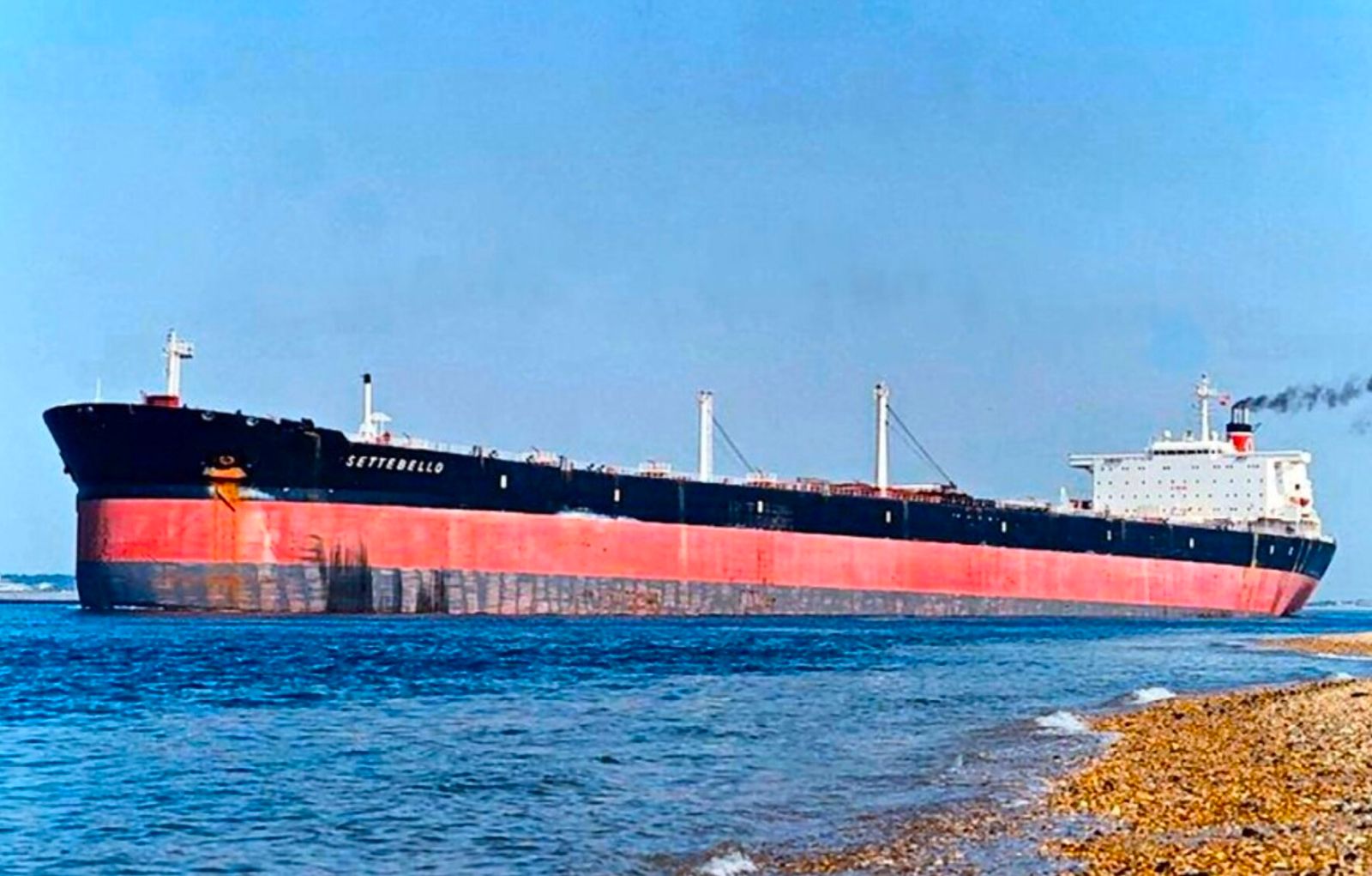
 The oil tanker Settebello. (Photo: X/@vishnumathur)
New Delhi: A Palau-flagged oil tanker with 24 Indian crew members on board was struck by a missile in the Gulf of Oman on Wednesday, triggering an engine-room fire and leaving three Indians missing. Maritime security sources assessed the strike as a United States interdiction action under Washington’s ongoing naval blockade of Iran. India condemned the attack and said 21 of the 24 crew had been rescued.
The vessel, identified as the Settebello, was sailing approximately 20 nautical miles northeast of Sohar when its engine room was hit at around 3pm IST. The British maritime risk management firm Vanguard confirmed the ship’s identity and said the Omani Navy responded to its distress call. The UK Maritime Trade Operations agency, UKMTO, reported the incident separately and confirmed that local authorities were on scene assisting with crew evacuation.
The tanker was partially laden and had last been tracked off Oman’s coast on June 1, according to the MarineTraffic ship-tracking platform. Its India-based operator, listed in maritime databases, could not be reached for comment.
New Delhi condemns, but names none
The Ministry of External Affairs issued a statement condemning the strike but, in keeping with its calibrated handling of the broader West Asia conflict, stopped short of naming the US as the party responsible.
“We condemn the attack on the commercial vessel Settebello off the coast of Oman, earlier today. Of the 24 Indian crew onboard, 21 Indians have been rescued thus far and 03 Indians are reportedly missing. Our Embassy in Oman is closely monitoring the situation and proactively coordinating with the Omani authorities in the ongoing search and rescue operation [sic],” the MEA said.
The ministry described the continuing attacks on shipping in the region as “deeply worrisome” and a “direct result of the ongoing conflict” in the region, reiterating India’s call for immediate de-escalation and a diplomatic resolution to the conflict. “The targeting of commercial shipping and civilian infrastructure in the region must end, and free and unimpeded navigation and commerce through the international waterways in the region in keeping with international law must be restored at the earliest,” it said.
No party has officially claimed responsibility for the Settebello strike. However, two independent maritime security sources – including the firm Ambrey – assessed it as consistent with US naval blockade-enforcement operations targeting vessels associated with Iranian ports. US Central Command (Centcom) has not issued a vessel-specific statement on the Settebello.
Pattern of interdiction
The Settebello incident is the second such strike in three days involving an India-operated tanker in the Hormuz corridor. On Monday, Centcom confirmed that an F/A-18 Super Hornet launched from the aircraft carrier USS Abraham Lincoln fired a precision munition into the engineering and steering compartments of the Palau-flagged MT Marivex in the Gulf of Oman after the vessel attempted to sail to an Iranian port in defiance of the US blockade. All 24 Indian crew members aboard the Marivex were rescued by Omani authorities.
The MEA spokesman, Randhir Jaiswal, at the weekly media briefing the following day, acknowledged that “there was some exchange of communication between the ship and the US Navy before the incident.” This was the closest New Delhi came to acknowledging American involvement without stating it directly.
The US imposed its naval blockade on Iran, on April 13, after the failure of the Islamabad talks to end the US & Israel-Iran war. As of Tuesday, Centcom said its forces had disabled seven non-compliant vessels, redirected 134 others that complied, and allowed 42 vessels carrying humanitarian aid to pass.
A chokepoint in crisis
The Gulf of Oman and the Strait of Hormuz have become among the most dangerous stretches of international waters since hostilities broke out on February 28, 2026. The strait – some 38 kilometres wide at its narrowest and jointly administered by Iran and Oman – normally carries one-fifth of the world’s oil and LNG shipments. The 2026 Strait of Hormuz crisis has already left at least 17 merchant ships damaged, seven of them abandoned, two captured, and at least 12 seafarers killed or missing.
India is among the world’s largest suppliers of seafarers, with tens of thousands of its nationals serving aboard commercial vessels transiting these waters. The recurrence of Indian-crewed ships caught in US-Iran crossfire, coupled with New Delhi’s carefully worded responses that avoid any direct rebuke of Washington, has drawn attention to the gap between India’s rhetorical commitment to protecting its maritime workers and its actual diplomatic leverage in the region.
The search and rescue operation for the three missing Settebello crew members was ongoing as of the evening of June 10, coordinated by Omani authorities in close contact with the Indian embassy in Muscat.
Follow us on social media for quick updates, new photos, videos, and more.
X: https://x.com/indiasentinels
Facebook: https://facebook.com/indiasentinels
Instagram: https://instagram.com/indiasentinels
YouTube: https://youtube.com/indiasentinels
© India Sentinels 2026-27