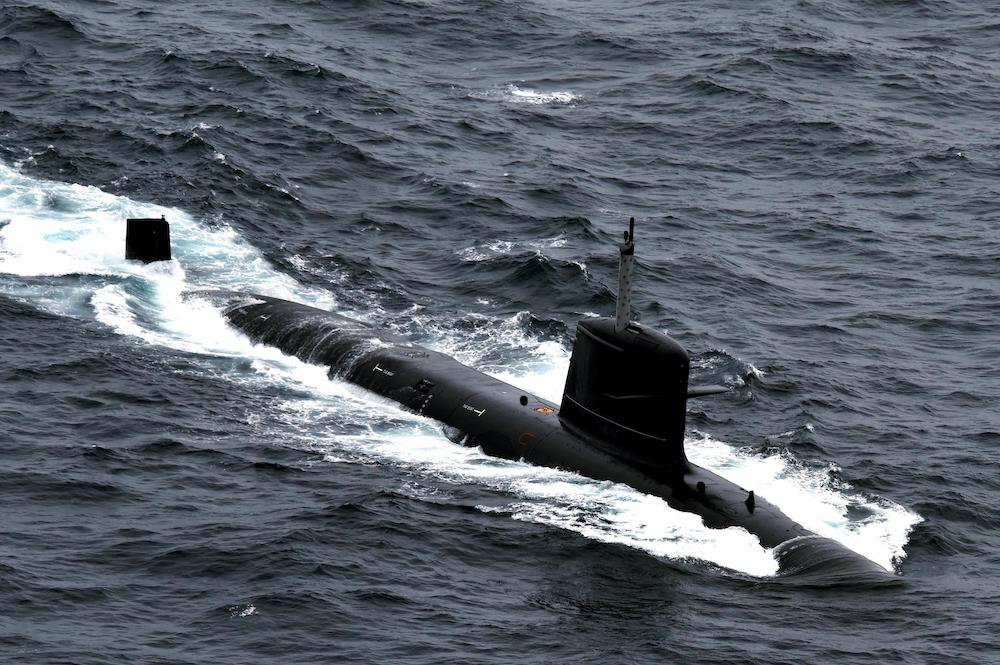
 INS Khanderi. (Photo: Indian Navy)
New Delhi: India’s second Kalvari-class submarine, INS Khanderi, is scheduled to be fitted with an indigenously developed air-independent propulsion (AIP) system before the end of 2026, in what would mark a significant step forward for the Indian Navy’s underwater warfare capabilities.
Senior defence sources familiar with the programme confirmed that the AIP system – developed by the Defence Research and Development Organisation’s (DRDO) Naval Materials Research Laboratory (NMRL) in Pune – has cleared extensive shore-based trials and met the required technical benchmarks. Integration work on INS Khanderi is expected to conclude before December 2026, while the submarine is docked for refit.
A senior DRDO official told India Sentinels that the “energy module” – the core of the AIP system – would be handed over to Mazagaon Dock Shipbuilders Limited (MDL) in Mumbai within the next three to four months. The module will be embedded within the submarine’s hull during the refit.
Sea trials are expected to begin between July and August 2027, with the full refit process projected to wrap up by early 2028.
A slot change, not a setback
As India Sentinels had reported in January 2023, the AIP system was originally intended for INS Kalvari, the lead boat of India’s six-submarine Kalvari-class fleet built under Project-75 . However, as the system was not ready in time for Kalvari’s refit schedule, the decision was taken to integrate it first into INS Khanderi. INS Kalvari is currently undergoing a separate refit.
The shift in sequencing reflects a pragmatic adjustment rather than a programme failure. DRDO sources indicated that the technology is now mature enough for shipboard integration, having progressed through multiple stages of land-based testing.
What AIP changes for a submarine
Conventional diesel-electric submarines must periodically raise a snorkel to run their diesel engines and recharge batteries – a process that exposes them to detection by radar and acoustic sensors. Without an AIP system, a submarine typically needs to surface or snorkel every four to five days.
AIP technology eliminates this constraint by enabling a submarine to generate electricity underwater without combustion, allowing it to remain fully submerged for several weeks at a stretch. This dramatically improves stealth and operational range – qualities of particular value in contested maritime environments such as the Indian Ocean region.
NMRL’s system uses phosphoric acid fuel cell technology, with the notable advantage that its only by-product is water, which can be discharged safely into the sea.
An exclusive club
Once the integration is complete and operationally validated, India will join a small group of nations – including Germany, Sweden, Japan, South Korea, Spain, and China – that have indigenously developed and deployed fuel cell-based AIP systems for submarines. France and Russia have pursued alternative AIP approaches.
India’s entry into this group through its own technology, rather than through purchase or licence, carries strategic significance at a time when indigenous defence capability is a stated national priority.
The Kalvari-class submarines were built at MDL in collaboration with France’s Naval Group, based on the Scorpène design. All six boats of the class – INS Kalvari, INS Khanderi, INS Karanj, INS Vela, INS Vagir, and INS Vagsheer – are now commissioned and operational.
They form the modern core of the Navy’s conventional submarine arm, which otherwise comprises ageing vessels. Of the Navy’s 16 conventional submarines, the remaining 10 – a mix of Soviet-era Sindhughosh-class (Kilo-class) and German-designed Shishumar-class boats – are over 30 years old and approaching the end of their service lives. The timeline for replacements under Project-75 India, which envisages six more advanced submarines, remains a matter of ongoing deliberation within the government.
The AIP retrofit programme, if executed on schedule, will give the Navy at least a partial capability edge while longer-term fleet expansion remains a work in progress.