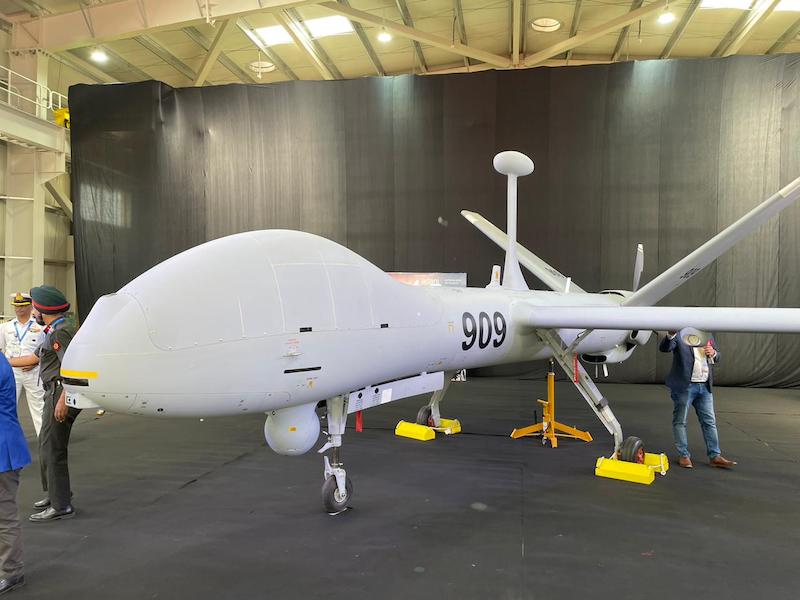
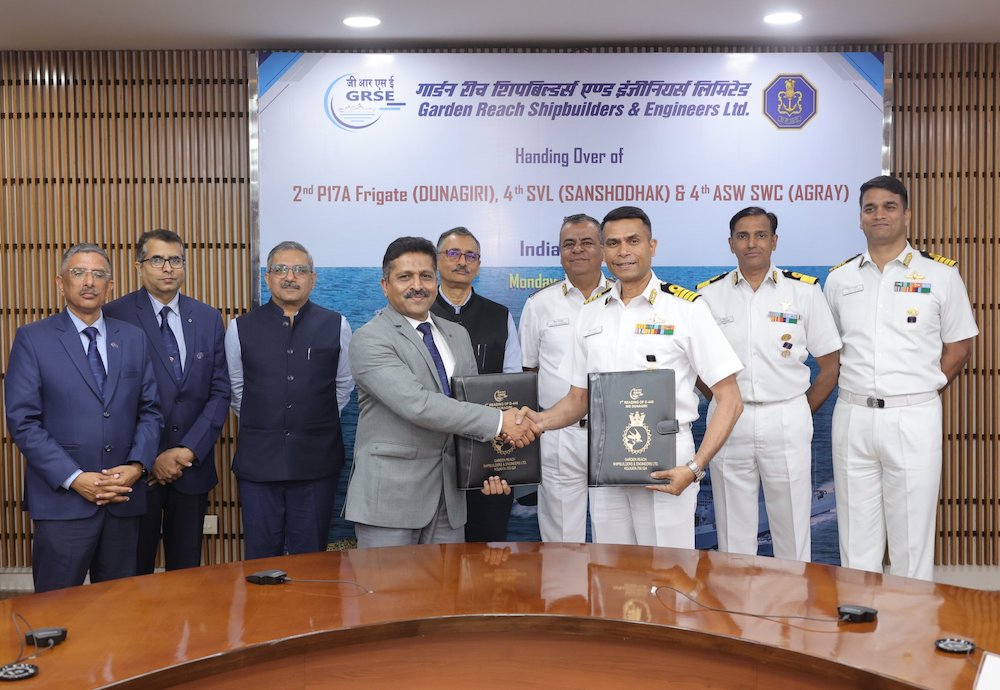
 Senior GRSE officials and Indian Navy officers during the handing-over ceremony of the three warships. (Photo: GRSE)
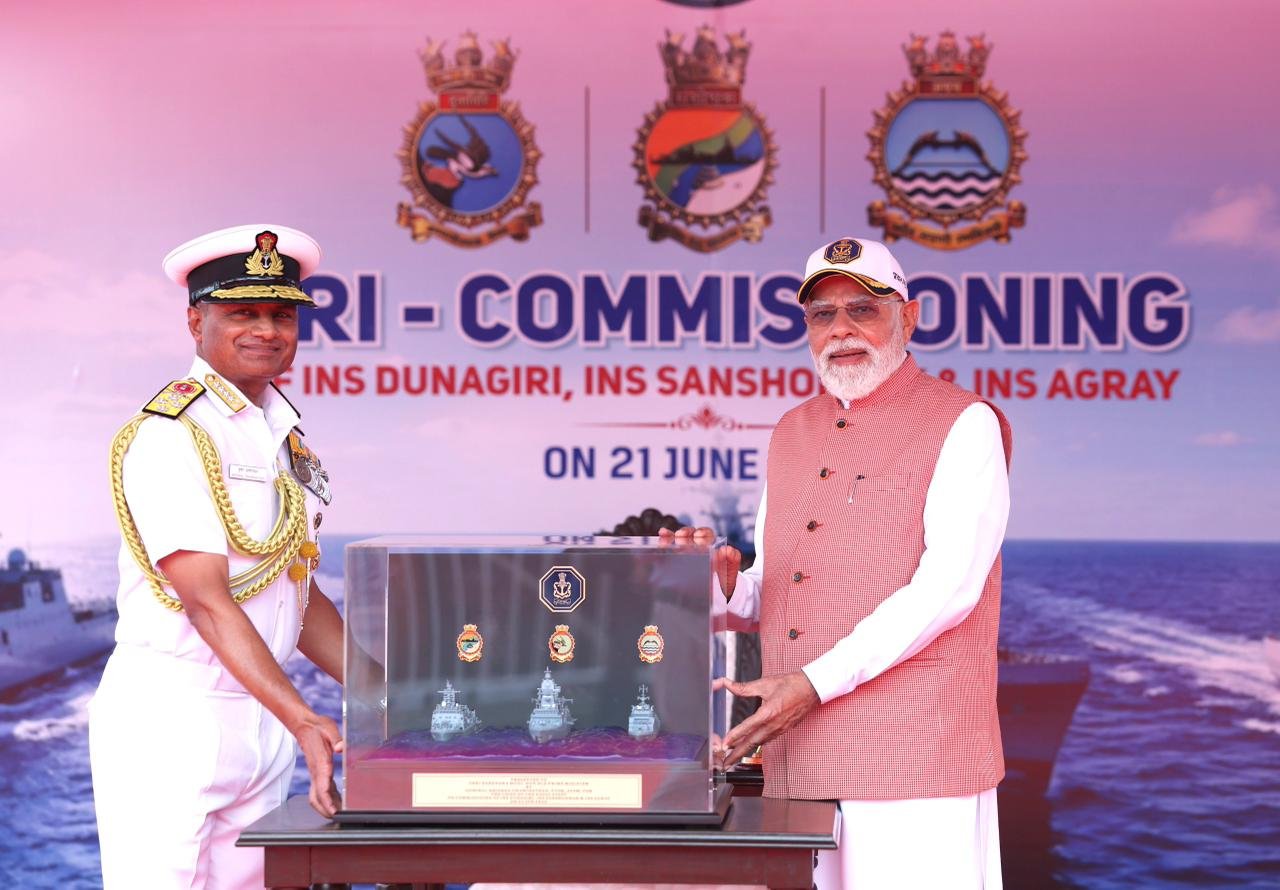
Kolkata: In a rare display of shipbuilding momentum, the Indian Navy took delivery of three indigenously built vessels from Garden Reach Shipbuilders & Engineers (GRSE) in Kolkata on Monday. The ships are Dunagiri, a stealth frigate; Sanshodhak, a hydrographic survey ship, and Agray, an anti-submarine warfare craft.
The triple handover in a single day is unusual even by the standards of a yard that has become one of India’s most productive naval shipbuilders.
The deliveries reflect a broader shift in India’s defence procurement strategy. The government has been pushing its domestic shipyards to reduce dependence on foreign platforms, and the three vessels handed over on Monday carry indigenous content of 75% to over 80%, involving more than 200 small and medium enterprises across the country.
Dunagiri: Fifth Project-17A frigate delivered
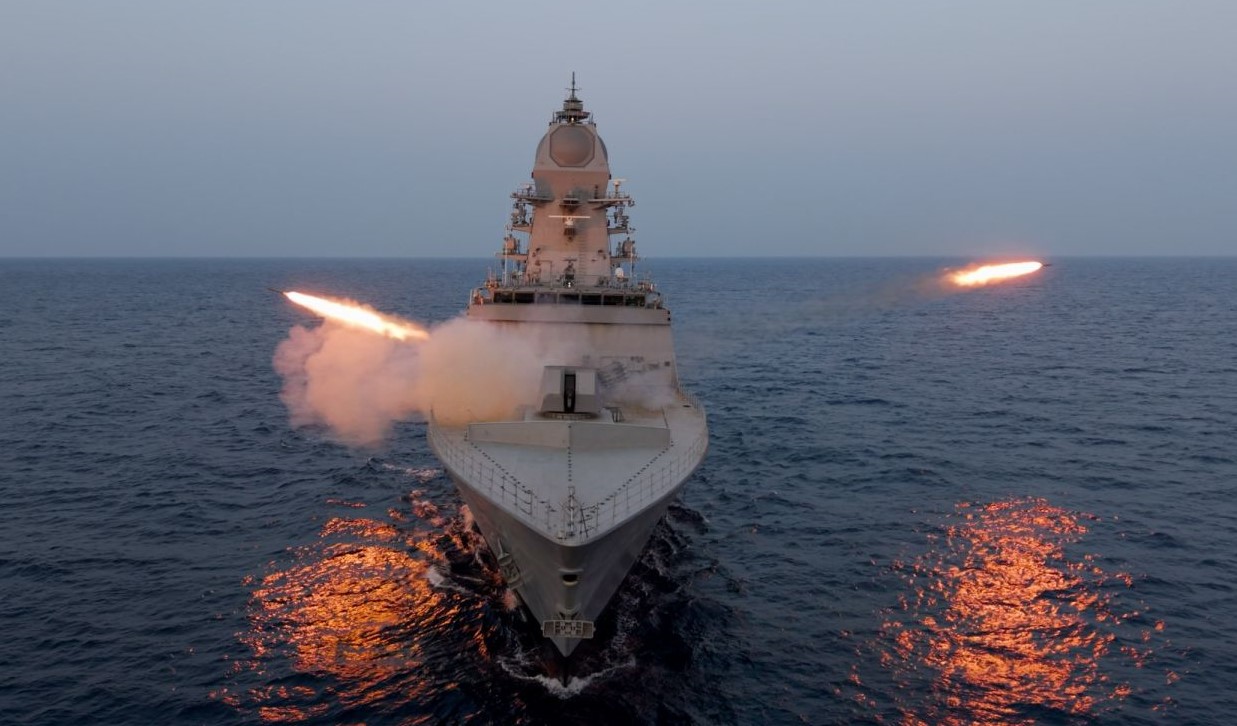
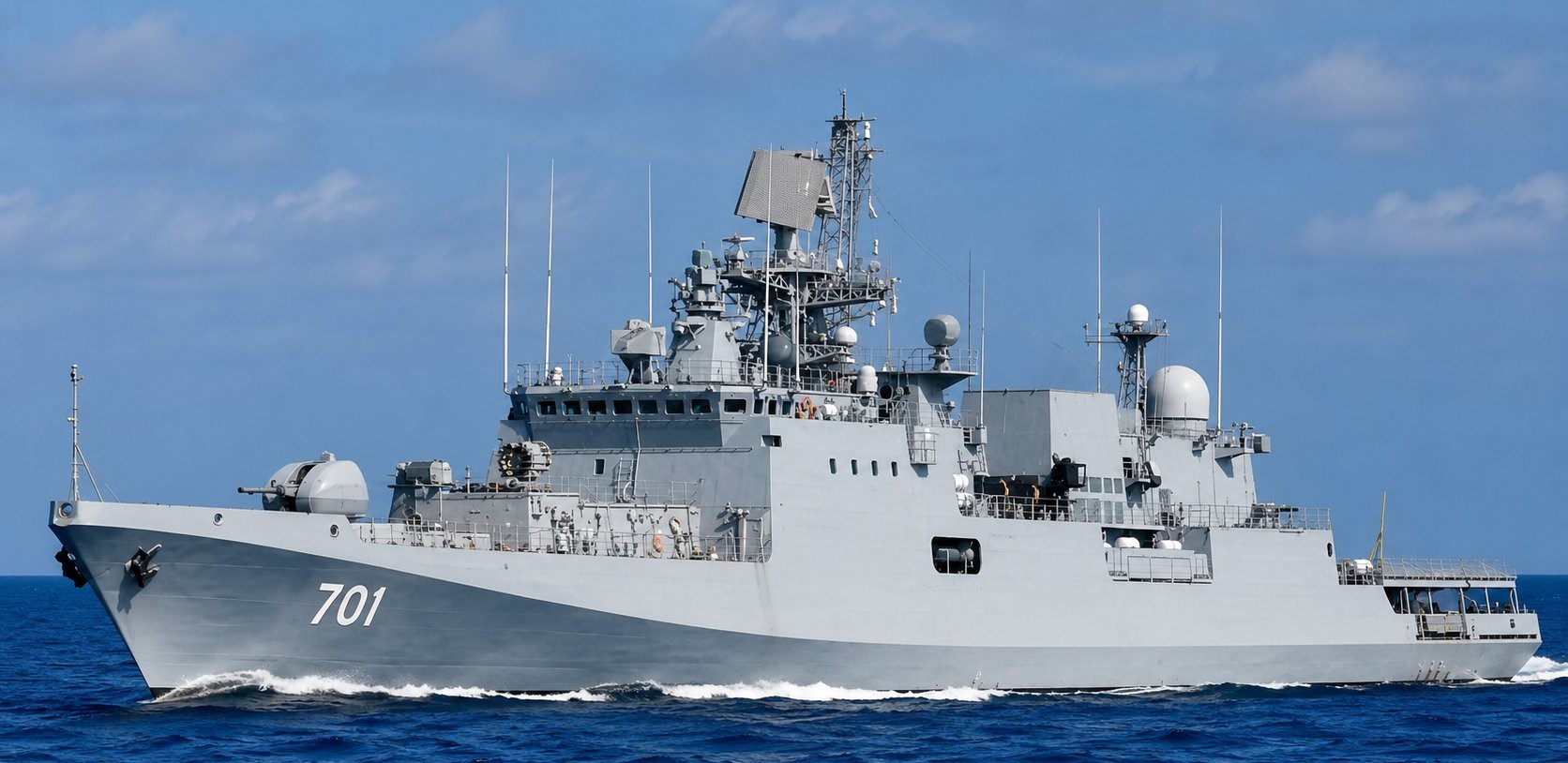
The most significant of the three deliveries is Dunagiri (Yard 3023), the fifth ship in the Nilgiri class under Project-17A and the second of the class built at GRSE. It is a guided-missile stealth frigate designed by the Warship Design Bureau (WDB) and represents India’s most capable surface combatant to enter serial production.
The ship revives a storied name. The original INS Dunagiri was a Leander-class frigate that served the Navy from May 5, 1977, to October 10, 2010 – 33 years of active service. The new Dunagiri is a fundamentally different kind of warship: far larger, stealthier, and substantially more lethal.
Project-17A frigates are configured with combined diesel or gas (CODOG) propulsion, pairing a diesel engine and a gas turbine to drive a controllable pitch propeller on each shaft. The weapon suite includes BrahMos supersonic anti-ship missiles, the medium-range surface-to-air MRSAM system, the MFSTAR multi-function radar, a super-rapid gun mount (SRGM), close-in weapon systems, and a combination of rockets and torpedoes for anti-submarine warfare – a considerably denser armament than the earlier Project-17 Shivalik-class frigates.
Notably, Dunagiri was built in 80 months, compared with the 93 months taken for Nilgiri, the first of the class. It is the fifth Project-17A ship delivered in the past 16 months – a pace that would have seemed ambitious even a few years ago. The learning curve in large warship construction is compressing, which matters because India has a sizeable fleet modernization backlog.
Sanshodhak: Last of four survey vessels
The survey vessel Sanshodhak completes a four-ship class contracted in October 2018. Its predecessors – INS Sandhayak, INS Nirdeshak, and INS Ikshak – were commissioned in February 2024, December 2024, and November 2025 respectively. Sanshodhak’s delivery on Monday closes out the class.
With a displacement of about 3,400 tonnes and an overall length of 110 metres, the ship is designed primarily for hydrographic survey of coastal waters, harbour approaches, and deep-water areas, as well as the mapping of navigational channels. It also carries equipment for collecting oceanographic and geophysical data for both defence and civilian use.
The vessel’s survey capability rests on a modern suite: a data acquisition and processing system, an autonomous underwater vehicle (AUV), a remotely operated vehicle (ROV), differential GPS long-range positioning systems, and a digital side-scan sonar. Twin diesel engines give it speeds in excess of 18 knots. The keel was laid in June 2022; the ship was launched in June 2023 and has since undergone comprehensive harbour and sea trials.
Hydrographic capability is operationally critical. Accurate seabed charts underpin submarine navigation, mine warfare planning, and the safe movement of the Navy’s increasingly large surface ships into shallow coastal waters – a domain that is growing in strategic importance as India’s interests in the Indian Ocean Region expand.
Agray: Shallow watercraft for submarine hunting
The third vessel, Agray, is the fourth of eight Arnala-class anti-submarine warfare shallow-watercraft (ASW SWC) being built by GRSE. These are specialist platforms: approximately 77 metres in length and, according to the Navy, the largest Indian naval warships propelled by waterjets – a propulsion choice suited to operations in confined, shallow littoral waters where conventional propellers would be vulnerable.
The ship carries lightweight torpedoes, indigenous rocket launchers, and a shallow-water sonar – the core toolkit for detecting and engaging submarines in coastal and near-shore environments. The class is also assigned mine-warfare and coastal surveillance roles, giving the Navy a versatile platform for the lower-intensity but strategically significant end of maritime security.
Like Dunagiri, the new ship inherits a legacy name. The original INS Agray was the fourth of the 1241 PE-class patrol vessels and was decommissioned in 2017. The Arnala class carries more than 80% indigenous content.
GRSE and the wider picture
GRSE, a defence public sector undertaking under the ministry of defence, has emerged as one of India’s two principal naval shipbuilders alongside Mazagon Dock Shipbuilders Limited in Mumbai. The yard has historically concentrated on smaller combatants and auxiliaries, but the Project-17A assignment has moved it into the category of major surface warship construction for the first time.
The scale of the industrial participation behind the three vessels is worth noting. The Project-17A programme alone has engaged more than 200 MSMEs and has generated direct employment for roughly 4,000 workers, with indirect employment put at more than 10,000. For a government that has made domestic defence manufacturing a political as well as strategic priority, these numbers matter beyond the purely naval calculation.
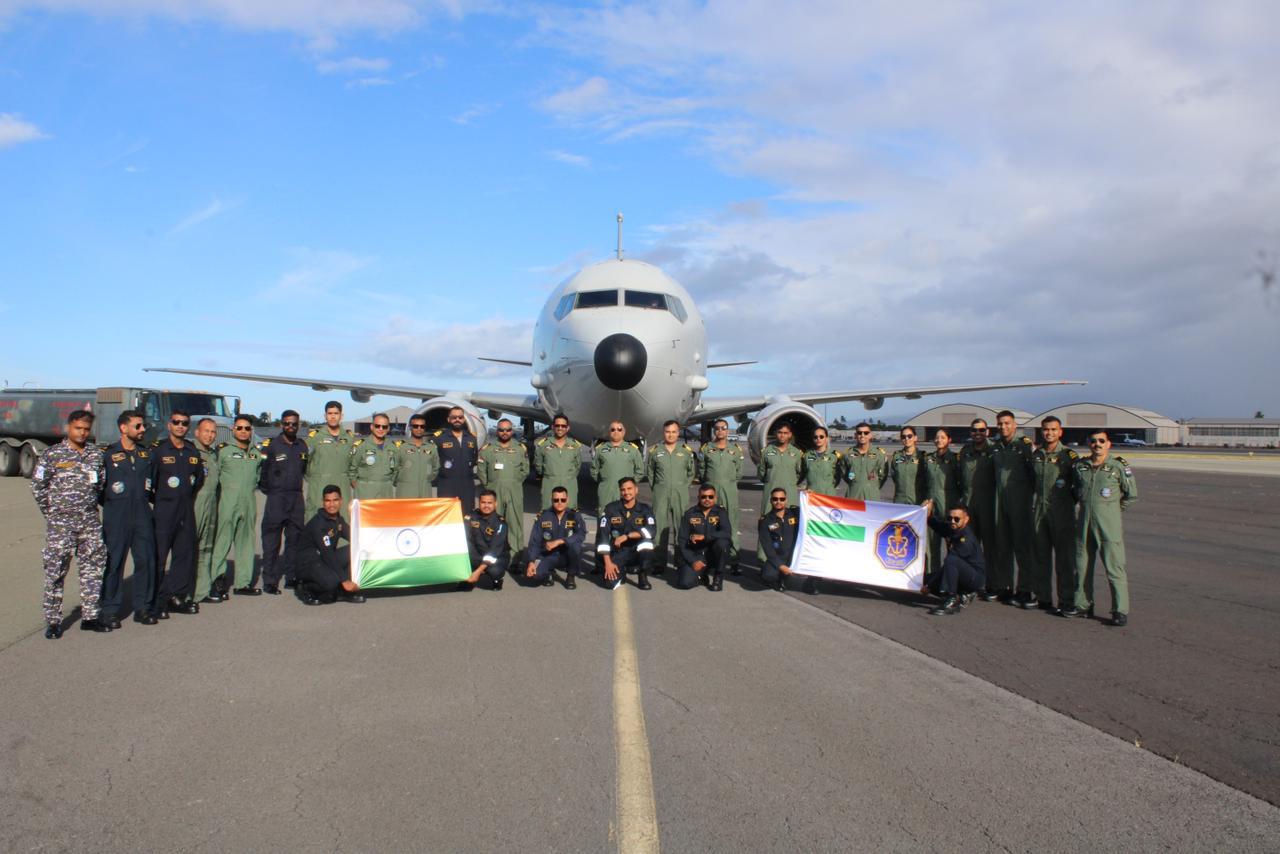
India’s Navy is in the middle of an ambitious expansion. It is simultaneously operating nuclear-powered ballistic missile submarines, building its second aircraft carrier, acquiring P-8I maritime patrol aircraft, and pushing through multiple surface combatant programmes. The ability to compress build periods – as demonstrated by Dunagiri’s 80-month construction cycle – is essential if the fleet is to keep pace with the government’s stated target of a 175-ship Navy by the early 2030s.
Monday’s simultaneous delivery of three ships is not merely a logistical coincidence. It signals that GRSE’s production pipeline – across multiple ship classes of different complexity – is now synchronized enough to produce parallel outputs. Whether that rhythm can be sustained will determine how quickly the Navy can close the gap between its current fleet strength and its long-term requirements.