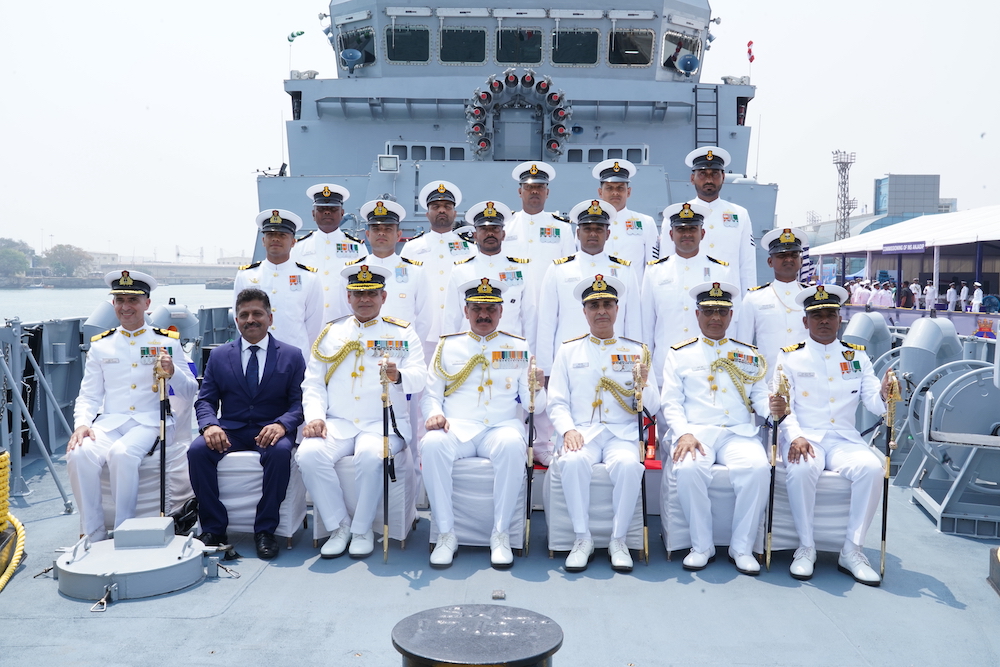
 Admiral Dinesh K Tripathi (C), Vice Admiral Sanjay Bhalla (3L), senior Navy officers on board INS Anjadip after the warship’s commissioning. (Photo: Indian Navy)
Chennai: India commissioned its fourth anti-submarine warfare shallow-water craft (ASW-SWC), INS Anjadip, at Chennai Port on Thursday, adding a vessel built with over 80 per cent indigenous content to a navy that is expanding at its fastest pace ever.
The ceremony was presided over by the chief of naval staff, Admiral Dinesh Kumar Tripathi, and hosted by the flag officer commanding in chief of the Eastern Naval Command, Vice Admiral Sanjay Bhalla. Representatives from the two shipbuilders – Garden Reach Shipbuilders & Engineers (GRSE), Kolkata, and Larsen & Toubro Shipbuilding, Kattupalli – attended alongside senior naval officers and civilian dignitaries.
A hunter built for shallow waters
Anjadip is 77 metres long, displaces around 1,400 tonnes and is configured for rapid-response anti-submarine operations in the littoral zone – the coastal and near-shore belt where conventional large warships struggle to operate effectively. She is equipped with shallow-water sonars, lightweight torpedoes, anti-submarine rockets and an integrated combat management system. The navy describes her role simply: locate and destroy submarines lurking close to the coast.
The ship is named after a small island off the coast of Karwar on India’s western seaboard – the same island that lent its name to a predecessor vessel which served from 1972 to 2003 and was involved in Operation Chutney, the naval component of India’s liberation of Goa in December 1961. Anjadip’s motto – अद्वितीय शत्रु विध्वंसक, meaning “unrivalled enemy destroyer” – carries forward that association.
The vessel has been assigned to the Tamil Nadu and Puducherry naval area under the eastern naval command, placing it in the waters off India’s southeastern coast.
One of 16, delivered in seven months
Anjadip is the fourth of 16 such craft on order, following INS Arnala, INS Androth and a third vessel. Admiral Tripathi noted that Anjadip was delivered just seven months after Arnala – a pace he described as a strong signal of GRSE’s reliability as a defence shipbuilder. The project is a public-private partnership: the hulls are built at L&T’s Kattupalli yard in Tamil Nadu, while GRSE, based in Kolkata, leads the programme and integrates the combat systems. BEL’s Ghaziabad unit supplied the combat management system.
The arrangement, Admiral Tripathi said, illustrates something broader: “Constructed at Kattupalli in the south by Team GRSE from Kolkata in the east, equipped with a combat management system designed at BEL, Ghaziabad in the north, and named after an island on our western seaboard – a true coming together of a maritime nation.”
Navy expanding at record speed
Thursday’s commissioning is part of a broader acceleration. In 2025, the Indian Navy brought into service 12 warships and one submarine. It plans to induct roughly 15 more vessels through 2026, which the Navy describes as the highest rate of induction in its history. All 50 ships presently on order are being built in Indian shipyards, and the Navy has set a target of reaching a 200-plus ship fleet by 2035.
The push is partly a response to a rapidly changing security environment in the Indian Ocean Region (IOR). Admiral Tripathi, speaking at the ceremony, drew on recent events to illustrate the stakes. The Red Sea crisis, triggered by Houthi attacks on commercial shipping since late 2023, caused freight rates on key Asia–Europe routes to surge by as much as 300 to 350 per cent at their peak, disrupting supply chains and driving up commodity prices. Separately, tensions around the Strait of Hormuz – through which a significant share of the world’s traded oil passes – have kept energy markets on edge; a brief closure of the strait for live-fire exercises recently pushed Brent crude up roughly 4.4 per cent in a single session.
The IOR carries an outsized share of global trade: approximately 2.9 billion people in 33 nations live along its coastlines, and 120,000 ships transit the region every year, carrying two-thirds of the world’s oil shipments, one-third of bulk cargo and half of its container traffic.
Since October 2023, Indian naval deployments in and around the Red Sea have escorted or monitored the safe passage of nearly 400 merchant vessels carrying approximately 16.5 million metric tonnes of cargo and oil worth over seven billion US dollars bound for India, according to figures cited by Admiral Tripathi.
Self-reliance as strategy
The commissioning was also framed as a milestone in India’s defence indigenization drive, which the Navy has branded under the government’s broader “Atmanirbhar Bharat” – or self-reliant India – policy. With over 80 per cent of Anjadip’s systems sourced domestically, including the combat management system and key sensors, the programme represents one of the higher indigenous content levels achieved in an Indian warship to date.
Admiral Tripathi framed self-reliance not merely as import substitution but as building sovereign competence – control over design, intellectual property and the ability to upgrade systems without dependence on foreign suppliers. The Navy has progressively expanded its Warship Design Bureau and deepened ties with private-sector defence firms, MSMEs, start-ups and academic institutions. The longer-term goal, he said, is a fully self-reliant force by 2047.
Shallow-water warfare and eastern seaboard
The emphasis on anti-submarine-warfare capability – and on the shallow-water variant in particular – reflects growing concern about submarine activity in the Indo-Pacific. The Bay of Bengal and the Andaman Sea, both in the eastern naval command’s area of responsibility, have seen increased submarine transits by regional navies in recent years. Shallow-water craft are specifically designed for operations where ocean depth, salinity gradients and noise conditions make detection by conventional frigates or destroyers less effective.
The Navy held its International Fleet Review and Exercise MILAN at Visakhapatnam earlier this year with 60 Indian warships and 19 vessels from partner nations participating – one of the largest such exercises hosted by India. The event was designed to reinforce interoperability with friendly navies and signal India’s intent to play a larger role in regional maritime security.
The Navy has also been active in humanitarian roles. Under Operation Brahma, Indian ships delivered relief material to Myanmar within 48 hours of a recent earthquake. Under Operation Sagar Bandhu, the Navy delivered aid to Sri Lanka following Cyclone Dithwah.
— Anjadip will be the first vessel of the class based out of the Tamil Nadu and Puducherry naval area. The remaining 12 anti-submarine shallow water craft under the 16-vessel programme are at various stages of construction.