— By Dr Baishali Sarkar
Every year, on the full moon of Āṣāḍha, Buddhists across the world pause to remember one of their most sacred days. It marks the Buddha's first sermon, the Dhammacakkappavattana Sutta, given seven weeks after His Enlightenment beneath the Bodhi Tree. He spoke in the Deer Park of Ṛṣipatana Mṛgadāya, known today as Sarnath, near Varanasi. His audience was the Pañcavaggiyā, five ascetics named Kondañña, Bhaddiya, Vappa, Mahānāma, and Assaji, who had once practised alongside Him. That discourse is remembered as the First Turning of the Wheel of Dhamma.
On 25 July 2026, Sarnath was inscribed as a UNESCO World Heritage Site, India's 45th and Uttar Pradesh's fourth. The listing recognises what the site has always meant to Buddhists: the place where the Buddha first taught after His awakening.
At the centre of that teaching was the Middle Way, Majjhimāpaṭipadā, a path that avoids both self-indulgence and self-punishment. The idea still holds up. It turns a moment from history into something practical, a reminder about compassion, restraint, and steady judgement at a time when stress and change are constant.
Why the middle way still matters
Modern life keeps pushing people toward extremes, chasing more or giving up everything. One extreme is attachment: to comfort, possessions, entertainment, status. The other is over-denial: overworking, harsh self-discipline, or ignoring one's own wellbeing. The Buddha rejected both and pointed instead to balance.
Globalisation has only sharpened this tension. Social media, advertising, and a shared consumer culture constantly nudge people to acquire more, achieve more, and measure themselves against others. At the same time, many feel pressed to work without pause and to judge their worth purely by output. The Middle Way speaks directly to that pressure.
Insight, not just instruction
The Sutta is careful to describe how the Buddha arrived at His teaching. He said He reached full awakening only once He understood each noble truth completely: what it is, what must be done about it, and that this had, in fact, been done. His declaration, "This is the last birth,", marked the end of the cycle of becoming.
From this insight came the Four Noble Truths (cattāri ariyasaccāni) and the Noble Eightfold Path (ariyo aṭṭhaṅgiko maggo), built on three foundations: śīla (ethical conduct), samādhi (concentration), and paññā (wisdom). For over two thousand years, these three have remained the core of Buddhist practice.
From sermon to symbol
Human struggles with desire and dissatisfaction haven't really changed, even as technology and economies have transformed everything around them. The Middle Way still offers a practical way through: moderation, mindfulness, and clear-headed choices, rather than rejecting the world or being ruled by it.
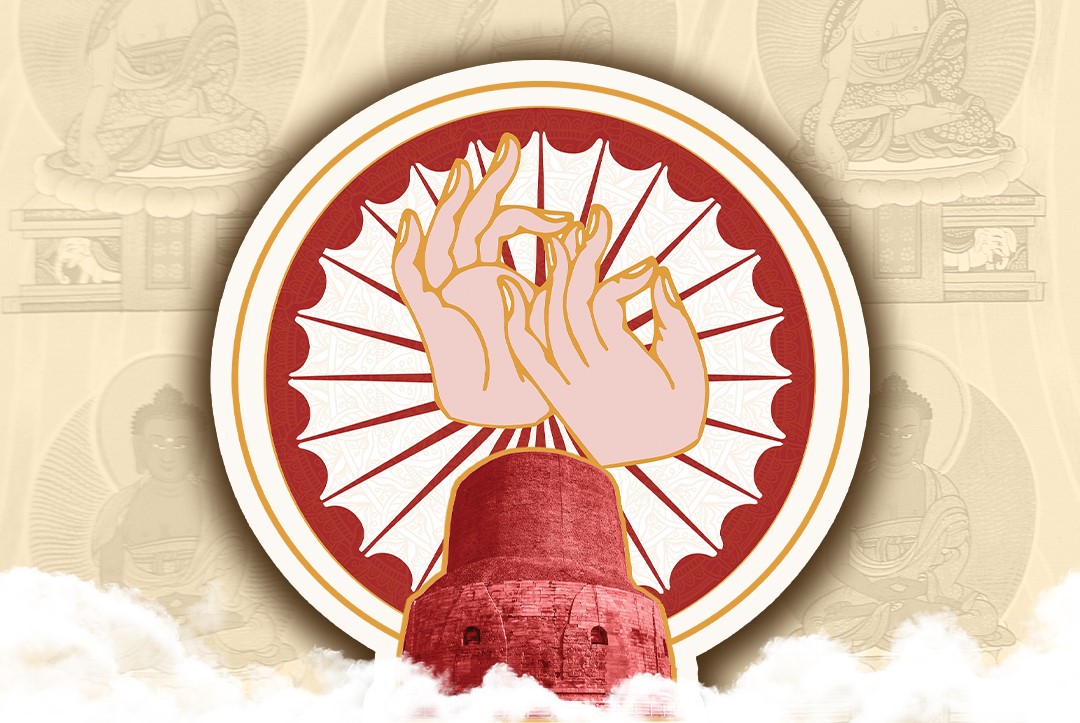
The reach of that first sermon went well beyond religion. The Wheel of Dhamma set in motion at Sarnath grew into a symbol of truth and moral order for an entire civilisation. Centuries later, Emperor Ashoka placed the wheel on his pillars and edicts to unify his empire under justice and ethical rule. It sits today at the centre of India's national flag as the Ashoka Chakra, its 24 spokes often read as the twelve forward links of Dependent Origination (anuloma paṭiccasamuppāda) and the twelve reverse links (paṭiloma). The Lion Capital of Ashoka, raised at Sarnath itself, is now India's National Emblem.
Other moments the day recalls
Tradition ties Āṣāḍha Pūrṇimā to other turning points in the Buddha's story. One account describes Queen Mahāmāyā dreaming of a white elephant entering her womb, taken as the sign of the Bodhisattva's final descent to earth. Many traditions place this conception on the same full moon.
The day is also linked to the Mahābhiniṣkramaṇa, the Great Renunciation, when Prince Siddhārtha gave up his privileged life to search for a way beyond ageing, sickness, and death. That decision began the journey that led to His Enlightenment and to a teaching meant for the good of all beings.
Across South Asia, the same day is widely marked as Guru Pūrṇimā, a time to thank one's teachers. For Buddhists, it often includes Uposatha observances: taking the Eight Precepts, sitting in meditation, and studying under senior monastics.
A teaching rooted in nature
Buddhist practice has always stayed close to the natural world, going back to the Buddha's own awakening under the Bodhi tree. Nature isn't treated as separate from human life but as part of it, which is why the tradition places such weight on restraint and responsibility toward the environment.
The same full moon opens Vassa, the three-month Rains Retreat, when monks and nuns settle in one place to deepen their meditation and study. The reason is practical as much as spiritual: monsoon season brings out worms, insects, frogs, and countless small creatures, so travel risks harming them. Staying put lets monastic discipline align with care for other living things, while lay communities support the Saṅgha through the retreat, strengthening the bond between the two.
Underlying all of this is Pratītyasamutpāda, Dependent Origination, the teaching that every form of life is connected, and that human actions ripple out into the wider world.
This isn't just theory. The Jātaka tales, a well-loved part of Buddhist literature, are full of stories about humans and animals living in harmony, and they've shaped Buddhist attitudes toward kindness and empathy for centuries. Paired with the Middle Way's call for moderation, they add up to a strong case for living responsibly.
In one lunar night, Āṣāḍha Pūrṇimā holds history, philosophy, national symbolism, and everyday practice together. It recalls the Buddha's first words of guidance, honours the teachers who carry them forward, and asks each of us to live those values, in how we treat one another and the fragile world we share.
(The author holds an M.A., M.Phil., and PhD in Buddhist Studies from the University of Delhi. She is a Research Consultant at the International Buddhist Confederation.)
Disclaimer: The views expressed in the article are the author’s own and don’t necessarily reflect the views of India Sentinels.
Follow us on social media for quick updates, new photos, videos, and more.
X: https://x.com/indiasentinels
Facebook: https://facebook.com/indiasentinels
Instagram: https://instagram.com/indiasentinels
YouTube: https://youtube.com/indiasentinels
© India Sentinels 2026-27