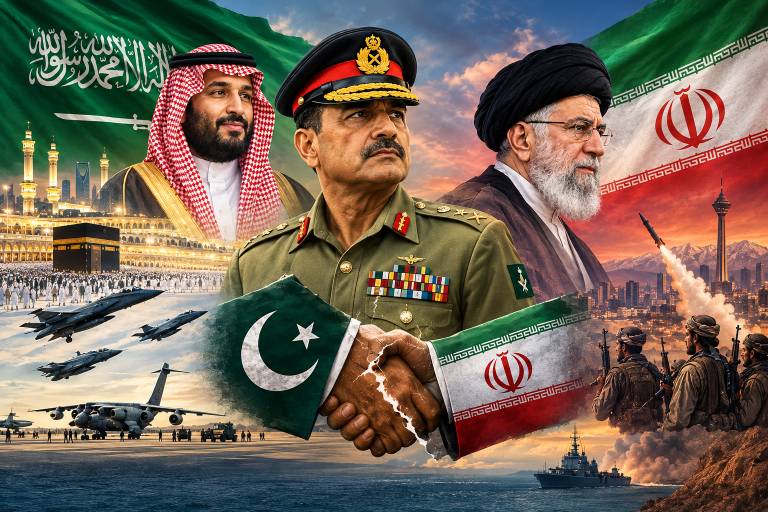
The record begins on 3 March, when Foreign Minister Ishaq Dar told the Senate that he had personally reminded Iranian Foreign Minister Abbas Araghchi of Pakistan's defence obligations to Saudi Arabia. Araghchi, he said, had asked in reply for guarantees that Saudi soil would not be used to attack Iran. Field Marshal Asim Munir was in Riyadh within hours, meeting Defence Minister Prince Khalid bin Salman to discuss, in the Saudi minister's words, the Iranian attacks on the kingdom and the measures needed to halt them within the framework of the mutual defence pact. It is the earliest point at which the two capitals heard the same message within the same twenty-four hours. Iran asked for a guarantee. Pakistan answered by going to Riyadh.
April brought the first deployment and the first diplomacy in quick succession. Pakistan sent fighter jets and support aircraft to Saudi Arabia after Iranian strikes on key Saudi energy infrastructure. Saudi Arabia then committed $3bn in new deposits and extended an existing $5bn. Between 8 and 13 April, Pakistan secured a US-Iran ceasefire and hosted the highest-level direct talks between the two governments since 1979. On 17 June, the Islamabad Memorandum of Understanding was signed, and Prime Minister Shehbaz Sharif thanked Qatar, Saudi Arabia, Turkey and Egypt and named Munir for his role. Pakistan was arming the kingdom Iran had struck while asking Tehran to trust it as an honest broker.
August carried two events that sit side by side uneasily in a retelling and comfortably in the calendar. The Pakistan-Iran Joint Trade Committee met in Islamabad on 4 and 5 August and reaffirmed a $10bn trade target. On 7 August, Sharif, Crown Prince Mohammed bin Salman and President Recep Tayyip Erdogan signed the Mecca Joint Defence Agreement. For Tehran, the sequence reads as a trade delegation seen off on one day and a defence treaty with its regional rival signed two days later.
The next move came in September, after Houthi missiles struck Saudi Arabia. On the 9th, Defence Minister Khawaja Asif said a spillover from Yemen would make the pact operational. On the 10th, the Foreign Ministry spokesman said no military reaction was under discussion and that Pakistan would act when the time came, while Reuters reported that Islamabad had warned Iran to rein in the Houthis.
On 25 September, Sharif told the UN General Assembly that a threat to Mecca and Medina was a red line, and the three army chiefs met in Riyadh the same day. On 2 October, Dar told reporters that he had briefed Tehran on the pact and on how Pakistan would honour it, and that Iran had suggested engaging the Houthis politically. On 5 October, the committee met in Riyadh and agreed to deploy forces. Asif said Pakistan's role was supportive, including reconnaissance, and that only Saudi forces were fighting. That is the day the choice was made. Whatever the wording about support and reconnaissance, Pakistan's ministers committed forces to the Saudi side of a war against the Houthis, Iran's allies, three days after Iran had put a political alternative to them.
Each message to Riyadh was accompanied, usually within days, by a message to Tehran, and each Saudi commitment to Pakistan was preceded or followed by a Pakistani commitment to Iran, as with the trade meeting held two days before the Mecca signing. The pattern can be read as shrewd. It can also be read as betrayal: Tehran was told courteously and in advance, and the notice changed nothing. The October activation surprised nobody who followed the Foreign Ministry's own briefings: Asif had named the trigger on 9 September, the commitment had been described to Riyadh in March, and Dar had told Iran on 2 October, three days ahead. Iran's request for guarantees in March and its offer of a political track in October were both on the record before the committee met.
Iran's language has moved over the same weeks. Spokesman Esmaeil Baghaei said on 4 October that Tehran hoped the reports of a Pakistani deployment were untrue. By 9 October, Iran International reported, state outlets had adopted a more confrontational tone. Tasnim had accused Turkey and Pakistan of joining the Saudi war, Araghchi had said such agreements would not constrain Iran, and Tehran was questioning Pakistan's role as an intermediary. Pakistan's description of its own role has not changed. Its Foreign Office spokesman said in July, while implementation of the Islamabad memorandum was in difficulty, that mediation efforts continued. Tehran's questioning of the mediator is the clearest sign of how it now reads the record.
Pakistan and Turkey describe the pact's growth differently. Pakistan's Foreign Ministry said on 10 September that there were no plans to expand it, while Turkey's defence ministry calls it open to expansion and has named Egypt as a candidate. Pakistan calls the pact defensive. Tehran has begun to read it otherwise.