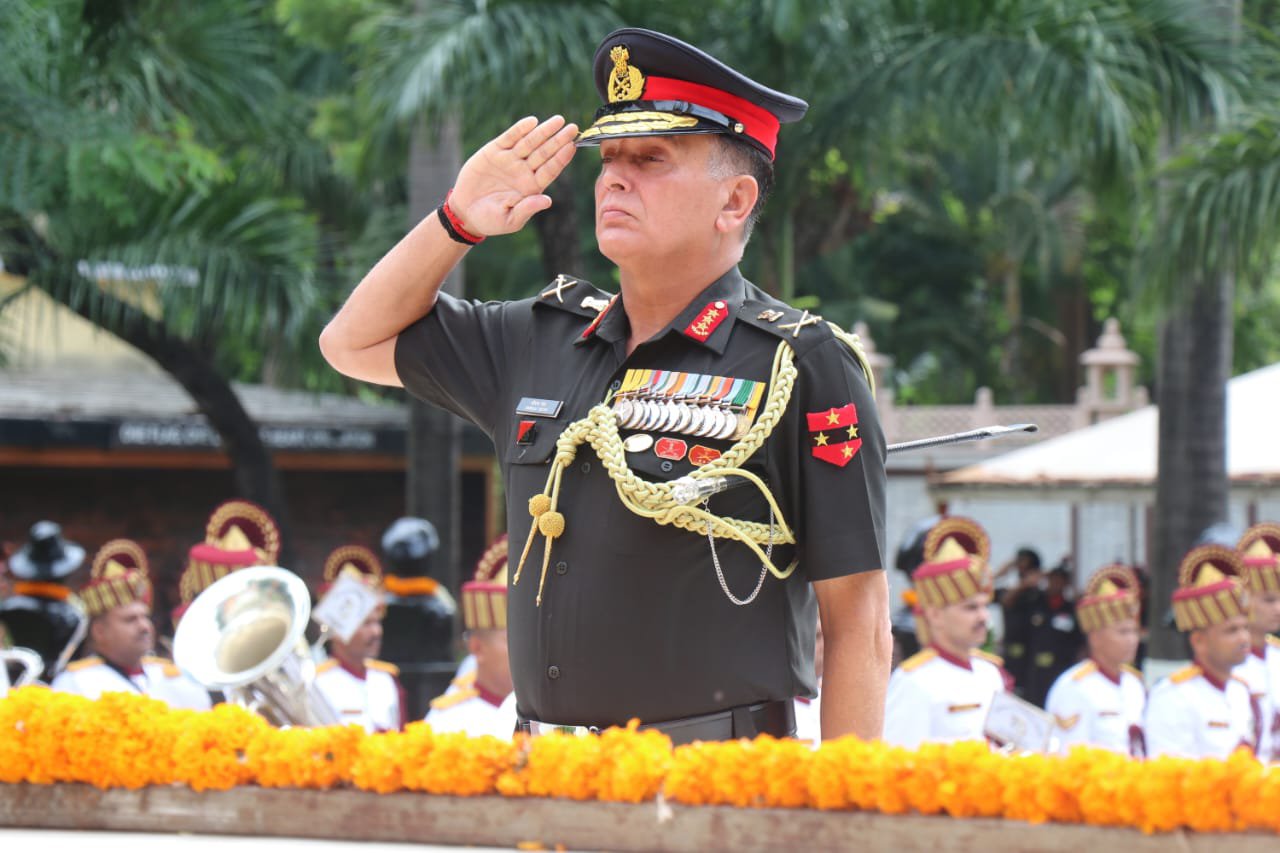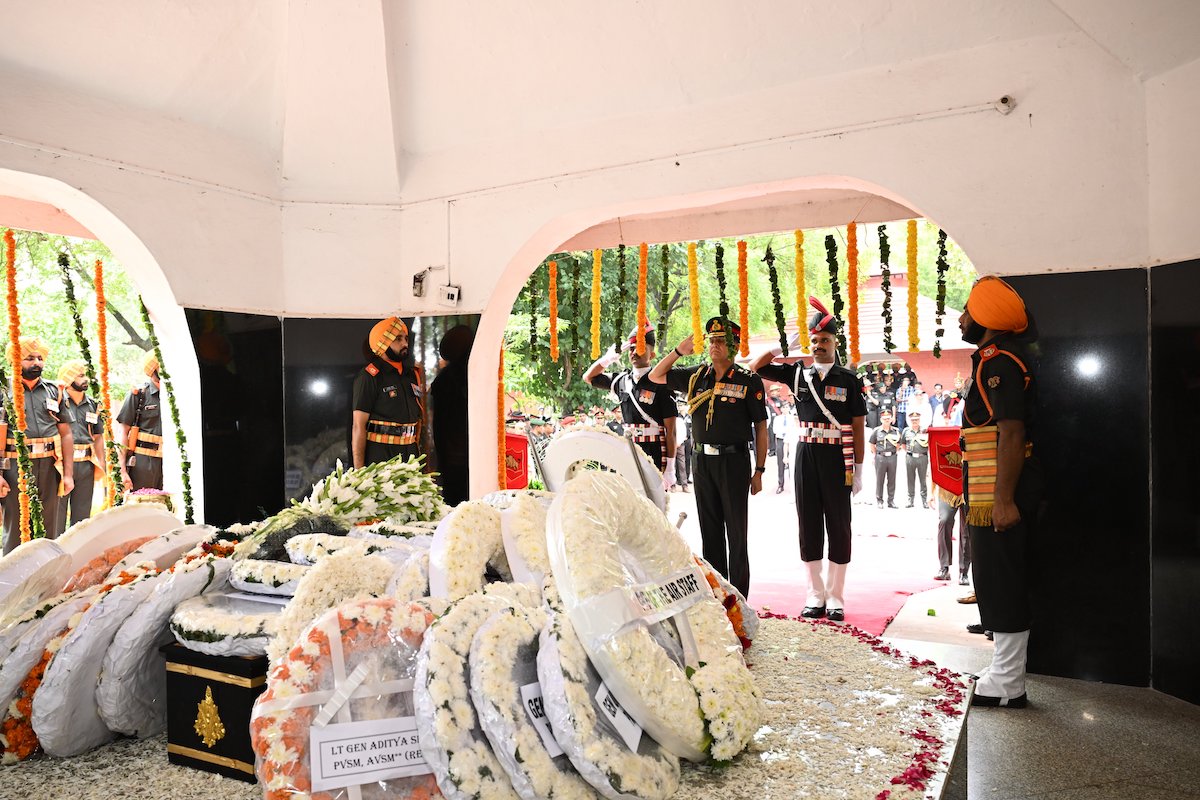
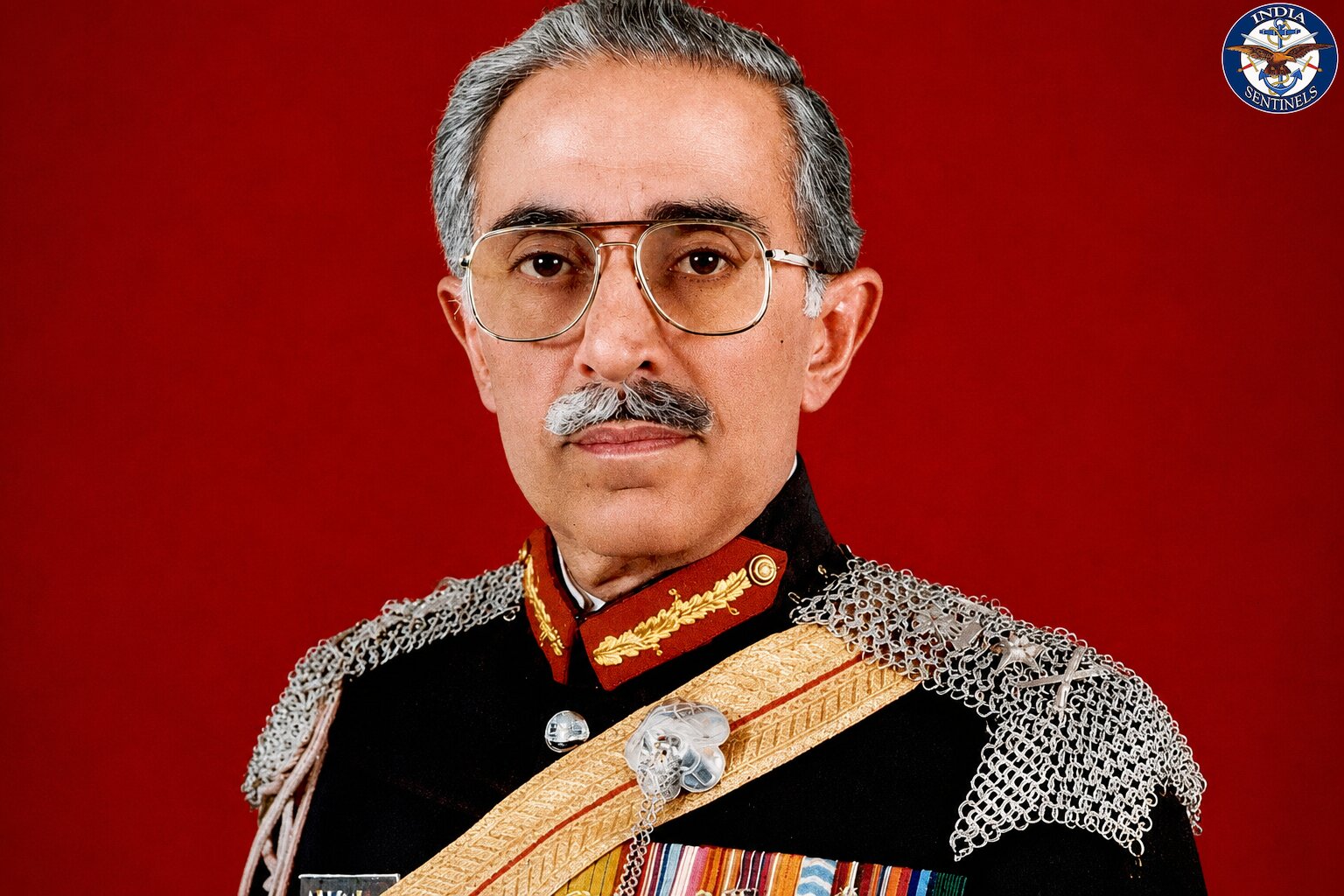
 General Vishwa Nath Sharma – June 4, 1930–July 31, 2026 (India Sentinels rendition of an old official photo.)
New Delhi: General Vishwa Nath Sharma, the first president’s commissioned officer to rise to command of the Indian Army, has died at his home in Delhi at the age of 96. His four-decade career culminated in a tenure as the chief of the Army, in which the force found itself fighting on four fronts at once – in Sri Lanka, on the LAC against China, tackling a coup in the Maldives, the deadly insurgencies in Punjab and in Kashmir.
Gen Sharma passed away in the early hours of Friday at his residence in Delhi’s Defence Colony, of natural causes, at around 4am. He was 96. His cremation has been scheduled for 10.30am on Saturday at the Brar Square Cremation Ground in Delhi Cantonment.
Until recently, the general had divided his time between the capital and his ancestral village of Dadh, in Himachal Pradesh’s Kangra district – a part of the country that has sent generations of its sons into uniform. News of his passing was met there with particular sorrow with residents recalling a soldier who, for all his rank, remained approachable and fond of recounting stories from his career.
The defence minister, Rajnath Singh, led the official tributes, calling Gen Sharma a military leader of exceptional distinction. In a message posted on X, Singh said he was deeply saddened by the news, and praised the general’s dedication, courage and honour in the service of the nation.
Singh also drew attention to the wider family legacy that Gen Sharma had carried, noting that he had upheld, with great distinction, the memory of his elder brother, Major Som Nath Sharma, independent India’s first Param Vir Chakra recipient. The minister’s message ended with a brief “Om Shanti” message.
The Army issued its own statement of condolence. The chief of the Army staff, General Dhiraj Seth, and all ranks said they were expressing profound grief at the loss of a man they described as a distinguished soldier and visionary military leader.
The Army’s message credited Gen Sharma’s leadership, commitment and legacy of duty with qualities that would go on inspiring soldiers for generations to come. It was a sentiment that found an echo well beyond the service itself.
Tributes gathered through the day on social media, from veterans and civilians alike. Several officers who had served under Gen Sharma recalled specific postings and years spent in his company, writing of him with evident warmth.
Others, with no personal connection to the general at all, simply thanked him for his service. A refrain ran through much of the online commentary that day – that the nation remained forever in his debt.
In Kangra, the tone was more personal still. Friends and admirers spoke of a soldier-statesman remembered less for the rank he held than for his warmth and his readiness to sit and talk, and many in the district framed his death as the passing of an era.
From Lahore sector to Army HQ
Gen VN Sharma was born in London on June 4, 1930, and was educated at Sherwood College in Nainital before moving to the Prince of Wales’ Royal Indian Military College in Dehradun. He was commissioned into the Armoured Corps’ 16th Light Cavalry in June 1950 – only months after India became a republic. This was the point at which the country’s officers began receiving their commissions from the president rather than the king.
It was a small administrative shift at the time, but it made him, decades later, the first officer of that new lineage to reach the Army’s top job.
As a major, he saw action in the Lahore sector during the 1965 war with Pakistan. During the 1971 conflict, he served as a colonel on the general staff of an armoured division on the western front. However, his postings after that marked him out as an officer of unusual range.
As a brigadier, he commanded both a mountain brigade and an armoured brigade in the Rajasthan desert; as a major general, he went on to lead a mountain division in the east.
He later commanded the College of Combat at Mhow – now renamed Army War College – before assuming the charge of the Eastern Command as its general officer commanding in chief (GOC-in-C) in June 1987. It was there as the Eastern Army commander that he found himself managing the Sumdorong-chu standoff with China, a tense military confrontation in Arunachal Pradesh’s Tawang sector that was defused only after prolonged diplomatic negotiation.
The standoff, which began in mid-1986 after Chinese troops were found attempting to alter the un-demarcated line of actual control (LAC) near Sumdorong-chu, is remembered among military historians as the Wangdung incident. The Army’s response, Operation Chequerboard, was launched the following summer under Gen Sharma’s predecessor, General Krishnaswamy Sundarji, and remains one of independent India’s most significant, if lesser-known, military mobilizations against China.
Gen Sharma succeeded Gen Sundarji as the 14th chief of the Army staff, holding the post from May 1, 1988, to June 30, 1990. His tenure was anything but tranquil.
The Indian Peace Keeping Force was already locked in a punishing counterinsurgency campaign against the Liberation Tigers of Tamil Eelam (LTTE) in Sri Lanka when he took office. Under his watch, the Army adapted to jungle and urban warfare before the force’s eventual withdrawal in March 1990.
At the same time, insurgency in Punjab required sustained Army support to civil authorities. A rapidly deteriorating security situation in Jammu & Kashmir – fuelled by cross-border infiltration – demanded a gradually expanding military role in the valley. Few Army chiefs have had to contend with three such distinct crises at once.
A fourth crisis, external and altogether more sudden, tested him within months of taking office. On the morning of November 3, 1988, word reached Army Headquarters that mercenaries, acting on a conspiracy hatched abroad, had stormed the Maldivian capital, Male, seized its key installations and driven the country’s president, Maumoon Abdul Gayoom, into hiding.
Gen Sharma took the initial briefing himself, then despatched the vice-chief of the Army staff, Lieutenant General Sunith Francis Rodrigues, to mobilize the 50 Para Brigade at Mathura, while he moved to the military operations room to oversee India’s response. Barely seven hours after the alert, two Indian Air Force Il-76 aircraft were airborne for the Maldives, carrying paratroopers who, for reasons of secrecy, had not even been told their true destination.
By nightfall, they had landed unopposed at Male’s Hulhule airfield and pushed on by commandeered boat to rescue the president, whom they found sheltering with his family in a servants’ quarters where he had been hiding since dawn.
Operation Cactus, as the mission came to be known, and the story told by Brigadier RJS Dhillon to India Sentinels’ Sandeep Mukherjee, remains one of the Indian armed forces’ most audacious expeditionary successes – improvised at speed, executed across open sea, and completed without a single Indian casualty. It stands as a quieter marker of Gen Sharma’s tenure: proof that his eighteen months in office were bookended not only by insurgency at home, but by a rescue mission abroad that reshaped India’s standing as a security guarantor in the Indian Ocean.
Glorious background
The general’s family history is itself woven into the story of the modern Indian Army. His father, the late Major General Amar Nath Sharma, served with distinction, while his elder brother, Major Som Nath Sharma, was killed in action during the Battle of Badgam in 1947, earning the Param Vir Chakra posthumously. In his final radio message from that battle, heavily outnumbered and with his arm in plaster, he is remembered to have vowed to fight to the last man and the last round rather than yield an inch of ground – words that have since become part of Army lore.
Another brother, Lieutenant General Surindra Nath Sharma, went on to become the Army’s engineer in chief, while his sister, Major Dr Kamla Tewari, served in the Army Medical Corps. Few families in India’s post-independence history can claim so dense a concentration of military service and sacrifice within a single generation.
Gen Sharma’s passing closes a chapter on a generation of officers who came of age around Independence and went on to define the modern Indian Army’s institutional character. His career, stretching from the battlefields of 1965 to the corridors of Army headquarters in the late 1980s, offers a window into how the force matured through decades of conflict, insurgency and reform.
General Vishwa Nath Sharma will be remembered, above all, as a soldier who inherited a formidable legacy and, by every account, upheld it with honour.
Follow us on social media for quick updates, new photos, videos, and more.
X: https://x.com/indiasentinels
Facebook: https://facebook.com/indiasentinels
Instagram: https://instagram.com/indiasentinels
YouTube: https://youtube.com/indiasentinels
© India Sentinels 2026-27