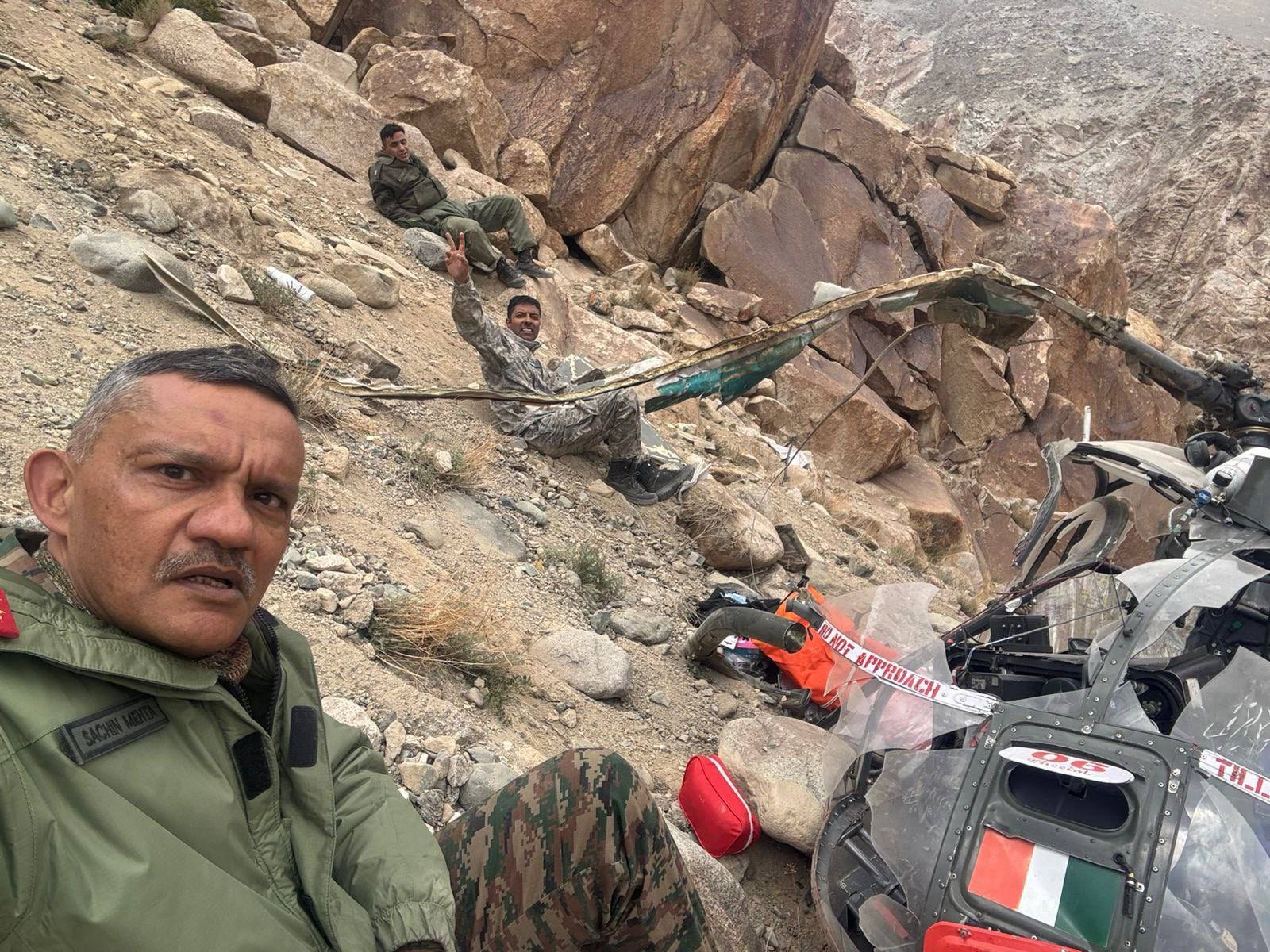
 The selfie taken by Maj Gen Sachin Mehta (L) soon after the chopper crash. (Photo via X)
New Delhi: A single-engine Cheetah helicopter carrying three Indian Army officers crashed, on Wednesday, in the high-altitude terrain of Tangtse, in eastern Ladakh – one of the most demanding flight environments anywhere on earth. The three men aboard – the general officer commanding (GOC) of the 3 Infantry Division, Major General Sachin Mehta, and the two pilots – a lieutenant colonel and a major, remarkably walked away with minor injuries.
Details of the incident entered the public domain only on Saturday, when Army officials formally confirmed the accident. According to multiple reports, Maj Gen Mehta had been travelling to a forward post when the helicopter, piloted by a lieutenant colonel and a major, went down in the rugged terrain close to the line of actual control (LAC). The Army has since ordered a court of inquiry to establish the exact cause of the crash, with officials expected to examine technical, operational, weather-related, and terrain-related factors.
What also arrested public attention was what happened immediately after: Maj Gen Mehta took a selfie. The photograph – which spread rapidly across social media platforms – showed the GOC and the two pilots seated near the wreckage on rocky terrain, one of the pilots flashing a victory sign. The image was read by many as an emblem of military sangfroid. It was also, in its way, a vivid illustration of just how routinely Army officers now confront the prospect of catastrophic accidents aboard legacy aircraft.
Tangtse sits at an altitude where the air is thin, the winds are capricious, and the terrain leaves almost no margin for error. The Cheetah helicopter is a familiar presence in such sectors – deployed for reconnaissance, casualty evacuation, troop movement, and logistical support along the Himalayan frontier. That it crashed there is not, by itself, unusual. What is unusual, and increasingly unsettling, is the frequency with which such crashes are occurring.
This incident involving an old Cheetah helicopter has reignited the debate on whether the country’s armed forces should continue with the old Cheetah and Chetak fleets, which were inducted in the services several decades ago.
Workhorses past their time
The Cheetah and Chetak helicopters are, in military terms, almost elderly. The Cheetah is the Indian-manufactured version of the French Aerospatiale SA 315B Lama; the Chetak derives from the Alouette III platform. Hindustan Aeronautics Limited (HAL) has been building them under licence for decades, and while both types have received periodic upgrades, the underlying airframe design traces its lineage to the 1950s and 1960s. They are, in the truest sense of the phrase, a different era’s machines operating in today’s threat environment.
All three services – the Army, the Navy, and the Air Force – operate variants of these helicopters, and all three have paid a price for it. Crashes involving Cheetah and Chetak aircraft have occurred with dispiriting regularity across Jammu and Kashmir, Ladakh, Arunachal Pradesh, and the northeastern states. These are not regions that forgive mechanical failure or pilot error: narrow valleys, sudden wind shifts, extreme cold, and altitudes above 15,000 feet combine to produce conditions that test the limits of both machine and crew.
Military aviation specialists are unambiguous about the physics involved. At extreme altitudes, rotor efficiency falls sharply as air density decreases. Engine performance degrades. Payload capacity shrinks. The safety margins that might accommodate a minor technical problem at sea level can, at 15,000 feet, compress to near-zero. It is in this context that the Cheetah’s age acquires its most uncomfortable significance – not merely as a matter of outdated avionics or tired metal, but as a compounding variable that makes an already hazardous operating environment more hazardous still.
Former military aviators are careful to distinguish between the platform and the problem. Many veterans describe the Cheetah as a forgiving aircraft in skilled hands – and, importantly, as one of the very few helicopters in any inventory capable of reliably landing at India’s highest-altitude border posts. That operational distinction is not trivial. The Siachen Glacier, the world’s highest battlefield, is accessible to precious few rotary-wing aircraft, and the Cheetah has held that capability. The case against it is not that it was ever a bad helicopter. The case against it is that its time has passed.
Two decades of delay
That time passed some years ago, and yet the fleet flies on. The story of India’s failure to replace the Cheetah-Chetak fleet is, by now, a familiar one in defence circles – a chronicle of procurement processes that collapsed under the weight of corruption allegations, bureaucratic inertia, and repeatedly shifting requirements. Foreign acquisition programmes were initiated, progressed, and then unravelled. Years became a decade; the decade became two.
The indigenous alternative, HAL’s Light Utility Helicopter (LUH), has finally moved into an advanced phase. The LUH has completed extensive high-altitude trials, which demonstrated improvements in avionics, survivability systems, and overall performance over the legacy platforms it is meant to replace. There is genuine optimism within some quarters of the defence establishment that formal induction is now a matter of when, not if.
The qualified word is “gradual”. Induction of the LUH in operationally significant numbers will take years. In the interim, the Cheetah and the Chetak remain the only available options for dozens of missions that cannot be deferred – resupply to snowbound posts, medical evacuation from forward areas, rapid movement of commanders along the LAC. The operational logic that keeps legacy aircraft flying is, in each individual case, entirely sound. It is the cumulative effect of that logic – sustained over years and across hundreds of sorties – that turns reasonable necessity into systemic risk.
A structural problem
It would be a misreading of the Tangtse crash – and of the pattern of crashes that precede it – to treat these events as isolated misfortunes. Aviation safety analysts consistently emphasize that accidents rarely result from single causes. In high-altitude military operations, the causation is typically layered: ageing airframes subject to metal fatigue, maintenance complexity exacerbated by dwindling spare-part availability, the physiological demands placed on pilots operating repeatedly in hypoxic conditions, unpredictable weather systems, and the relentless pressure of operational tempo.
Each factor, taken individually, may be manageable. Together, they constitute a structural problem – one that no amount of pilot skill or maintenance diligence can permanently neutralize when the underlying platform is operating on borrowed time.
The viral selfie from Tangtse will fade from public memory within days. The survival of Mehta and the two pilots will be celebrated – rightly – as evidence of both good fortune and military resilience. What must not fade is the recognition that the same conditions will exist for the next crew, and the crew after that, until the fleet is finally, substantively replaced.
Clock is running out
India is in the middle of an ambitious modernization of its armed forces, with a particular emphasis on indigenous capability development. Defence budgets have risen. The political will to reduce import dependence is real and sustained. Against this backdrop, the continued reliance on helicopters designed more than half a century ago is not merely an anachronism – it is an anomaly that grates against every stated modernization priority.
Along India’s borders with China and Pakistan – both of which present increasingly complex and high-altitude operational challenges – the ability to move quickly, sustain forward positions, and evacuate casualties is not a peacetime convenience. It is a wartime necessity. The helicopters that will be asked to perform those missions in any future contingency should not be aircraft whose design predates the moon landings.
The court of inquiry ordered by the Army will produce its findings in due course. It will examine the technical record, the weather data, the pilots’ logs. What it cannot resolve – because it falls outside its mandate – is the systemic question that the Tangtse crash, like each crash before it, forces back onto the table: how many more of these inquiries must be convened before the fleet modernization that has been promised for nearly two decades is finally delivered at the pace and scale the situation demands?
Major General Sachin Mehta and his pilots are alive. Their Cheetah is not. India’s armed forces are fortunate that this time the equation did not reverse.
Follow us on social media for quick updates, new photos, videos, and more.
X: https://x.com/indiasentinels
Facebook: https://facebook.com/indiasentinels
Instagram: https://instagram.com/indiasentinels
YouTube: https://youtube.com/indiasentinels
© India Sentinels 2026-27