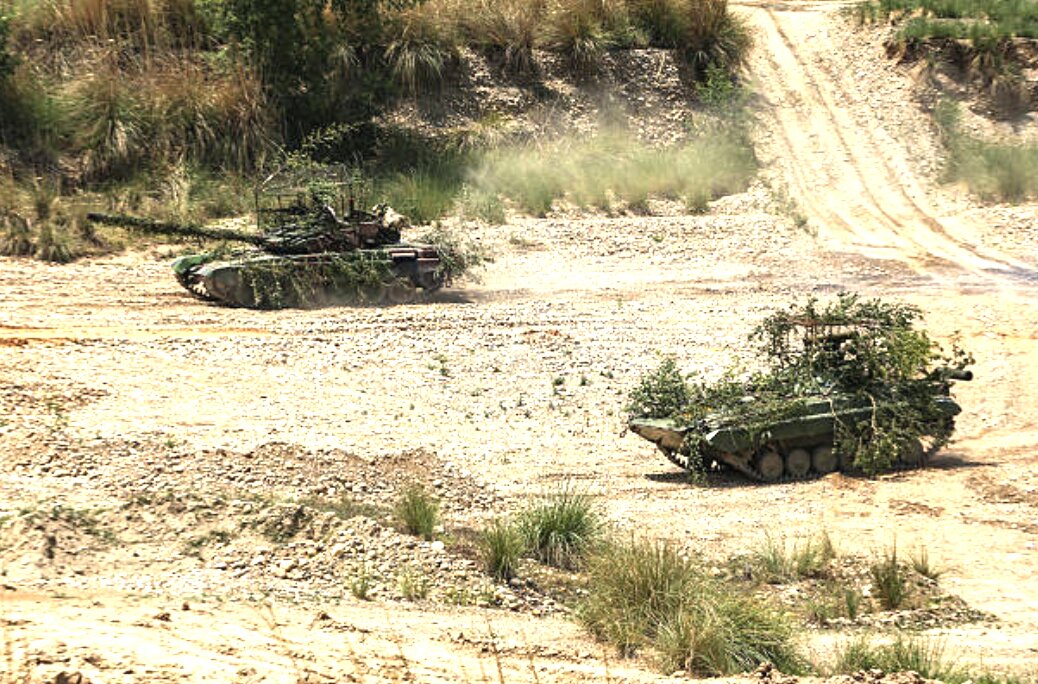
 An Indian Army tank and a BMP during a drill in Jammu. (File photo)
New Delhi: The Indian Army is set to bring its Mechanized Infantry Regiment and Armoured Corps under a single directorate from June 1, reversing a separation that had kept the two combat arms in distinct administrative silos for years. New Indian Express and Times Now citing senior Army sources described the move as an organizational restructuring aimed at sharper operational efficiency – one of the more consequential structural changes to ground combat formations in recent memory.
The two arms were originally housed together before being split. The Army has now concluded that a unified directorate will improve coordination between tanks and the infantry that fights alongside them – a lesson reinforced, at considerable cost, by the war in Ukraine and, more recently, by India’s own operational experience during Operation Sindoor in May 2025.
Historical roots
The mechanized infantry traces its institutional origins to April 2, 1979, when the Mechanized Infantry Regiment was formally constituted and its affairs transferred from the Directorate General of Infantry to the Directorate of Armoured Corps, which was subsequently renamed the Directorate General Mechanized Forces in 1986. In the formative years, the Army drew on established battalions from premier infantry regiments – frequently the first battalion of each – including the Madras, Sikh, Kumaon, Dogra, and Jat regiments, as well as the Gorkha and Garhwal rifles.
The first 14 battalions were converted from existing infantry units rather than raised from scratch.
Interestingly, this is not the first time the two arms have operated under unified command. Since February 2005, the directorate evolved into a fully integrated model responsible for all issues relating to the Armoured Corps, Mechanized Infantry Regiment, and the Brigade of the Guards. The current move appears to re-establish and reinforce that integrated structure, suggesting the Army has periodically revisited – and recommitted to – the principle of unified mechanized command.
The Army today operates the Mechanized Infantry Regiment with 27 battalions scattered across various armoured formations, forming, together with the 21 battalions of the Brigade of the Guards, the mechanized infantry arm that combines with the armoured corps to constitute the mechanized forces. Most of these battalions are equipped with the Soviet-designed Boyevaya Mashina Pekhoty (BMP) II (BMP-2) infantry combat vehicle. Each battalion fields roughly 750–800 officers and soldiers and around 45 of these vehicles. The BMP variant manufactured at Avadi in Tamil Nadu, under licence and with progressive indigenization, carries six to seven soldiers in addition to its three-man crew and is typically fitted with anti-tank weapons.
Why tanks need infantry
Mechanized infantry serves two principal functions. It allows foot soldiers to advance at the pace of armoured formations, giving ground combat the mobility that modern warfare demands. Tanks operating without infantry cover are acutely vulnerable to enemy soldiers armed with portable anti-tank weapons at close range; infantry riding alongside armour neutralizes that threat.
The consequences of ignoring this principle were on stark display in the opening phase of the Russia-Ukraine war, which began in February 2022. Russian armoured columns advanced in long convoys along roads, without adequate infantry support, and suffered devastating losses to Ukrainian anti-tank teams. The images of destroyed Russian armour on the outskirts of Kyiv became among the most analysed in recent military history. The BMP-2’s armour, while comparatively thin, also offers mechanized infantry meaningful protection from small-arms fire during an advance.
A formidable armoured fleet
The Indian Army fields one of the largest armoured fleets in the world. Its tank strength stands at roughly 3,400 main battle tanks, comprising approximately 2,100 T-72M1 Ajeya vehicles – Soviet-era but progressively upgraded – around 1,200 T-90S Bhishma tanks, and 124 Arjun Mk-1 tanks, the last being an indigenously developed platform. A further 118 Arjun Mk-1A variants, fitted with AI-assisted targeting and improved survivability features, are on order. The T-90S Bhishma, produced under licence at the Heavy Vehicles Factory in Avadi, Tamil Nadu, is considered the backbone of the Indian tank fleet.
On the infantry fighting vehicle side, the Army operates around 2,400 BMP-2 Sarath – the Indian name for the Soviet BMP-2, licence-built at the ordnance factory in Medak, Telangana, since 1987. The Sarath is amphibious, armed with a 30mm cannon, a coaxial machine gun, and Konkurs anti-tank guided missiles, and can carry seven troops alongside its three-man crew. In March 2024, the state-owned Armoured Vehicles Nigam Limited signed a contract to upgrade 693 of these vehicles with night-fighting capability, an advanced fire-control system, and third-generation anti-tank missiles.
Lessons from Ukraine, Sindoor
The Army is also fitting cope cages to BMP-2 units – protective structures designed to counter first-person-view (FPV) drones and loitering munitions. These protective structures, designed to shield against FPV drones and loitering munitions, mark a critical adaptation to the changing dynamics of the battlefield, particularly following India’s military engagement during Operation Sindoor in May 2025.
More recently, the Army has been observed operating BMP-2 vehicles fitted with a new, adjustable configuration of anti-drone cage protection mounted over the main turret – a more evolved and flexible design compared to earlier improvised solutions, allowing crews to adapt the protection level based on mission requirements and threat perception.
Operation Sindoor, launched in May 2025 in response to the terrorist attack on tourists in Pahalgam in April 2025, saw Indian forces strike terrorist infrastructure across the border in a calibrated operation that also served as a live test of the Army’s doctrine and equipment. In its aftermath, the Army announced several structural initiatives, including the establishment of five Bhairav battalions, two Rudra brigades, and new Ashni drone platoons to be deployed across 380 infantry battalions.
The Zorawar dimension
The reorganization also comes as the Army prepares to induct a new class of armoured vehicle altogether. India’s DRDO has completed development trials of the Zorawar light tank, developed jointly with Larsen and Toubro, and user trials are underway.
The 25-tonne platform, designed for high-altitude warfare, is aimed at induction by 2027 and was developed specifically to address the Army’s need for a lightweight, agile platform capable of operating in the rugged terrain along the line of actual control (LAC). The programme was initiated after the 2020 Galwan clash, which exposed the operational limitations of heavier tanks like the T-72 and T-90 in mountainous terrain, and China’s deployment of its Type 15 light tank underscored the urgency for an Indian equivalent.
The unification of the mechanized infantry and armoured corps directorates, seen in this broader context, is less an administrative convenience and more a doctrinal signal: that the Army is organizing itself around the realities of combined-arms warfare in an era defined by drones, precision munitions, and adversaries who have learned – as Russia learned at great cost on the outskirts of Kyiv – that armour without infantry is armour waiting to be destroyed.
Follow us on social media for quick updates, new photos, videos, and more.
X: https://x.com/indiasentinels
Facebook: https://facebook.com/indiasentinels
Instagram: https://instagram.com/indiasentinels
YouTube: https://youtube.com/indiasentinels
© India Sentinels 2026-27