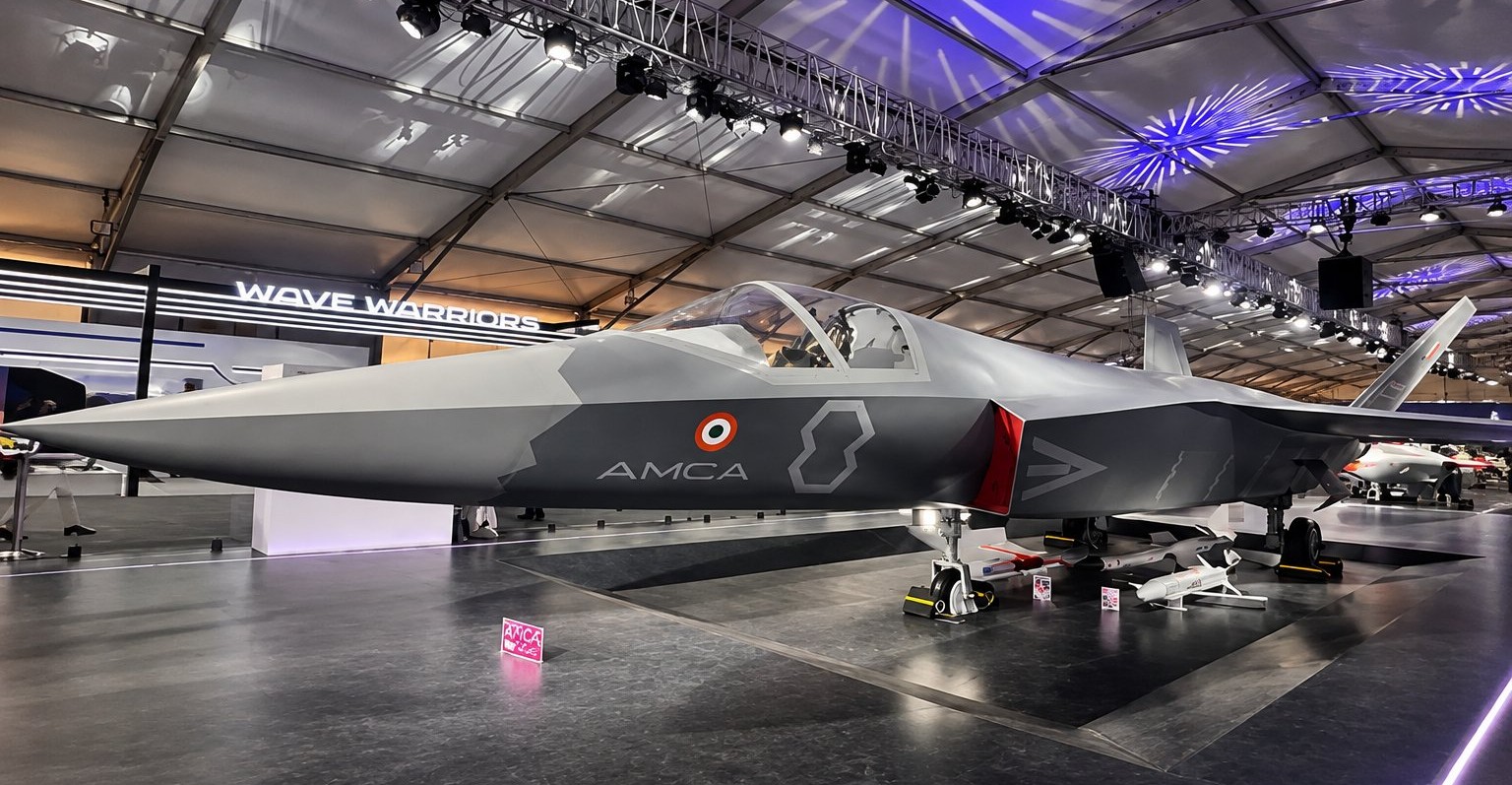
 Full-scale model of Advanced Medium Combat Aircraft. (File photo)
— By Huma
New Delhi: India’s effort to develop a home-grown engine for its fifth-generation fighter aircraft has entered a more competitive phase, with Reliance Industries Limited (RIL) and Rolls-Royce announcing a strategic intent to work together on the powerplant for the Advanced Medium Combat Aircraft (AMCA).
The announcement last week adds a new dimension to an already closely watched contest involving some of the world’s leading aerospace companies. While the partnership marks Reliance’s renewed presence in the defence sector, its larger implication lies in the propulsion challenge facing India’s AMCA programme and the technology choices that will shape the country’s future combat-aircraft capability.
Under the proposed arrangement, Reliance and Rolls-Royce will explore establishing an Aerospace Gas Turbine Complex in India. The facility is expected to serve as a centre for power and propulsion technology, with ambitions spanning design, development, manufacturing, testing, production and long-term support.
The proposal comes as India seeks to develop a roughly 120-kilonewton-class engine for later versions of the AMCA. The aircraft’s initial prototypes are expected to fly with the American GE F414 engine, allowing the airframe development programme to progress while work on an indigenous powerplant continues. That makes the engine competition one of the most consequential parts of the wider AMCA programme.
Why the engine matters
India has made significant progress in developing fighter aircraft, but advanced propulsion remains a major technological gap.
The AMCA is being designed as a twin-engine stealth fighter with advanced sensors, electronic warfare capabilities, internal weapons carriage and sophisticated mission systems. To deliver the required performance, the aircraft will eventually need a powerful and reliable indigenous engine.
Developing such an engine is considerably more difficult than manufacturing one under licence. A modern fighter powerplant involves technologies covering high-temperature materials, turbine blades, compressors, combustion, cooling, engine controls and precision manufacturing.
The most demanding components operate in extremely high-temperature environments, requiring specialised metallurgy and manufacturing techniques.
India’s long-running Kaveri engine programme demonstrated the difficulty of developing a fighter engine that meets the required combination of thrust, reliability and performance.
The AMCA programme is now an opportunity to overcome that limitation. The objective is not merely to produce an engine domestically, but to create the technological and industrial base required to design, manufacture, test, maintain and eventually upgrade advanced military engines within the country.
Rolls-Royce enters a two-way contest
The latest announcement also sharpens competition with France’s Safran, which has been pursuing a potential partnership with the Defence Research and Development Organisation for a high-thrust engine for the AMCA’s later variants.
Rolls-Royce has also been seeking a role in the programme and has offered an extensive technology-transfer proposition as part of its pitch.
The emergence of competing proposals from two major European engine manufacturers gives India greater room to negotiate on the terms of any eventual partnership. The decision, however, will involve considerably more than selecting an engine manufacturer.
Technology transfer, intellectual-property rights, manufacturing capabilities, development timelines, costs and the ability to independently maintain and upgrade the engine are likely to be central considerations.
The immediate AMCA development strategy reflects a pragmatic approach. The initial prototypes are expected to use the GE F414, an established engine that can support the early stages of aircraft development and flight testing. Waiting for an indigenous engine before flying the aircraft could otherwise add years to an already complex programme.
The eventual transition to an Indian-developed engine is expected to take place with later AMCA variants. This approach allows the aircraft and engine programmes to progress in parallel.
It also gives Indian industry time to develop the specialised capabilities required for high-thrust propulsion without holding up the entire fighter project.
The challenge will be ensuring that the indigenous engine programme receives the technological access and industrial support needed to move beyond assembly towards genuine design and development capability.
The Ministry of Defence has shortlisted three private-sector-led groups for the aircraft development and production programme: Tata Advanced Systems, the Larsen & Toubro-Bharat Electronics Limited combine, and the Bharat Forge-BEML consortium.
The move represents a departure from India’s traditional defence-industrial model, in which major aircraft programmes were largely driven by government agencies and public-sector companies.
Private industry is now being brought into the core development and production process. A successful high-thrust engine programme could create capabilities relevant to future fighter aircraft, unmanned combat systems and other advanced aerospace applications.
It could also strengthen India’s domestic supply chain by creating demand for specialized materials, precision components, testing facilities and high-end manufacturing. The AMCA could therefore become a test of whether India’s defence-industrial expansion can move from production capability to technological ownership.
Competition could work in India’s favour
The growing competition between Rolls-Royce and Safran provides India with an opportunity to demand deeper commitments from potential partners.
The central issue will be the extent of technology transfer. The AMCA is intended to remain in service for decades. Its propulsion system will therefore need to evolve alongside the aircraft.
India will ultimately need the ability to undertake upgrades and develop future versions without being completely dependent on an overseas supplier.
A critical piece of India’s fighter ambitions
The AMCA programme is moving forward at a time when the Indian Air Force is seeking to strengthen its fighter fleet and prepare for a more technologically demanding regional environment.
The Tejas Mk1A and Mk2 programmes will form important parts of the future fleet, while the AMCA is intended to provide a more advanced indigenous capability. But the success of the AMCA will depend on more than the aircraft’s airframe and stealth features.
(She is a senior journalist, who looks after the defence and strategic affairs developments. She is known for her reporting and writing on India’s defence sector, military modernization, aerospace, national security , diplomacy and strategic affairs.)
Follow us on social media for quick updates, new photos, videos, and more.
X: https://x.com/indiasentinels
Facebook: https://facebook.com/indiasentinels
Instagram: https://instagram.com/indiasentinels
YouTube: https://youtube.com/indiasentinels
© India Sentinels 2026-27