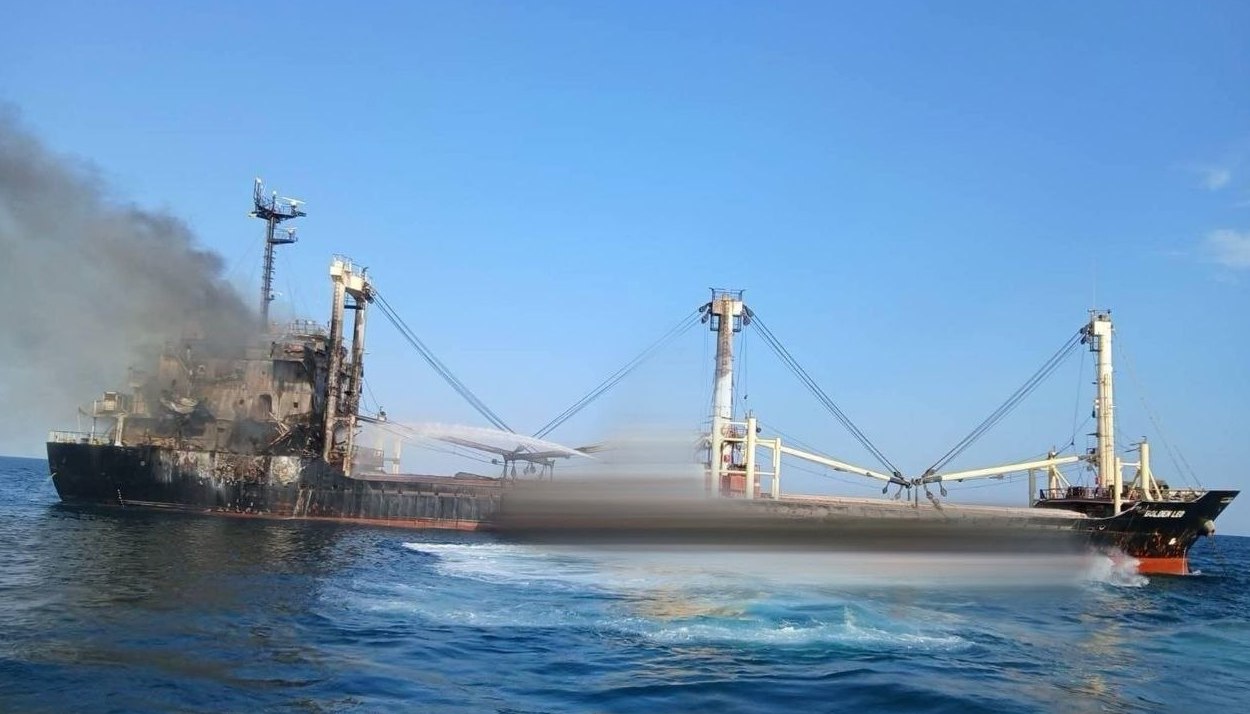
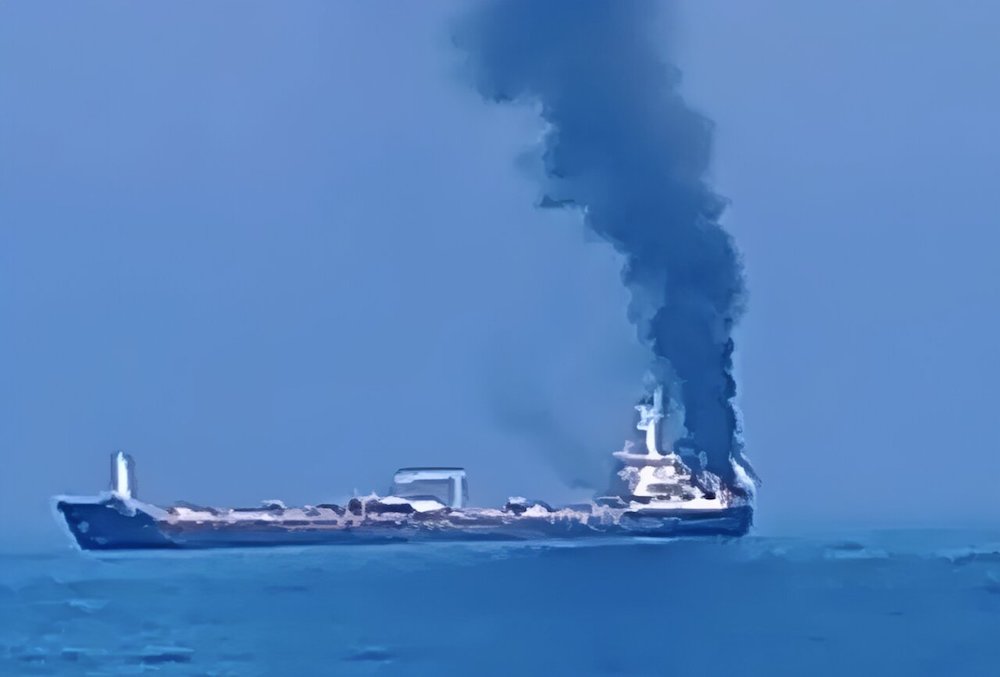
 This AI-enhanced screengrab of a viral amateur video shows smoke coming out of MT Jalveer after being hit by a US missle.
New Delhi: Less than 24 hours after three Indian sailors lost their lives in a US Navy strike on the oil tanker Settebello, another tanker carrying Indian crew has come under attack in the Gulf of Oman. The Guinea-Bissau-flagged bitumen tanker MT Jalveer, with 20 Indian seafarers on board, was struck by two US Hellfire missiles in its engine room on the night of June 10–11, triggering a fire that engulfed the vessel’s funnel and accommodation areas and forced a full crew evacuation near the Omani port of Shinas.
All 20 sailors are safe, according to the Ministry of Ports, Shipping & Waterways.
The attack came even as New Delhi was still absorbing the shock of what happened the day before. The three Indian crew members initially reported missing after the Settebello strike – deck cadet Aditya Sharma, engine fitter Shivanand Chaurasiya, and chief engineer Patnala Suresh – were confirmed dead on Thursday. The shipping minister, Sarbananda Sonowal, described it as deeply unfortunate and said he had directed officials to ensure the immediate repatriation of rescued crew and the swift return of the mortal remains of the deceased for their final rites.
MT Jalveer now becomes the third Indian-crewed vessel to be disabled by US forces in the space of one week – a pattern that is rapidly stretching the limits of New Delhi’s carefully calibrated diplomatic posture toward Washington.
Centcom owns strike
Unlike the Settebello incident, where no party initially claimed responsibility and maritime security firms pieced together a US attribution, Washington did not wait this time. The US Central Command (Centcom) confirmed in a statement that it acted against the Guinea-Bissau-flagged MT Jalveer as it attempted to transport oil from Iran through the Gulf of Oman. It said a US aircraft fired two Hellfire missiles into the ship’s engine room after the crew repeatedly failed to comply with directions from US forces.
The vessel sent a distress call while off Oman’s port of Shinas after a fire broke out around its engine room and funnel, according to British maritime risk management company Vanguard. Images circulated on social media by the Forward Seamen’s Union of India showed crew members being winched off the burning vessel by helicopter, thick black smoke billowing from the bridge and upper accommodation decks.
An inter-ministerial briefing confirmed that all crew members were safe and that evacuation to Shinas port had commenced, with six more crew members still to be evacuated as of the time of the briefing.
Week that upset India’s maritime apple cart
The MT Jalveer strike is the culmination of a week that has caused profound unease in India’s maritime and diplomatic establishments. The sequence began on Monday, when Centcom confirmed that an F/A-18 Super Hornet launched from the aircraft carrier USS Abraham Lincoln fired a precision munition into the engineering and steering compartments of the Palau-flagged MT Marivex in the Gulf of Oman, after the vessel attempted to sail to an Iranian port in defiance of the US blockade.
All 24 Indian crew members aboard the Marivex were rescued by Omani authorities [archived link].
Two days later, on Wednesday, the Palau-flagged oil tanker Settebello, also with 24 Indian crew on board, was struck approximately 20 nautical miles northeast of Sohar, with its engine room hit at around 3pm IST, triggering a fire. The UK Maritime Trade Operations agency reported the incident and confirmed that local Omani authorities were on scene assisting with crew evacuation.
Two independent maritime security sources, including the firm Ambrey, assessed the strike as consistent with US naval blockade-enforcement operations targeting vessels associated with Iranian ports. Centcom has since confirmed its involvement.
As of Wednesday evening, the search and rescue operation for the missing Settebello crew was being coordinated by Omani authorities in close contact with the Indian embassy in Muscat. That operation ended in grief on Thursday when all three were confirmed dead.
India’s response
New Delhi’s reaction has tracked the escalating toll. After the Marivex incident, the Ministry of External spokesman, Randhir Jaiswal, acknowledged, with studied understatement, that “there was some exchange of communication between the ship and the US Navy before the incident” – as close as the ministry came to naming the attacker.
After the Settebello strike, the MEA reportedly summoned the deputy chief of the US mission [archived link] in New Delhi, Jason Meeks – with US ambassador Sergio Gor being away in Kazakhstan, to officially convey its protest. Although the MEA did not issue a formal statement specifically naming the US, it condemned the attack and described the continuing incidents as “deeply worrisome” and “a direct result of the ongoing conflict in the region.”
At the UN security council, India’s permanent representative Harish Parvathaneni expressed “deep concern” over the attacks on merchant vessels, informing the body that several Indian nationals had been killed or gone missing. He underscored that nearly 10 million Indian citizens live and work in the Gulf region and that their safety was of “utmost priority” for New Delhi.
On Thursday, with three deaths confirmed and yet another vessel struck, the language sharpened further. Jaiswal directly attributed the Jalveer attack to the US Navy at a media briefing – a significant rhetorical step for the government that had until then been reluctant to name Washington in public communications.
The MEA described the continuing incidents affecting commercial shipping as “deeply concerning”.
US says blockade compliance non-negotiable
Washington has shown no signs of modifying its enforcement posture in response to Indian casualties. US officials have maintained that the targeted tankers were “non-compliant” sanctioned vessels operating as part of Iran’s oil-exporting network, and that warplanes fired only after – what it said – “the crews repeatedly failed to comply with lawful maritime directions and blockade protocols from American forces.”
As of earlier this week, Centcom reported that its forces had disabled seven non-compliant vessels, redirected 134 others that complied with instructions, and allowed 42 vessels carrying humanitarian aid to pass through. The Jalveer now adds to that tally.
Diplomatic minefield
The timing is particularly difficult for New Delhi. The US attacks on Indian-crewed vessels come at a moment when the prime minister, Narendra Modi, is expected to hold bilateral talks with the US president, Donald Trump, on the sidelines of the G7 summit next week. That meeting, which is intended to consolidate the momentum of the India-US strategic partnership, now risks being overshadowed by the deaths of Indian sailors at American hands.
India is the world’s largest supplier nation of seafarers, with tens of thousands of Indians crewing commercial vessels worldwide, including in the Gulf corridor. The recurrence of Indian-crewed ships caught in American naval blockade operations, coupled with New Delhi’s carefully worded responses that avoid direct rebukes of Washington, has drawn attention to the gap between India’s stated commitment to protecting its maritime workers and its actual diplomatic leverage in the conflict.
India’s initial cautious diplomatic approach has been shifting toward public outrage as the casualties mount – a trajectory that will be difficult to reverse if further attacks follow.
A waterway under siege
The Gulf of Oman and the Strait of Hormuz have become among the most dangerous stretches of international waters since the current round of hostilities broke out on February 28, 2026. The strait – some 38 kilometres wide at its narrowest – normally carries one-fifth of the world’s oil and LNG shipments. The 2026 Strait of Hormuz crisis has already left at least 17 merchant ships damaged, seven abandoned, two captured, and at least 12 seafarers killed or missing.
An analyst at Verisk Maplecroft described the situation as a “low intensity conflict” where both the US and Iran are attempting to negotiate from positions of strength – Washington by ramping up blockade enforcement, Tehran by squeezing global oil flows through Hormuz. It is Indian sailors, crewing vessels caught between two nuclear-armed powers locked in a proxy economic war, who are paying the price.
New Delhi has now reiterated its call for de-escalation three times in as many days. Whether that message – delivered through diplomatic channels and UNSC addresses – carries any weight in Washington or Tehran is a question that the families of Aditya Sharma, Shivanand Chaurasiya, and Patnala Suresh are entitled to ask.
Follow us on social media for quick updates, new photos, videos, and more.
X: https://x.com/indiasentinels
Facebook: https://facebook.com/indiasentinels
Instagram: https://instagram.com/indiasentinels
YouTube: https://youtube.com/indiasentinels
© India Sentinels 2026-27