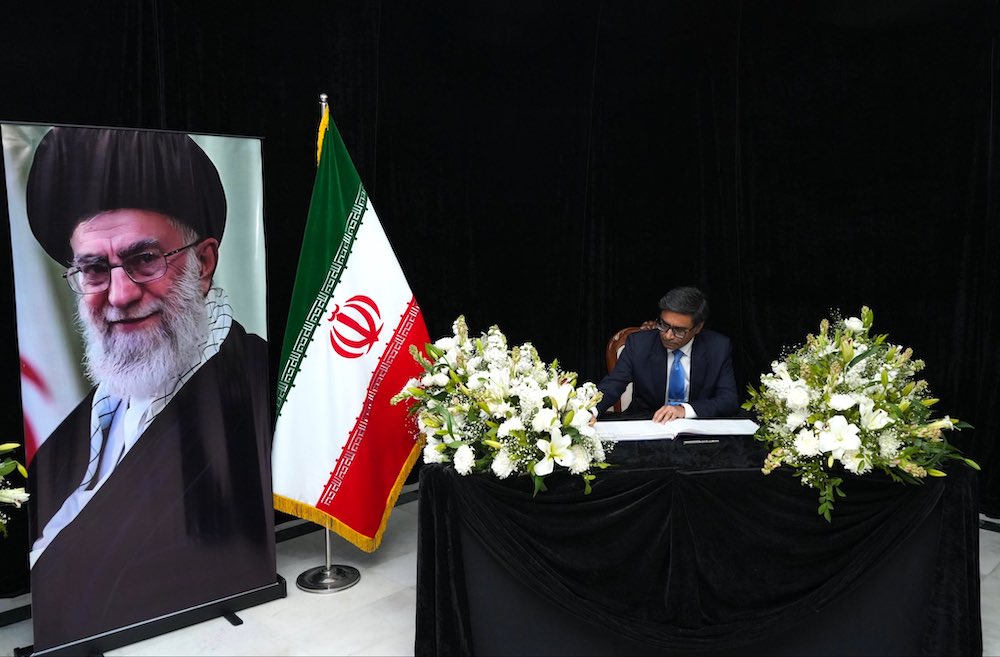
 Vikram Misri signing the condolence book at the Iranian embassy in New Delhi, on March 5, 2026. (Photo: MEA)
New Delhi: India has at last formally expressed condolences over the assassination of Iran’s supreme leader, Ali Khamenei, with the foreign secretary, Vikram Misri, signing the book of condolence at the Iranian embassy in New Delhi, on Thursday. Misri then had a brief one-on-one meeting with the ambassador of Iran to India, Mohammad Fathal.
This came nearly five days after Khamenei was killed in a joint American-Israeli airstrike on February 28.
The delay was conspicuous. While Russia and China condemned the strikes within hours and called them a violation of international law, New Delhi stayed silent for days – issuing no statement, offering no condolences, and making no public comment on the military operation that killed one of the most consequential figures in the Middle East over the past three-and-a-half decades.
When India did respond, it did so with careful restraint. “Sincerest condolences on behalf of the government and people of India. We pray for peace for the departed soul,” Misri wrote in the condolence register. The message – brief, measured, and conspicuously free of any political comment – reflected New Delhi’s evident discomfort with the episode.
The external affairs minister, S Jaishankar, also spoke by telephone with his Iranian counterpart, Seyed Abbas Araghchi, and mentioned the conversation in a post on X. The call is understood to have covered bilateral ties and the broader implications of the crisis for regional stability, although the ministry issued no detailed readout.
As India Sentinels had reported, the strikes that killed Khamenei were launched in the early hours of February 28, targeting military installations, government offices, and the residences of senior political and military figures across Iran. Khamenei, 86, who had led the Islamic Republic since 1989, was killed along with several family members. The strikes marked a dramatic escalation of the conflict between Israel and Iran that had been intensifying since late 2023.
Israel publicly welcomed the outcome of the operation. The US, which participated in the strikes, has not issued a formal statement condemning the killing. Most western governments have been similarly guarded, underscoring how deeply polarized international opinion on Iran has become.
India’s silence in the immediate aftermath drew criticism in diplomatic circles, where it was seen as a sign of New Delhi hedging between its strategic ties with Israel and the US on the one hand and its longstanding energy and trade relationship with Iran on the other. India had been among the largest buyers of Iranian crude oil and has significant interests in the Chabahar port project, a key piece of its connectivity strategy toward Afghanistan and Central Asia.
The prime minister, Narendra Modi, had spoken to the Israeli prime minister, Benjamin Netanyahu, after the strikes, stressing the need for an early cessation of hostilities – a formulation that stopped well short of a condemnation. India has not condemned the strikes on Iran.
The optics of Misri’s condolence-signing sit uneasily against that backdrop. A foreign secretary signing a condolence register – rather than a minister or the prime minister – is itself a calibrated act, communicating sympathy without political commitment. India’s response has been the minimum required to maintain diplomatic decorum with Tehran, without antagonizing Washington or Tel Aviv.
Critics argue that New Delhi’s approach, whatever its strategic logic, has come at a cost to its credibility as a voice for a rules-based international order. The killing of a sitting head of state in a targeted military strike – however controversial his legacy – raises serious questions under international law, questions India has conspicuously chosen not to engage with.
Iran has been in a state of turmoil since the strikes, with a leadership succession process under way and deep uncertainty about the country’s future direction. The international community is watching closely to see whether Tehran opts for escalation or a period of internal consolidation. India’s belated and subdued response suggests New Delhi is keeping all options open – and making no enemies it does not have to.