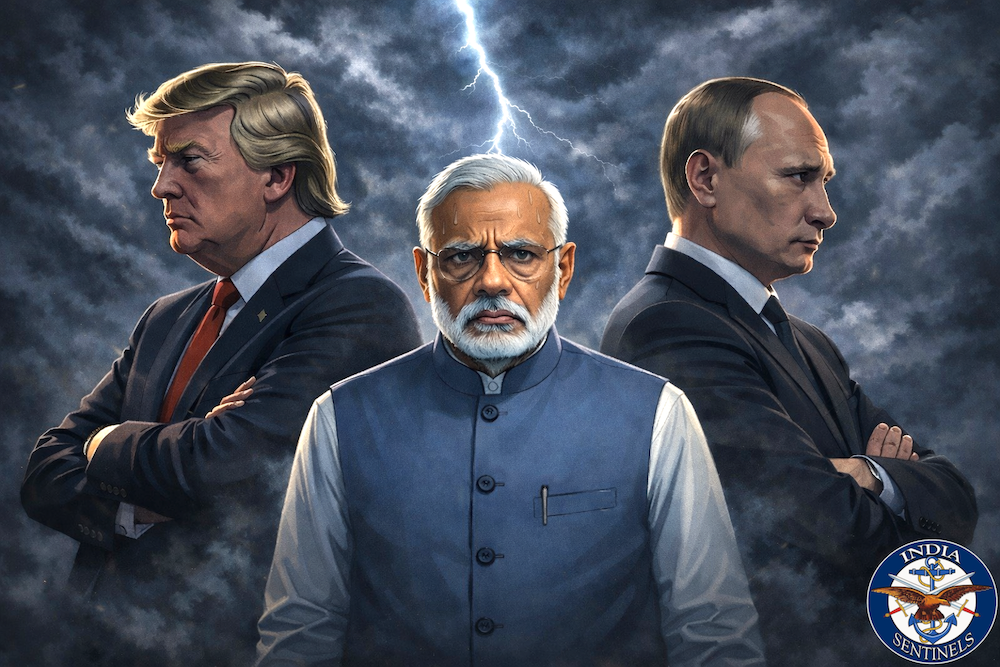
 Illustration for representation. (© India Sentinels 2026–27)
New Delhi: Washington has granted India a 30-day waiver to receive Russian oil cargoes already at sea – a move framed by the United States treasury as pragmatic crisis management. However, it has ignited a bruising domestic debate in India about sovereignty, strategic autonomy and whether the Narendra Modi government has quietly surrendered its independent foreign-policy instincts at the Trump administration’s doorstep.
Narrow licence, loud message
The waiver, formalized on Friday, as the US treasury’s Office of Foreign Assets Control (OFAC) Russia-related General License 133, authorizes Indian entities to receive, discharge, and pay for Russian-origin crude oil and petroleum products loaded on vessels on or before that date, with delivery to Indian ports expected by early April. It does not permit new loadings of Russian crude, does not provide blanket relief from the G7 price-cap framework, and explicitly excludes any dealings with persons or banks already designated under US sanctions.
In short, it is a one-time regularization of cargoes caught in legal limbo – not a reopening of the Russian oil trade.
The treasury secretary, Scott Bessent, announced the measure [archived link] in a post on X, linking directly to the OFAC notice and describing it as a step to “enable oil to keep flowing into the global market”. Bessent called India “an essential partner of the United States” and added, pointedly, that Washington “fully anticipates that New Delhi will ramp up purchases of US oil” – a line that was neither diplomatic nicety nor subtle suggestion. It was a signal that the waiver comes with an expectation attached.
Adding to that, the US energy secretary, Chris Wright, posted the same announcement using “allowing”, which many in India thought was condescending. He wrote [archived link]: “We have implemented short term measures to help keep oil prices down. We are allowing our friends in India to take oil that is already on ships, refine it, and move those barrels into the market quickly. A practical way to get supply flowing and ease pressure.”
How India got here
To understand the waiver, one must trace the arc of pressure that preceded it. In August 2025, the US president, Donald Trump, signed an executive order imposing an additional 25 per cent tariff on Indian imports, explicitly citing New Delhi’s direct and indirect purchases of Russian Federation oil as undercutting Washington’s effort to squeeze Moscow’s war-financing capacity. Tariffs were later compounded, pushing effective rates on some Indian goods towards 50 per cent, contributing to what has been described as a 2025 US-India diplomatic and trade crisis.
Then, on February 2 Trump announced what he called a “historic” trade deal with India, under which Washington removed the punitive 25 per cent tariff. A White House fact sheet stated that India had “committed to stop directly or indirectly importing Russian Federation oil.” The secretary of state, Marco Rubio, reiterated this publicly, presenting it as proof that American pressure on partners was working.
New Delhi’s own account was rather different. The February 7 joint statement made no explicit mention of any binding commitment to halt Russian oil imports. The external affairs minister, S Jaishankar, and foreign secretary Vikram Misri stressed that Indian oil companies made decisions based on market conditions and national interest.
Indian analysts treated Trump’s characterization as, at best, a politically convenient American reading of a more ambiguous Indian pledge to wind down purchases over time. Ship-tracking data confirmed that India had indeed trimmed Russian crude volumes in late 2025 and early 2026 – but had not cut flows to zero.
Hormuz crisis changes everything
Before the ambiguity of that February understanding could be resolved, events intervened violently. As India Sentinels had reported, on February 28, US and Israeli forces launched strikes on Iran, killed the supreme leader, Ali Khamenei, and triggered waves of Iranian retaliation across the Persian Gulf. Tehran declared the Strait of Hormuz closed and threatened to attack any vessel attempting passage.
The consequences for India were immediate and severe. More than 37 Indian-flagged ships and approximately 1,100 sailors were stranded in the Persian Gulf, Gulf of Oman and surrounding waters, and at least three Indian seafarers on foreign-flagged vessels were killed in attacks.
The Strait of Hormuz normally carries roughly a fifth of global oil and LNG flows.
India, which imports about 88 per cent of its crude, depends heavily on Middle Eastern suppliers whose exports transit this route. Analysts estimated India held roughly 40 to 45 days of cover in strategic and commercial reserves – a window that is uncomfortably short if the blockade persists.
It is against this backdrop that General License 133 arrived. Ship-tracking data and trader accounts suggest that roughly 9.5 million barrels of Russian crude already in or near the Arabian Sea could now be diverted to Indian ports under the licence window, potentially pushing Russia’s share of India’s imports back towards 40 per cent. The waiver does not, however, resolve India’s broader vulnerability because the bulk of its Gulf crude and most of its LNG imports remain inaccessible as long as Hormuz stays shut.
India’s silence and its costs
India’s official response to the killing of Khamenei was notably restrained. The Ministry of External Affairs called the situation in West Asia “deeply concerning” and appealed for de-escalation, but offered no condemnation, no condolences and no comment on the legality of the strikes. The prime minister, Narendra Modi, framed India’s position as one of supporting regional stability, without naming the US or Israel.
The restraint carried its own strategic costs. Iran had been a civilizational partner, an energy supplier, and the gateway to India’s access to Afghanistan and Central Asia through the Chabahar port. Silence in the face of its supreme leader’s assassination risked being read – in Tehran and across the global south – as tacit endorsement of the strikes.
However, five days, since assassination of Khamenei, on Thursday, the foreign secretary, Vikram Misri, went to the Iranian embassy in New Delhi and officially condoled the Iranian supreme leader’s death.
A further shock came when a US nuclear-powered submarine torpedoed the Iranian frigate IRIS Dena roughly 40 nautical miles off Sri Lanka’s southern coast – days after the vessel had participated in India’s International Fleet Review off Visakhapatnam. Admiral Arun Prakash, former chief of the Indian Navy, publicly questioned how a US attack submarine could have operated so close to India’s shores without detection and urged the government to convey “deep concern and displeasure”.
The government remained largely silent on that, too.
Read also: A War of Choice: Where India stands – and its multilayered implications
‘Do we need permission?’
The Russian oil waiver, landing in this charged atmosphere, became a lightning rod. Congress MPs Manish Tewari and Randeep Singh Surjewala asked on X whether India now needed “permission” from the US to secure its own energy needs. Congress’s K C Venugopal called it “deeply humiliating” that India required a US waiver to buy oil from a “time-tested partner.”
Left leaders from the Communist Party of India and Communist Party of India (Marxist) wrote to Modi describing the episode as a “humiliation of sovereign India” and evidence of foreign policy drifting from non-alignment. The Aam Aadmi Party leader, Arvind Kejriwal, and the Tamil Nadu chief minister, MK Stalin, drew the same conclusion. Phrases such as “American blackmail”, “neo-imperial arrogance”, and “alms for 30 days” circulated widely on social media, shifting the public narrative from technical sanctions relief to national dignity.
The BJP and the government’s response was to frame the waiver as a triumph of “strategic oil diplomacy” – a pragmatic outcome secured through Modi’s personal rapport with Trump, which allowed India to receive cargoes it had already contracted and cushion domestic fuel prices amid the Hormuz disruption. Ministers pointed out, with some justification, that India had managed to buy discounted Russian oil for years despite Western pressure – proof, they argued, that New Delhi had not simply been following US diktats.
Between Washington, Moscow and Tehran
Both narratives contain a measure of truth, and a measure of self-serving distortion. The waiver is technically narrow: it covers stranded cargoes, not a green light to resume large-scale Russian oil purchases. In a genuine supply emergency, accepting it is rational, not servile. At the same time, the optics of Washington publicly “allowing” the world’s fifth-largest economy to buy oil from a particular country through a “licence” – even briefly – are corrosive to the image of Indian strategic independence that the country has spent years cultivating.
What the episode makes unmistakably clear is that India’s energy dependence, its deepening security alignment with Washington, and its residual ties with Moscow are no longer separable domains of foreign policy – each constrains the others. The Trump administration’s willingness to toggle tariffs and waivers based on Indian energy choices has demonstrated that Washington regards sanctions policy as a live instrument for shaping Indian behaviour, and that New Delhi, for all its rhetoric about strategic autonomy, has limited room to resist.
Managing that triangle – a key security partner in Washington, a major energy supplier in Moscow and a strategically critical but now destabilized Iran – is the central challenge facing Indian diplomacy. A 30-day licence from the US Treasury is no substitute for a long-term answer.
Follow us on social media for quick updates, new photos, videos, and more.
X: https://x.com/indiasentinels
Facebook: https://facebook.com/indiasentinels
Instagram: https://instagram.com/indiasentinels
YouTube: https://youtube.com/indiasentinels
© India Sentinels 2026-27