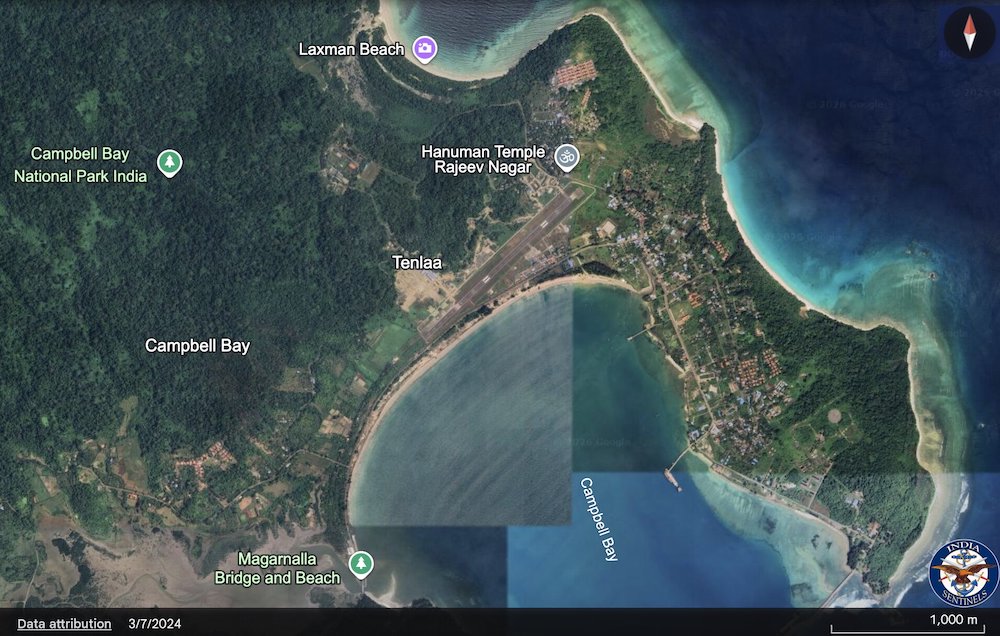
 A satellite view of INS Baaz at Campbell Bay, Nicobar Island. (Google Earth)
New Delhi: After nearly five years of inconclusive feasibility studies, the government has formally abandoned its long-pending proposal to expand INS Baaz, the Indian Navy air station at Campbell Bay in the Nicobar Islands. A greenfield international airport at Galathea Bay has now been cleared to proceed in its place.
The INS Baaz expansion had initially carried considerable strategic appeal. Upgrading an already-operational naval airstrip into a full-fledged civil-cum-strategic airport appeared cost-effective, logistically straightforward, and well-suited to consolidating India’s presence at the southernmost reaches of the Andaman & Nicobar archipelago – a chain of islands whose geographic position at the mouth of the Malacca Strait gives it disproportionate strategic weight.
That logic did not survive contact with ground realities.
Site assessments identified a hill rising over 80 metres on the northern flank of INS Baaz as a fundamental aviation safety hazard for wide-bodied commercial aircraft. This obstacle that could not be engineered away without excavation costs and construction timelines that made the entire proposition untenable. Runway expansion would also have encroached on inhabited settlements, raising the prospect of displacing local communities.
Ecologists warned, further, that sustained flight operations at the existing naval airstrip would inflict significantly greater damage on local fauna than a purpose-built greenfield facility – no minor consideration in one of India’s most ecologically sensitive island chains.
Senior officials, speaking on background, said the full scale of the difficulties became apparent only gradually, as successive assessments accumulated. “Every study that came back added another layer of difficulty,” one official said. “By the time the full picture emerged, it was evident that no amount of engineering could fully overcome what nature and existing infrastructure had already determined.”
Galathea Bay alternative
Located roughly 30 kilometres from INS Baaz, Galathea Bay offers open topography, adequate coastal depth, and scope for phased development. Five alternative sites were evaluated before planners settled on Galathea Bay. They deliberated on a range of criteria that included topographical suitability, air navigation safety, impact on tribal populations, and ecological consequences.
The decision fits within a broader strategic trajectory. The Indian government’s ambitious Great Nicobar Island holistic development plan, cleared in 2021 at a projected cost of around ₹72,000 crore, envisages a transshipment port, a township, a power plant, and, crucially, an international greenfield airport as integrated components of what is intended to become a strategic node in the Indo-Pacific. The airport at Galathea Bay is central to that vision: without reliable air connectivity, the rest of the development plan has limited practical traction.
The Nicobar group’s proximity to international shipping lanes – the Malacca Strait handles roughly 40 per cent of global trade – has long made it a priority in India’s strategic planning, and more sharply so since the rapid expansion of Chinese naval activity in the Indian Ocean region. An operational international airport at Galathea Bay would enable both civilian connectivity and, when required, dual-use military access at a location few rival facilities can match geographically.
For the residents of Great Nicobar, the years of uncertainty have given way to cautious optimism. The prospect of direct international air links holds implications for tourism, trade, and the islands’ long-term economic integration with the mainland.
Follow us on social media for quick updates, new photos, videos, and more.
X: https://x.com/indiasentinels
Facebook: https://facebook.com/indiasentinels
Instagram: https://instagram.com/indiasentinels
YouTube: https://youtube.com/indiasentinels
© India Sentinels 2026-27