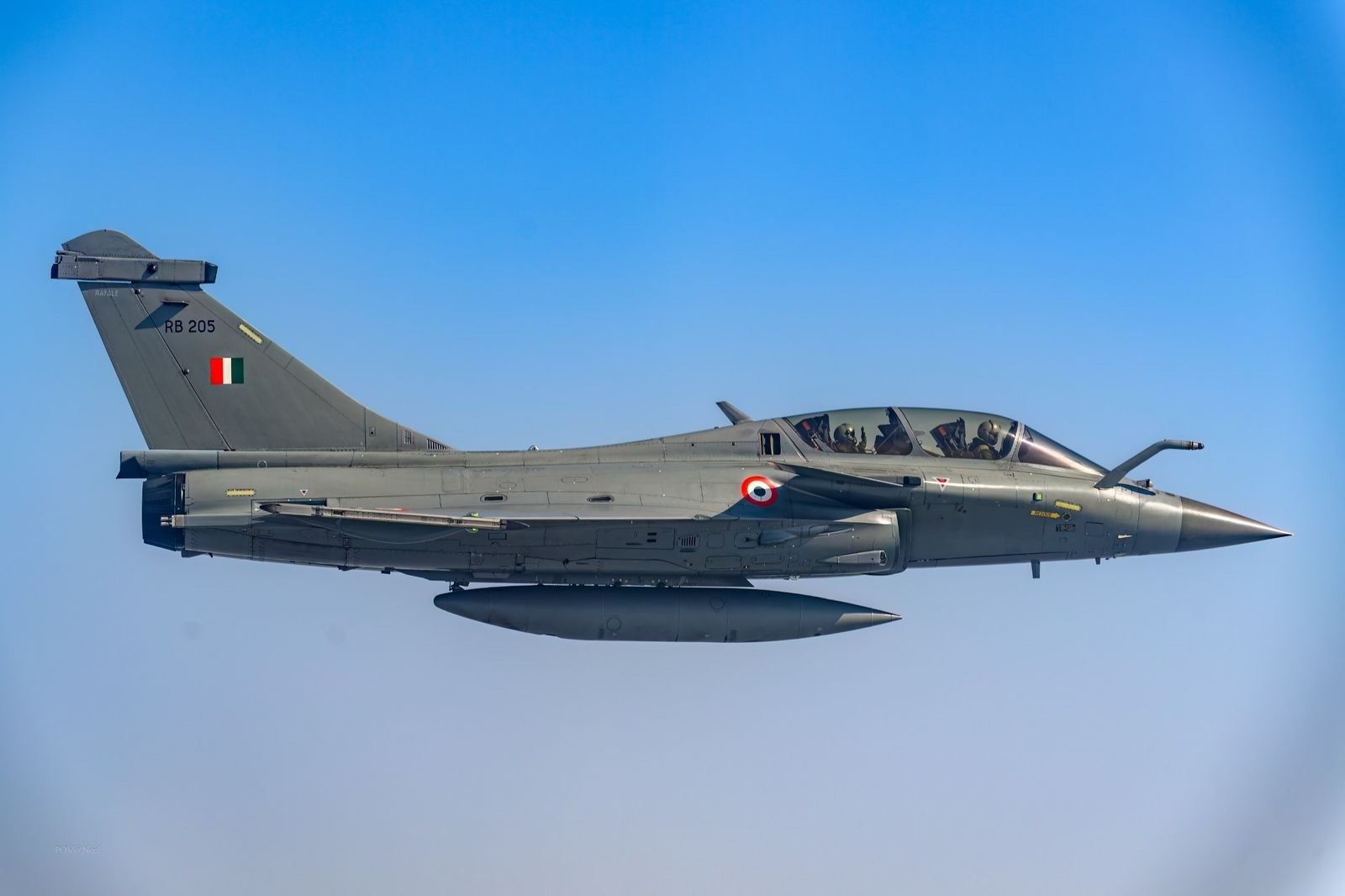
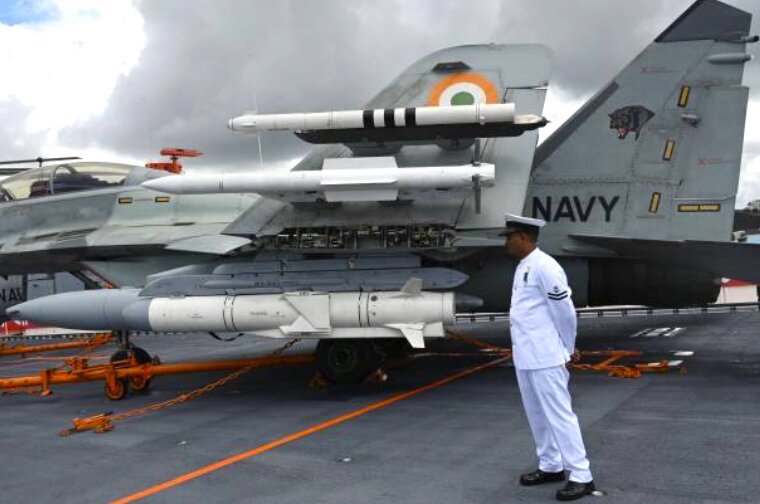
 An Indian Navy MiG-29K on INS Vikrant. (Photo via Facebook)
New Delhi: The Naval Armament Inspectorate (NAI) in Goa has issued an expression of interest (EoI) seeking Indian companies to indigenously design, develop, and manufacture the 80mm aero rocket currently used by the Navy’s MiG-29K and MiG-29KUB carrier-based fighters. The EoI, dated May 26, marks another step in the Navy’s push to cut dependence on foreign-origin munitions.
The rocket in question is an unguided, air-to-ground weapon fired from B8M-1 pod launchers fitted to MiG-29K aircraft that operate from INS Vikramaditya. The Navy’s entire inventory of the munition has so far been procured from a foreign original equipment manufacturer (OEM), and no indigenous source currently exists. The EoI states that the objective is to develop an exact form-fit-function equivalent and simultaneously establish a domestic production line.
What the rocket does
The 80mm aero rocket is a dual-purpose munition. Fitted with a hollow-charge fragmentation warhead, it is designed to defeat armoured targets such as tanks and armoured personnel carriers, as well as unarmoured targets including radar installations, parked aircraft, and troop concentrations. An inert practice variant, carrying the same ballistics, mass, and dimensions as the live round, is used for aircrew training.
The rocket is 1,528–1,542mm long, weighs 11.3kg, and carries a 3.6kg warhead of which 0.9kg is explosive fill. It reaches a maximum speed of 600 metres per second and has an effective range of 1,300 to 4,000 metres. Armour penetration is rated at 400mm at a 90-degree impact angle, and the fragmentation jacket produces a minimum of 400 splinters of approximately 3 grams each. Propulsion is provided by a single-grain, flash-less solid propellant charge weighing 3.1kg, with a burn-out time ranging from 0.45 seconds at +60°C to 1.3 seconds at -60°C.
The warhead is initiated by a piezoelectric contact fuse that arms between 1.1 and 1.7 seconds after launch, providing a safety window during the initial phase of flight. Fuse reliability is specified at above 0.98 at a 95% confidence level.
What Navy wants
The EoI lays out a demanding set of eligibility conditions. Respondents must be Indian companies with a proven track record in designing and manufacturing military-grade aero rockets or ground-based rockets, with the R&D infrastructure, testing facilities, and financial capacity to carry out the full development cycle. Crucially, all sub-assemblies must be developed indigenously; no dependence on the foreign OEM will be permitted.
Firms will be required to obtain airworthiness certification from the Centre for Military Airworthiness and Certification (CEMILAC) and must hold the necessary licences for filling, storing, and handling explosives. Vendors shortlisted as technically compliant will have to supply prototype quantities on a no-cost, no-commitment basis for trial evaluation. The Navy makes clear that no financial liability rests with it if a developed item fails qualification or acceptance trials.
The rocket must meet a rigorous set of military standards, including MIL-STD-810G/H for environmental ruggedness and MIL-STD-461F/G for electromagnetic compatibility. It must function across a temperature range of –60°C to +60°C, survive storage conditions up to 100% humidity, and operate at aircraft ceilings of up to 17,500 metres. Shelf life is set at a minimum of 15 years.
Numbers and timeline
Once a prototype successfully completes qualification trials, the Navy intends to procure 273 high-explosive rounds and 2,400 practice/inert rounds as an initial batch. Induction is tentatively planned for 2026–27.
Responses to the EoI must reach NAI Goa by June 20. Firms seeking clarifications may contact Commander Ankit Mangla, chief inspector of Naval Armament, at NAI Goa by June 10. Companies wishing to undertake a study visit to the armament inspectorate must apply at least 10 days in advance to obtain security clearance. All documents shared under the EoI are subject to a non-disclosure agreement.
Part of broader plan
The initiative reflects a wider trend across the armed forces to localize production of ammunition, rockets, and missile systems that have traditionally relied on foreign supply chains. The MiG-29K fleet has faced persistent scrutiny over supply chain vulnerabilities tied to its Russian-origin systems, and the Navy has recently moved on multiple fronts to address this — including separate indigenization drives for critical airframe subsystems.
On the weapons side, the indigenous NASM-MR medium-range anti-ship missile has already been successfully integrated with the MiG-29K, with developmental flight trials having commenced earlier this year. The 80mm rocket programme adds unguided ground-attack munitions to the list of capabilities the Navy wants produced domestically, targeting a segment of aerial ordnance manufacturing that has so far seen little indigenous participation.
Follow us on social media for quick updates, new photos, videos, and more.
X: https://x.com/indiasentinels
Facebook: https://facebook.com/indiasentinels
Instagram: https://instagram.com/indiasentinels
YouTube: https://youtube.com/indiasentinels
© India Sentinels 2026-27