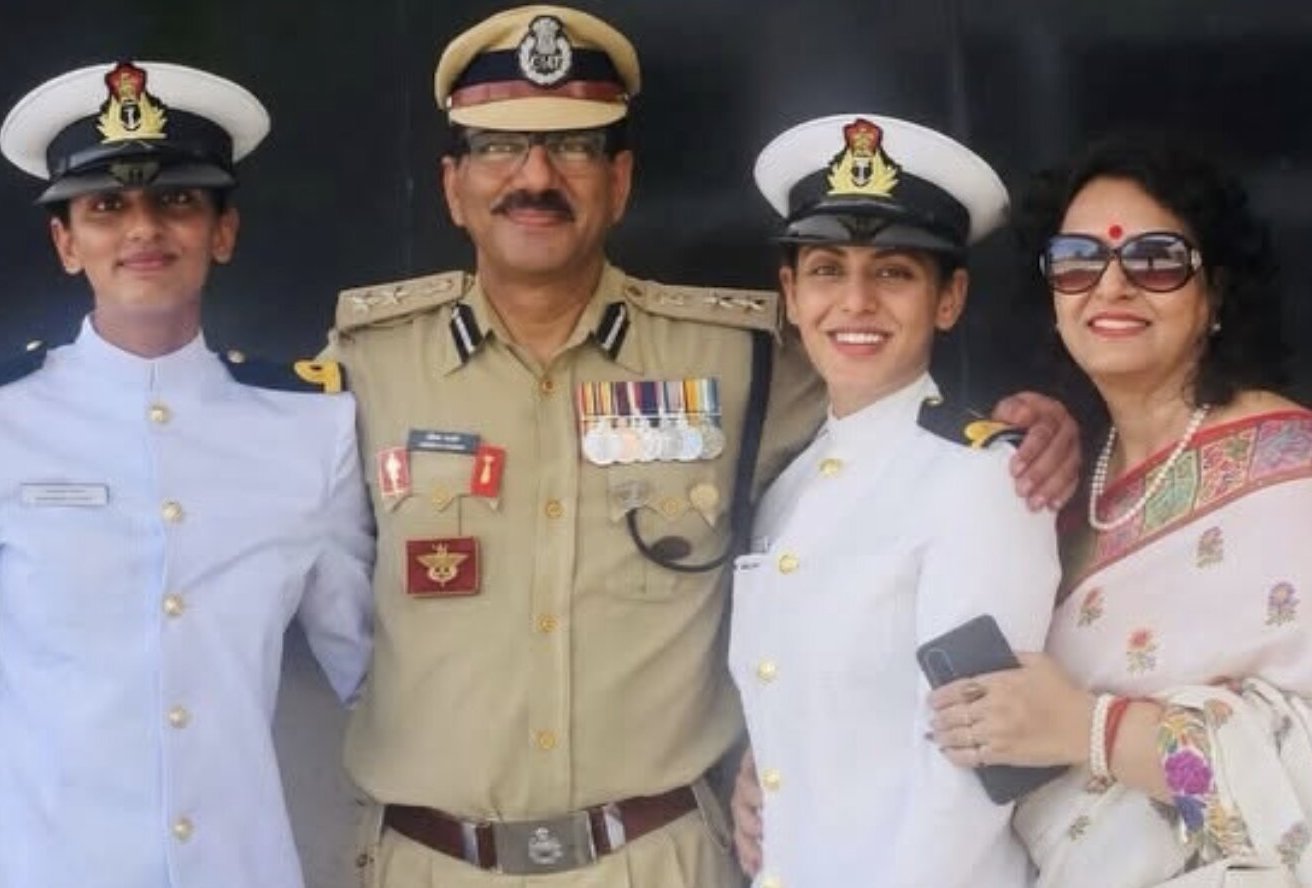
 Sub Lieutenant Astha Tyagi (L) and Sub Lieutenant Akanksha Tyagi (3R) with their parents. (Photo: Facebook/Doon Defence Academy)
New Delhi: When Sub Lieutenant Akanksha Tyagi passed out of the Indian Naval Academy at Ezhimala, Kerala, last week, her elder sister Sub Lieutenant Astha Tyagi was watching in the audience – already wearing the same white uniform she had earned at the same academy a year earlier. For a family from Ghaziabad, Uttar Pradesh, with no prior military tradition, it was a moment that quietly rewrote its own history.
The two sisters, whose father is a Central Industrial Security Force commandant and mother an advocate, have become the first members of the Tyagi family to join the armed forces – and they have done so in back-to-back years, through different entry streams of the Indian Navy, a coincidence that speaks as much to individual determination as it does to the household in which they were raised.
Astha, the elder of the two, took the longer and harder road. A law graduate with a postgraduation in constitutional law from Rajiv Gandhi National University of Law, Patiala, she entered the Navy through the JAG (Judge Advocate General) cadre – a route that demands both academic rigour and the kind of mental resilience that most defence aspirants test once or twice before moving on. Astha appeared before the Services Selection Board seven times and received a recommendation each time, a record that is as unusual as it is telling. She also secured all-India rank 4 in the Army JAG entry but chose the Navy’s whites over the Army’s olive green.
Akanksha, who completed her schooling alongside her sister at DAV Public School in Sreshtha Vihar, Delhi, took a different academic path – a BTech in computer science with a specialization in artificial intelligence and machine learning – and entered the Navy through the Naval Armament Inspector (NAI) cadre, a technically demanding branch that oversees the testing, storage and maintenance of naval weapons and ammunition. Her selection reflects a growing trend within the Navy of recruiting officers with strong technology backgrounds as the service modernizes its weapons systems and integrates AI-driven capabilities into operational platforms.
Both sisters credit the National Cadet Corps for much of their early grounding. Astha attended the Republic Day Camp in 2018, where she was adjudged best cadet (Senior Wing Army) from the Delhi Directorate, and later represented India in the Youth Exchange Programme in Russia the same year. Akanksha, following the same trajectory, earned her NCC “C” certificate with an A grade and attended multiple training camps including the Pre-RDC. The NCC, long regarded as a feeder institution for defence recruitment, has played a visible role in shaping both sisters’ careers – a point worth noting at a time when the corps’ funding and reach are periodically debated at the policy level.
Their sporting backgrounds are equally substantive. Astha represented Delhi in multiple disciplines – badminton, basketball, handball and tchoukball – at the School Games Federation of India nationals and at senior and junior national-level competitions. Akanksha earned a gold medal in badminton and competed at the SGFI nationals in tchoukball.
The family environment from which both officers emerged is itself notable. Their mother, Sushma Tyagi, has practiced at the Delhi high court for 25 years and is a qualified international mediator. She was herself an NCC cadet, attended the Republic Day Camp, holds the NCC “C” certificate with an A grade, and played netball at national level and cricket at state level. Their father, a senior commandant in the CISF, has served with the National Security Guard and holds the president’s award for distinguished service – among the highest honours within the paramilitary framework.
The Indian Naval Academy at Ezhimala, from which both sisters were commissioned, is among Asia’s largest naval academies. Spread over roughly 2,500 acres on the Kerala coast near the Karnataka border, it was inaugurated in 2009 and has since become the primary institution for training naval officers across executive, technical and specialist cadres. The academy follows a rigorous academic and physical training programme before the passing-out parade that formally commissions officers into the Navy.
Women officers in the Navy have, in recent years, been granted permanent commission across an expanding range of branches and cadres, a policy shift that has gradually broadened operational and career opportunities. Sub Lieutenant Astha Tyagi’s entry into the JAG cadre and Sub Lieutenant Akanksha Tyagi’s selection into the NAI cadre both sit within this wider institutional opening, even if their individual journeys were driven by something far more personal than policy.
What distinguishes this story is not simply that two sisters from the same family joined the same service. It is the texture of the journey – the years of SSB attempts, the NCC camps, the sports competitions, the academic choices, the elder sister’s persistence becoming the younger one’s reference point. That kind of momentum, within a single family and across a single generation, is worth marking.