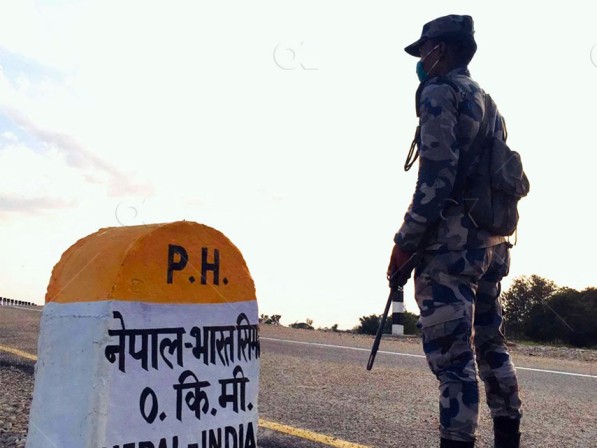
 India-Nepal border. (File photo)
For most of the modern era, the Himalayas have served as India's natural northern rampart. But mountains do not defend themselves, and the 1,751-kilometre open border India shares with Nepal means that Kathmandu's strategic choices are, in effect, New Delhi's strategic exposure. As the contest between India and China hardens across the high frontier, one question can no longer be deferred: can Nepal's cherished doctrine of balanced neutrality survive a Himalayas that two giants are racing to militarise?
A partnership written into the ranks
The India-Nepal security relationship is not a treaty of convenience; it is woven into the institutions of both states. The 1950 Treaty of Peace and Friendship and the 1947 Tripartite Agreement created an open border and a shared military tradition that endures today in roughly 32,000 Nepali Gorkhas serving across seven Gorkha regiments of the Indian Army. Since 1950, the two nations have conferred the honorary rank of General on each other's army chiefs, a gesture of trust with few parallels anywhere.
That trust is operational, not ceremonial. The annual Surya Kiran exercise, now in its nineteenth edition, trains the two armies together in counter-terrorism and high-altitude warfare, while India's Operation Maitri after the 2015 earthquake showed how quickly cooperation converts into rescue. India has also long underwritten the Nepal Army's modernisation through equipment and training. This is the architecture that a drift toward Beijing would quietly dismantle.
What China is building on the other side
To understand the danger, look north of the Nepal-Tibet line. Over the past decade, China has bound the Tibetan plateau to its war machine: close to 30 dual-use airports across Tibet and Xinjiang combined, a high-speed rail line pushed to Nyingchi near Arunachal Pradesh, and a belt of "well-off" border-defence villages whose Party cadres double as instruments of surveillance and political control. The contrast at the frontier is stark: paved highways, military outposts and full-spectrum monitoring on the Tibetan side; on the Nepali side, outposts like Hilsa that remain difficult to access and poorly connected by road.
More troubling for Nepal's sovereignty, a 2021 internal Nepali government report obtained by the Associated Press found that China had installed surveillance systems inside Nepal, including in border buffer zones where construction is banned by bilateral agreement. A "China-Nepal joint command mechanism" now coordinates border patrols, residents of Lo Manthang have been pressured to remove images of the Dalai Lama from shops, and researchers have documented quiet Chinese encroachments in Humla. This is what Beijing's "friendship" looks like up close: a digital dragnet that does not stop at the border and a definition of security that treats Tibetan Buddhism itself as a threat.
Why India's defence runs through Kathmandu
For India, the nightmare is not Chinese soft power but Chinese hardware. If Nepal were to host Chinese surveillance nodes, dual-use airstrips or logistics hubs, the People's Liberation Army would gain a southern vantage point over the Indian plains and a second axis of pressure to complement the Line of Actual Control. Nowhere is this more acute than the Siliguri Corridor, the 20-to-22-kilometre "Chicken's Neck" that is India's only land bridge to its northeastern states. Beijing's interest in this sliver is no longer abstract: a BRI project cleared in Jhapa in December 2024 and a proposed Nepal-China Friendship Industrial Park sit uncomfortably close to that bottleneck.
The wider Trans-Himalayan railway Beijing dangles before Kathmandu carries the same logic that produced the China-Pakistan Economic Corridor: connectivity today, leverage tomorrow. Nepal's experience so far suggests the bargain is lopsided; nearly a decade after signing onto the BRI, Nepal has little to show on the ground but a great deal of strategic obligation.
None of this is an argument for Nepal to surrender its sovereignty or its access to China's market. It is an argument that genuine neutrality requires a balance China is no longer offering. Balanced non-alignment assumes two neighbours who both respect Nepal's borders and freedoms. One of them is building villages on contested ground, watching Nepali citizens through imported cameras, and has left the joint boundary-inspection mechanism frozen since 2006. The other shares Nepal's temples, its soldiers and its disaster responders.
Nepal's politics are now unusually fluid. The Gen Z protests of 2025 swept away the old order, and the 2026 election that brought Balendra Shah to power offers a rare chance to set foreign policy on first principles rather than factional tilt. That reformist instinct should extend to strategy, because neutrality that ignores an asymmetry of intentions is not neutrality but slow drift.
A stable, sovereign, genuinely non-aligned Nepal is unambiguously in India's interest and in Nepal's. The threat to that equilibrium is not coming from the south. It is being poured in concrete and fibre-optic cable on the Tibetan plateau. For India's northern defence, and for Nepal's own independence, the line that must hold is not on any map. It is the principle that no outside power gets to turn the roof of the world into a watchtower.