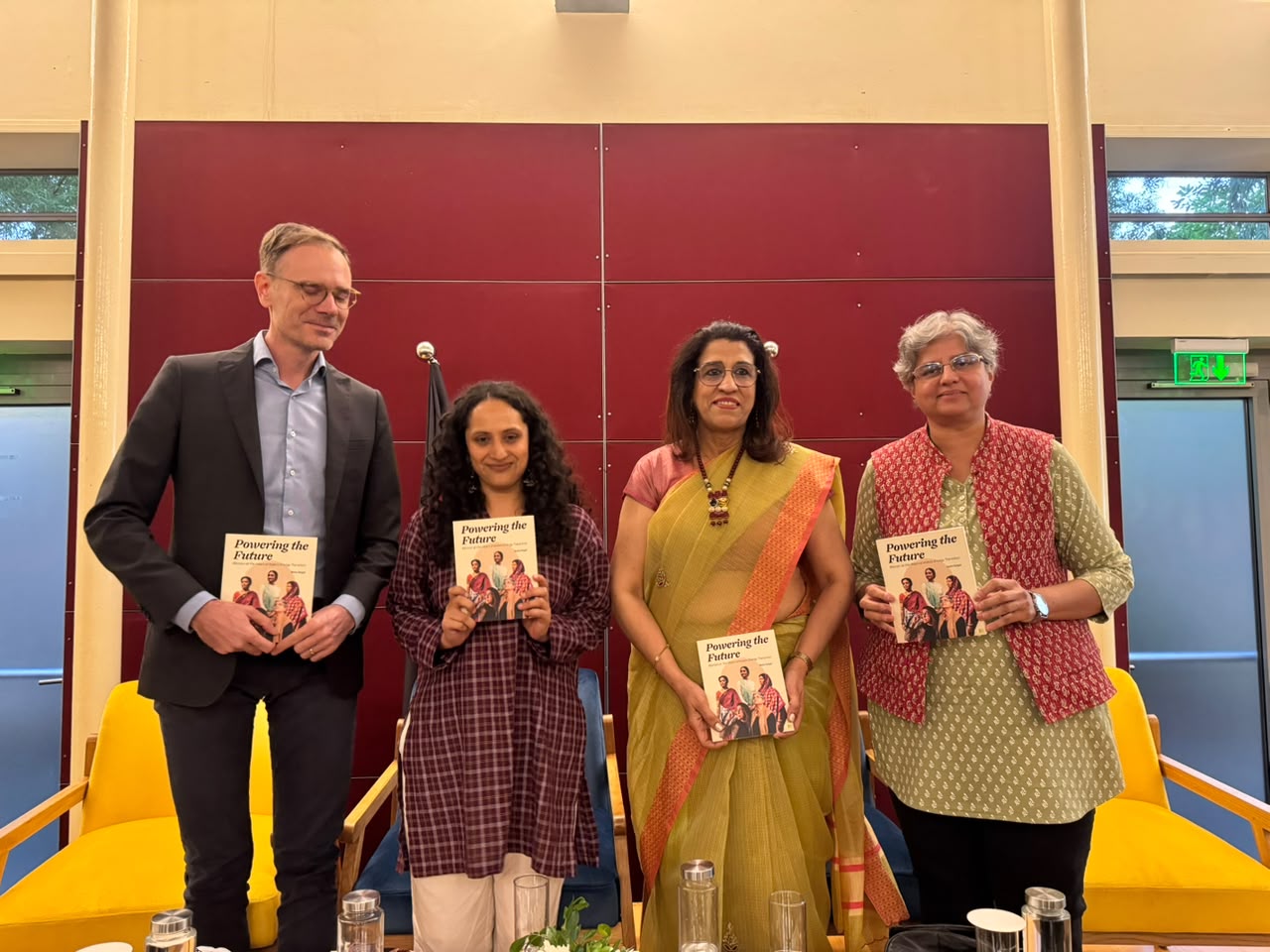
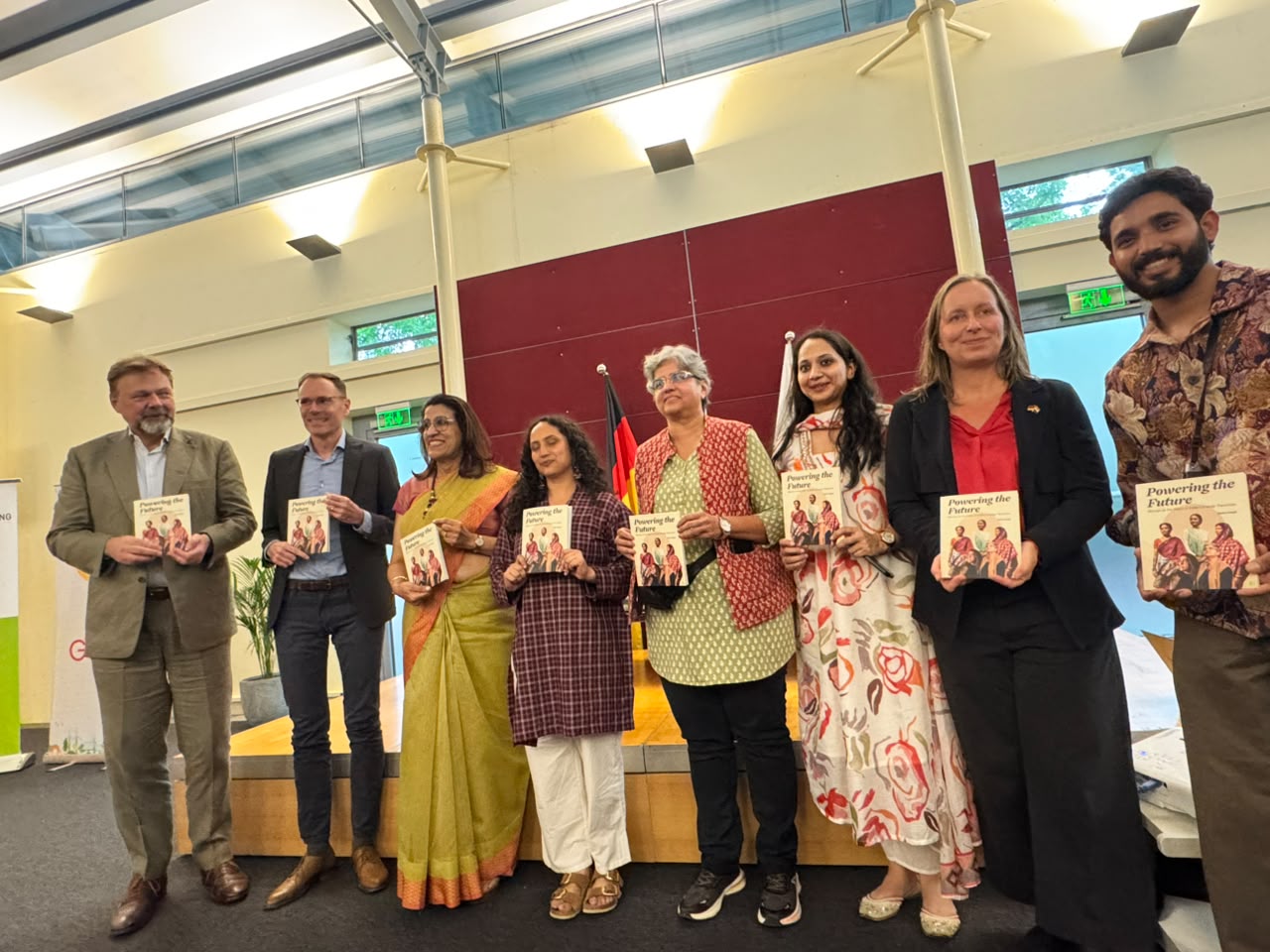
 Panelists at India-Germany climate talks. (Photo: German Embassy in Delhi)
New Delhi: Women must be recognized as innovators, entrepreneurs, researchers, community leaders and decision-makers if India’s clean energy transition is to succeed, experts said at the latest edition of the India-Germany climate talks, hosted by the German embassy in New Delhi on Thursday.
The event marked the launch of a book, ‘Powering the Future: Women at the Heart of India’s Energy Transition’, written by Neha Saigal, co-founder of Intertidal Lab and the Climate & Care Initiative in Bengaluru, and published by the New Delhi office of the Heinrich Böll Stiftung, a German political foundation.
Drawing on case studies from Odisha, Punjab, Jharkhand, Maharashtra and Tamil Nadu, the book documents women driving sustainable energy solutions across the country and argues that gender should be a core pillar of climate and energy policy rather than a peripheral concern.
Opening the discussion, the German ambassador to India, Philipp Ackermann, said a gender-responsive energy transition was as much an economic opportunity as a matter of equality. India’s renewable energy drive, he said, could unlock new markets, create jobs and spur innovation if women had equal access to resources, decision-making and leadership.
Read also: Why extreme weather has become a global security threat
He described the transition as “a gender-responsive energy transition is not just good for gender equality – it is an economic opportunity.”
Ackermann added that the Indo-German Partnership for Green and Sustainable Development was intended to build a transition that was people-centred and inclusive, and not focused on technology alone.
A panel discussion followed, moderated by Jochen Luckscheiter, director of the Heinrich Böll Stiftung’s New Delhi office. The panellists were Priyadarshini Karve, founder of Samuchit Enviro Tech and chief executive of the Clean Energy Access Network in Pune; Amrita Rana, a radiologist and director of Rana Diagnostics who is also a founding member of Clean Air Punjab; and Saigal, the book’s author.
The discussion examined the opportunities and obstacles women face across the energy sector, from research and entrepreneurship to community leadership and policymaking. Panellists said an equitable transition would depend on ensuring women had fair access to finance, technology and leadership positions.
Saigal said India’s energy transition offered a chance to place gender at the centre of policy rather than treat it as an afterthought. Women, she said, were central to energy systems as users, carers and providers of livelihoods, and their experience should shape the transition.
She argued that India was not undergoing a single energy transition but several, each shaped by local conditions, and that the shift away from fossil fuels should not reproduce existing inequalities.
Karve spoke about her work at the intersection of science, entrepreneurship and decentralized renewable energy, and the case for expanding access to clean energy while creating room for women to lead in innovation and enterprise.
Rana discussed the links between public health, clean mobility and climate action, saying community engagement and women’s leadership could speed up the shift to cleaner transport and improve air quality in Indian cities.
Luckscheiter said tackling climate change required not only technological innovation but also greater inclusion and representation within the energy sector. Panellists agreed that India’s energy transition offered a chance to advance climate action, economic development and gender equality together, and that embedding gender-responsive approaches into energy planning would be critical to a just and resilient transition.
The gap the panel described is well documented. Women account for about 11% of India’s renewable energy workforce, against a global average of 32%, according to research by the International Energy Agency and India’s Council on Energy, Environment and Water.
Both organizations have found that the limited number of women in the sector are concentrated in administrative and non-technical roles, with far fewer in engineering, operations or senior leadership. The Council on Energy, Environment and Water has estimated that closing such gender gaps in the workforce could add trillions of dollars to India’s economy by the middle of the next decade.