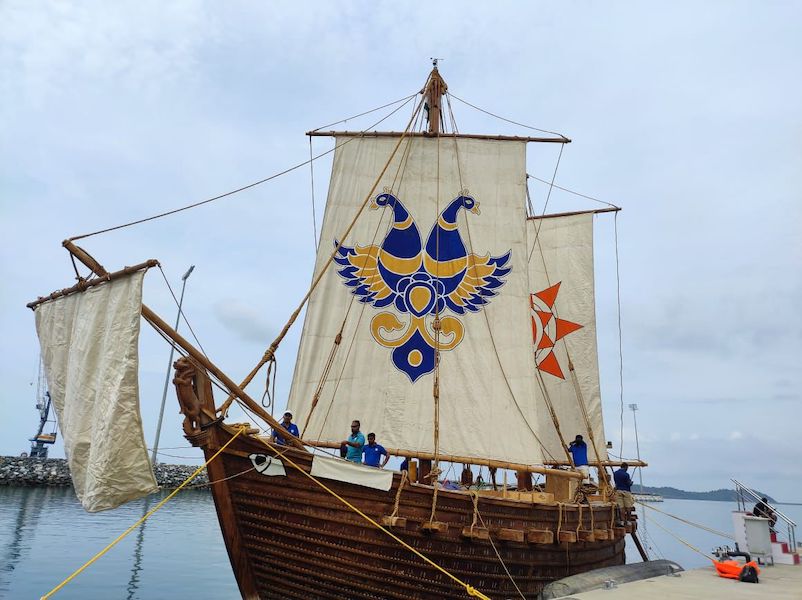
 INSV Kaundinya (File photo)
— By Cdr Neeraj Vashisth
“Be it for spices, beads, jewellery, cotton, or the richness of our culture, the thriving sea-lanes served as bridges of commercial and intellectual exchange. For centuries, this nurtured global trade, providing a pathway to the growth and prosperity of many nations.”
— Prime Minister Narendra Modi
India’s maritime traditions date back to Vedic times, and perhaps even earlier. The tablets discovered at Harappan sites remain undeciphered, leaving tantalizing possibilities about our ancient seafaring prowess.
While researching my first book, “Ayodhya to Ayutthaya”, which explores the deep socio-cultural relations between India and Southeast Asia, particularly India and Thailand, I experienced an instant and profound realization of India’s historical connection to global trade networks via the oceans. The Government of India’s initiatives to revive India’s maritime heritage and place it firmly on the world map were impossible to miss. In this essay, I share some of these remarkable stories.
A Ship Stitched with History
In the near future, INSV Kaundinya, a reconstruction of a 5th-century stitched ship inspired by paintings in the Ajanta Caves, will set sail from Porbandar to Oman. The vessel’s unique design employs the traditional nail-less shipbuilding technique using coconut fibre, a method that has survived through oral traditions and archaeological evidence.
However, the most absorbing aspect of this project lies not in its construction but in its purpose: to revive maritime consciousness and instill a sense of pride by recreating historical voyages and promoting cultural memories. INSV Kaundinya represents more than a vessel; it embodies a nation reconnecting with its oceanic identity.
The Legend That Sailed Across Seas
During my visit to Cambodia, my guide introduced me to three notable statues in Sihanoukville, a southern province. I was particularly drawn to the 21-metre-tall statue of an Indian prince and Cambodian princess – the largest copper statue in Cambodia.
The story of the Indian prince Kaundinya sailing to Cambodia and marrying the Naga princess Soma forms part of common folklore in southern Cambodia. This legendary voyage ushered in an era of India’s historic connection with Southeast Asia through both land and sea routes.
Consequently, many ancient kingdoms – including the Champa Kingdom, Kambojadesa, and the Khmer civilization – owe their spiritual and cultural origins to Indian Hinduism, developed on the coasts of contemporary Vietnam and Cambodia. The legend of Kaundinya, however, is not an isolated tale. INSV Kaundinya may well be the first of many such commemorative voyages.
Princess Suriratna’s Sacred Journey
Around the same time as the legendary Kaundinya, Princess Suriratna travelled via sea route from Ayodhya to Korea to marry King Suro, who had been divinely instructed to expect her arrival. Her legacy forms a significant part of the cultural heritage for millions of descendants bearing the surnames Heo, Kim, and Kimhae in South Korea today.
A friend from South Korea once told me he considers Ayodhya his ancestral maternal home. The former first lady of Korea made efforts to visit Suriratna’s memorial at Ayodhya in 2018. During my recent visit to Ayodhya, I was unsurprised to witness Suriratna’s memorial drawing considerable tourist interest.
Given that reviving ancient maritime routes stands as the principal aim of INSV Kaundinya’s commission, she may well be deployed in the near future to recreate the ancient maritime route between India and Korea, sailing in the wake of Princess Suriratna’s momentous journey.
Great Maritime Networks
Centuries after Kaundinya, two major ports – Mahabalipuram (also known as Mamallapuram) and Quanzhou – became vital connecting links of trade and cultural exchange between India and China during the reign of the Pallava dynasty. Maritime connections and trade routes weren’t merely commercial arteries; they were conduits of philosophy, art, architecture, and spiritual exchange.
It was both diplomatic astuteness and these historic maritime connections that led to the selection of Mahabalipuram as the venue for the informal summit between Prime Minister Narendra Modi and China’s president, Xi Jinping, in October 2019. The Pallavas were followed by the great Chola empire, whose naval expeditions to Southeast Asia are well documented and celebrated in Tamil literature and temple inscriptions.
The Chola navy represented one of the most formidable maritime forces in medieval Asia, with Rajendra Chola I’s naval expedition to Southeast Asia in the 11th century demonstrating India’s blue-water capability centuries before European powers ventured into Asian waters. There are numerous ancient maritime routes which INSV Kaundinya may chart, one voyage at a time.
Initiatives for Maritime Revival
To give credit where it is due, the Government of India has commissioned numerous initiatives and projects aimed at spreading consciousness about our rich maritime heritage and fostering economic opportunities from the maritime sector in recent years.
Maritime India Vision 2030, Maritime Amrit Kaal Vision 2047, the Sagarmala Project, Project Mausam, and the National Maritime Heritage Complex project represent some of the major initiatives taken in the last decade. During the ‘Monsoon’ international conference held at the Indira Gandhi National Centre for the Arts, Delhi, in 2024, I witnessed the scope and ambition behind Project Mausam, where we discussed the revival of Chola expedition routes among other subjects.
Project Mausam, in particular, seeks to reconnect India with nations across the Indian Ocean world through a network of cultural and economic linkages, acknowledging that monsoon winds once dictated the rhythm of trade and cultural exchange across vast oceanic distances.
Navy’s Role in Maritime Consciousness
For obvious reasons, the Indian Navy has been associated with all these projects, aiming to spread awareness about India’s maritime legacy while securing maritime borders. For long, we accepted the limitation of reaching out to people in non-coastal areas, as the majority of naval bases and stations are naturally located in coastal regions.
However, in recent years, the Navy has undertaken numerous initiatives to increase outreach and awareness about our rich maritime heritage. With ingenuity and clear objectives, the Navy has commenced conducting annual operational demonstrations on both the east and west coasts at locations beyond where naval stations are situated, bringing the blue uniform to India’s heartland.
To spread awareness among students, the Navy has been conducting a national-level quiz competition with maritime themes to engage schools from across the country. With rising awareness about our maritime legacy, car rallies, motorcycle expeditions, and motivational lectures, seminars, and conferences conducted by the Navy nationwide are widely subscribed and viewed on social media platforms.
Building Monuments to Maritime Memory
The Navy is deeply involved in the National Maritime Heritage Complex project at Lothal, Gujarat – the site of one of the most prominent cities of the Indus Valley Civilization, which possessed a sophisticated dockyard as early as 2400 BCE. During my visit to the complex, I found the sheer scale, research, and purpose behind the project truly intriguing.
The site will showcase India’s maritime heritage spanning over 5,000 years, from the Harappan era to the present day, through 14 themed galleries, a museum, and a full-scale recreation of ancient ships.
Beyond the National Maritime Heritage Complex, the Navy is spearheading construction of Nausena Shaurya Vatika and Nausena Sangralaya at Lucknow in collaboration with the state government, bringing naval heritage to Uttar Pradesh, India’s most populous state far from any coastline.
The Navy is also pursuing the establishment of naval sailing nodes at several locations across the country to increase awareness about maritime activities. In the same vein, the Navy, in partnership with the Ministry of Culture and Hodi Innovations, commissioned INSV Kaundinya.
A Trailer for Stories Untold
The fact is that India’s maritime heritage is colossal and rich, and the Navy occupies a central position in calling attention to this magnificent legacy. In the context of India’s ageless maritime traditions, there are numerous mariners like Kaundinya waiting to have their stories told. There are endless narratives hidden in the paintings at Ajanta Caves. There are numerous caves like Ajanta scattered across India, each holding fragments of our maritime past.
My intuition – which has earned appreciation in my circle – is that Kaundinya is merely a trendsetter, or perhaps a trailer for an epic yet to unfold. We may well be living through some of the finest moments in the revival of India’s maritime heritage.
The oceans that once carried our merchants, scholars, and adventurers to distant shores are calling us back. INSV Kaundinya’s journey will not merely recreate a historical voyage; it will chart a course for a maritime-conscious India, reminding us that we are not just a land-based civilization but a nation whose identity has been profoundly shaped by the seas that embrace our vast coastline.
As the vessel sets sail, it carries with it not just the memory of ancient mariners but the aspirations of a nation rediscovering its place in the Indian Ocean world – a world that India helped create, sustain, and enrich for millennia.
About the author: Commander Neeraj Vashisth is an alumnus of NDA 121 course. He is an anti-submarine warfare specialist. He has authored two books “Ayodhya to Ayutthaya” and “Kim and Krishna”. He takes keen interest in maritime affairs.
Disclaimer: The views expressed in the article are the author’s own and don’t necessarily reflect the views of India Sentinels.
Follow us on social media for quick updates, new photos, videos, and more.
X: https://x.com/indiasentinels
Facebook: https://facebook.com/indiasentinels
Instagram: https://instagram.com/indiasentinels
YouTube: https://youtube.com/indiasentinels
© India Sentinels 2025-26