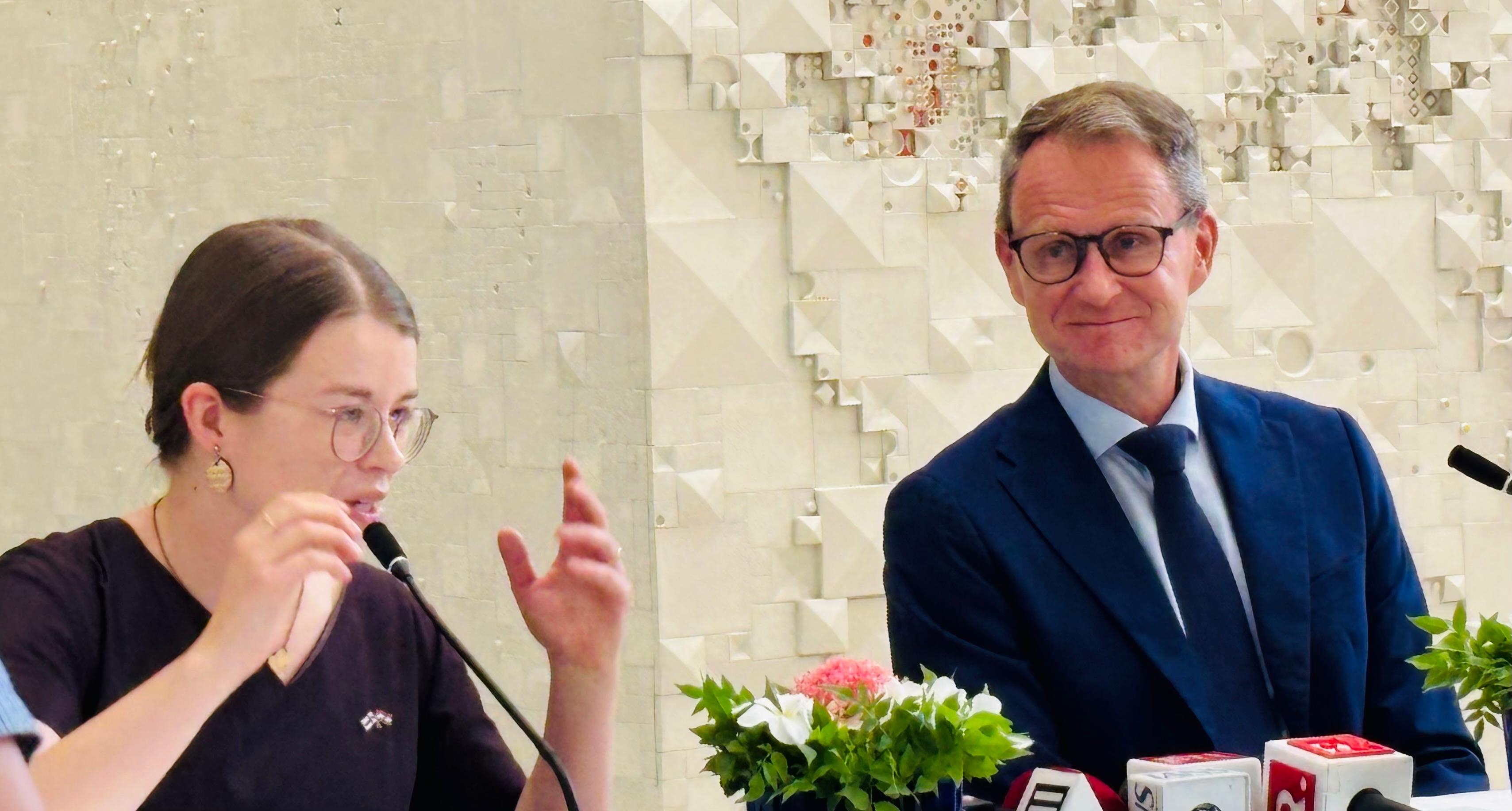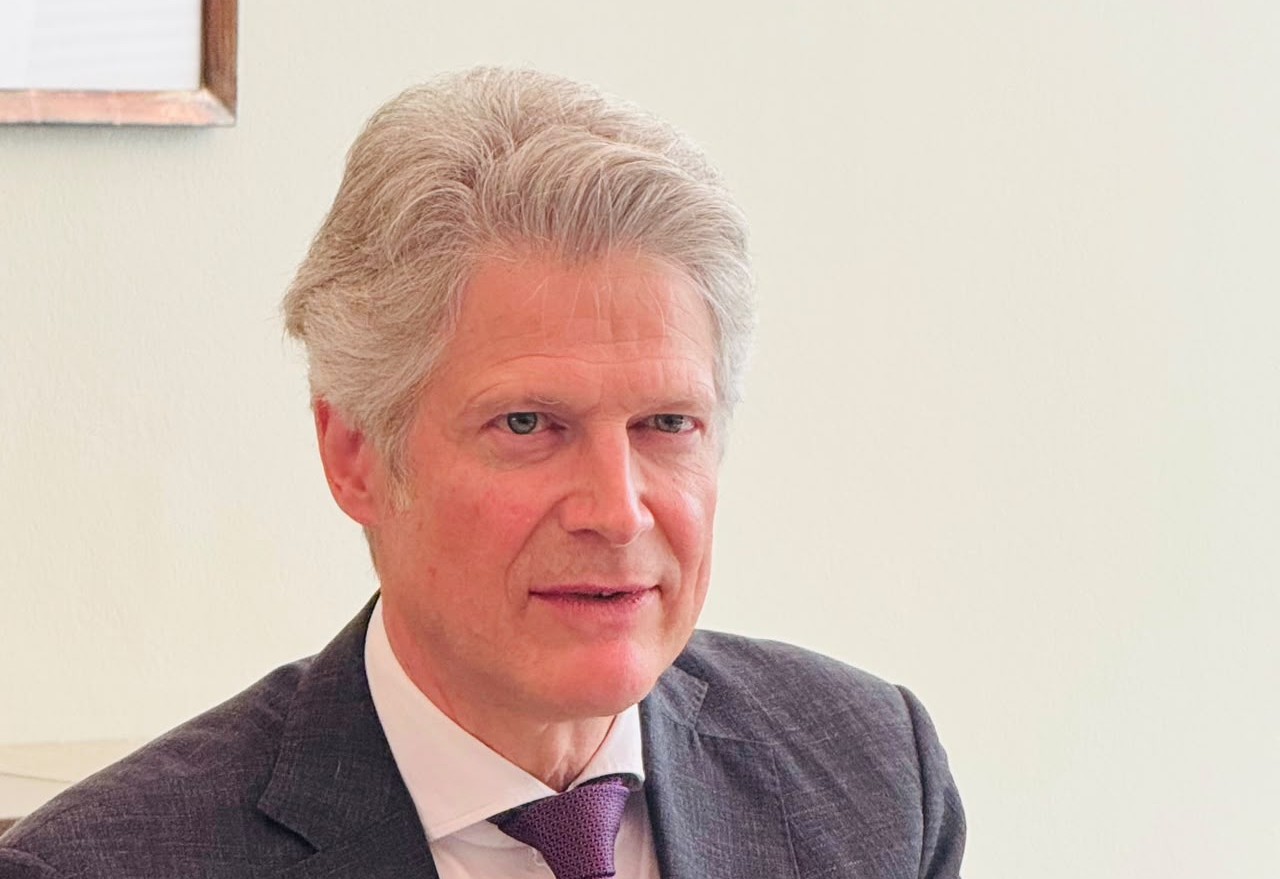
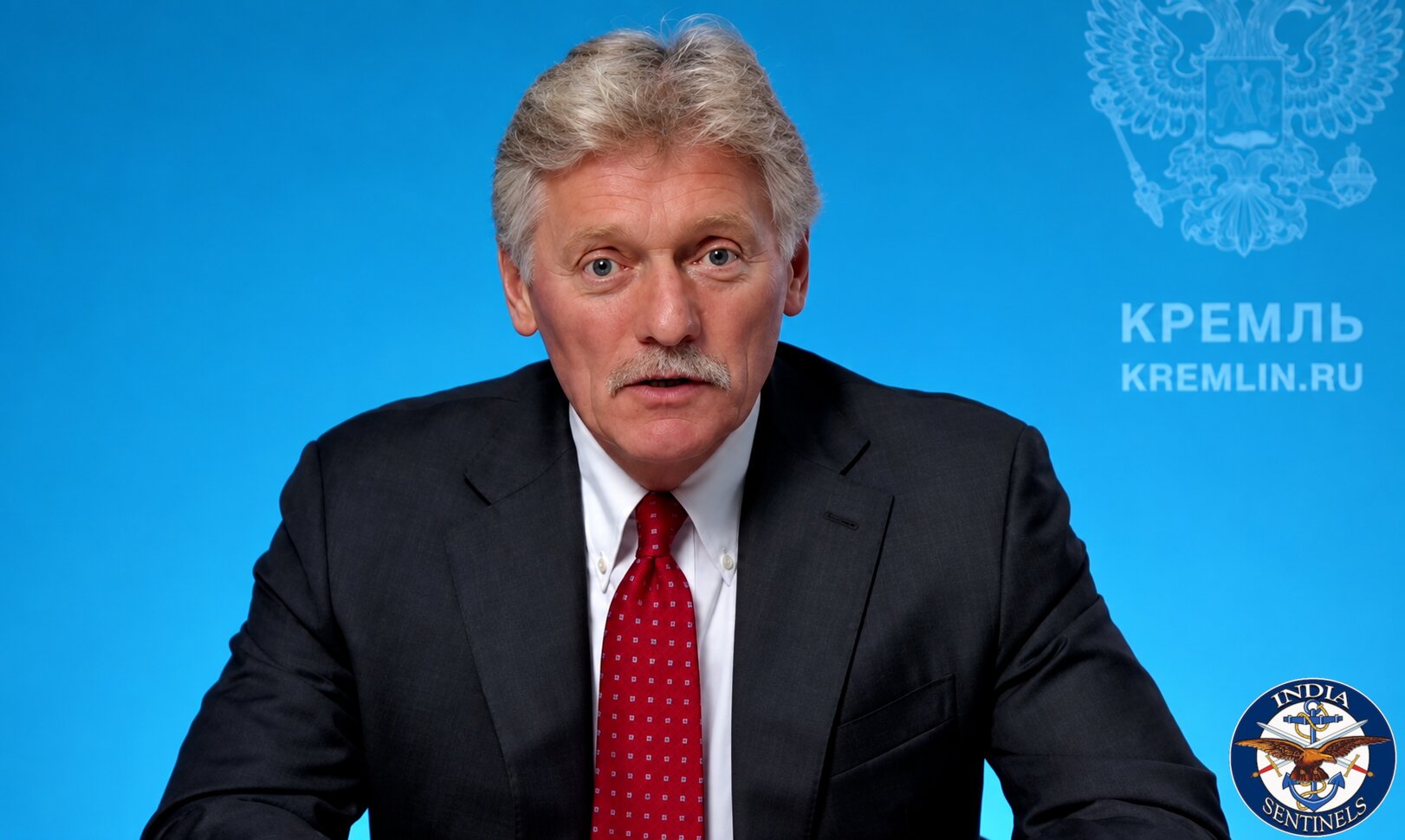
 Dmitry Peshkov during his virtual news conference with Indian journalists in New Delhi. (India Sentinels photo)
New Delhi: The prime minister, Narendra Modi, and the president of Russia, Vladimir Putin, will hold bilateral talks in New Delhi on Friday, a day before the 18th BRICS Summit opens at Bharat Mandapam. The proposed sale of Russia’s Su-57 fighter, including the possible transfer of production technologies to India, is expected to feature prominently in the discussion, alongside trade, energy and civil nuclear cooperation.
The Kremlin spokesman, Dmitry Peskov, confirmed the meeting during a virtual briefing with Indian journalists on Tuesday. He said the two leaders would first work through the bilateral agenda before turning to matters concerning the wider grouping.
Peskov also used the briefing to defend BRICS against accusations that it functions as an anti-western platform, and to explain Moscow’s growing reliance on national currencies for trade. His comments, taken together, sketched out the themes that are likely to dominate both the Modi-Putin meeting and the summit that follows.
Su-57 sale and question of tech transfer
Peskov described the Su-57 as a “very, very sophisticated machine” and one of the best fighters in the world. He confirmed that its sale to India was on the bilateral agenda, and acknowledged that New Delhi was seeking access to the aircraft’s production technologies.
He offered no specifics on what technologies were under discussion or how far talks had progressed. Peskov said such negotiations were inherently sensitive and were better conducted away from public view.
Countries that develop advanced military platforms generally prefer to keep the underlying technology to themselves, Peskov said. He added that Russia’s strategic partnership with India had nonetheless prompted Moscow to consider what could reasonably be shared with its Indian counterparts.
This suggests the talks go beyond a straightforward purchase of finished aircraft. Localization of components, licenced production and selective technology access all appear to be under consideration, reflecting India’s now-standard requirement that major defence acquisitions strengthen domestic manufacturing rather than simply add to the import bill.
The Su-57 is Russia’s twin-engine, low-observable multirole combat aircraft, built for both air-superiority missions and strikes against land and maritime targets. Moscow has been promoting its export variant, the Su-57E, as a near-term option for India as the Indian Air Force grapples with a shortage of fighter squadrons while the indigenous AMCA (advanced medium combat aircraft) remains some years from service.
Any Indian decision would still hinge on a detailed assessment of the aircraft’s stealth characteristics, sensors, engines and life-cycle costs. Control over mission systems, and the freedom to integrate Indian-origin weapons and avionics, are likely to weigh just as heavily in New Delhi’s calculations as the headline price of the deal.
Friday’s meeting builds on a conversation the two leaders held barely ten days earlier. Modi and Putin last met in Bishkek on August 31 on the sidelines of the Shanghai Cooperation Organisation summit, where they discussed trade, energy, defence cooperation and the safety of Indian seafarers operating in the Black Sea.
At that meeting, Modi urged Russia to move away from what he called an “endless war” and towards a resolution of the Ukraine conflict. India has consistently framed dialogue and diplomacy, rather than sanctions, as the only realistic route to a settlement.
Trade, energy and currency question
Economic ties will occupy a central place on Friday’s agenda. Russia-India trade reached a record $70 billion in 2024, before dipping in 2025 under the weight of tighter western sanctions, then recovering over the first half of 2026.
The two countries have set a target of $100 billion in bilateral trade by 2030. New Delhi, however, remains concerned about the imbalance created by its heavy imports of Russian oil, coal, fertilizers and defence equipment, and has pushed Moscow to buy more Indian pharmaceuticals, agricultural produce, engineering goods, textiles and information-technology services in return.
Payment mechanisms are likely to receive close attention, given how far western financial restrictions have complicated transactions involving Russian entities. Peskov said Moscow was not pursuing “de-dollarization” as a goal in itself, and that Russia remained open to any payment method acceptable to its partners.
According to Peskov, roughly 90 per cent of Russia’s payments with BRICS countries are now conducted in national currencies rather than the US dollar. He was careful to frame this as a response to circumstance rather than strategy.
“It’s not because we are aiming for de-dollarization, for getting rid of US dollars. No, to the contrary,” Peskov said. He argued that Washington’s own decision to cut Russia off from the dollar, not any Russian design, had pushed Moscow towards national currencies, adding pointedly that “America is ruining trust in US dollar.”
Energy cooperation is set to remain a fixture of the relationship. Moscow has assured New Delhi of continued crude oil and fertilizer supplies even as India faces diplomatic pressure from western capitals over its purchases of discounted Russian crude, a dynamic that has sharpened with renewed instability across West Asia.
Civil nuclear cooperation is also likely to come up. Russia’s Rosatom is building four additional VVER-1000 reactors at the Kudankulam Nuclear Power Plant in Tamil Nadu, after the first two units entered commercial service, and the two sides have discussed further collaboration on small modular reactors.
Ukraine remains the backdrop
The war in Ukraine will inevitably colour the talks, even if it is not their primary focus. India has neither endorsed Russia’s military campaign nor joined western sanctions, arguing instead that its energy purchases reflect national requirements and global market conditions rather than political alignment.
The external affairs minister, S Jaishankar, made a similar case in a recent meeting with Ukraine’s president, Volodymyr Zelenskyy, arguing that halting Russian oil imports would not by itself end the war. This reflects India’s longstanding policy of strategic autonomy: preserving ties with Moscow without foreclosing engagement with Washington and European capitals.
Peskov said Russia’s own position broadly aligned with India’s preference for a peaceful resolution. He said Moscow had not started the war and was instead trying to bring an existing conflict to a close, welcoming what he called India’s willingness to contribute and the efforts of the American president, Donald Trump.
He added that American negotiators had been shuttling between Moscow and Kyiv, and that Russia hoped for a resumption of three-way talks involving Moscow, Kyiv and Washington. Peskov was more sceptical about Ukraine’s own appetite for ending the fighting, suggesting that European governments pushing for Russia’s “strategic defeat” continue to encourage Kyiv to prolong the war.
Separately, Peskov criticized a proposed United States bill targeting countries that trade with Russia and Iran. He called it contradictory for Washington to engage Moscow diplomatically while simultaneously sanctioning third countries for doing business with it, describing such measures as illegal, unfair and unacceptable.
BRICS and ‘global majority’
Peskov rejected the characterization of BRICS as a bloc directed against the west, explicitly aligning himself with India’s position on the question. “We join India in not agreeing with those who say that BRICS are against some western countries. BRICS are for BRICS members,” he said.
He credited India with investing heavily in its current BRICS presidency, and singled the country out as the world’s most populous nation and largest democracy. Peskov argued that the existing unipolar order was losing competitiveness even as it resorted to harsher measures to sustain itself, contrasting this with what he termed the “global majority” seeking a system built on equal standing and freedom from unilateral sanctions.
India assumed the BRICS presidency on January 1, chairing the grouping for a fourth time under the theme “Building for Resilience, Innovation, Cooperation and Sustainability.” The bloc now comprises eleven full members, with Indonesia having joined as a full member in 2025, alongside ten partner countries associated with the grouping. Russia formally backed India’s chairship at the India-Russia annual summit in December 2025, and this year’s gathering also marks BRICS’s 20th anniversary since its founding.
Putin has confirmed his attendance at the summit, and China’s president, Xi Jinping, is also expected in New Delhi, underlining the scale of the diplomatic gathering India is hosting. The Modi-Putin meeting on Friday will therefore serve two purposes at once: testing whether Russia’s Su-57 offer comes with technology access substantial enough to satisfy India’s manufacturing ambitions, and setting the tone for a summit in which New Delhi is keen to project itself as a bridge between the global majority and the wider international order.
Follow us on social media for quick updates, new photos, videos, and more.
X: https://x.com/indiasentinels
Facebook: https://facebook.com/indiasentinels
Instagram: https://instagram.com/indiasentinels
YouTube: https://youtube.com/indiasentinels
© India Sentinels 2026-27