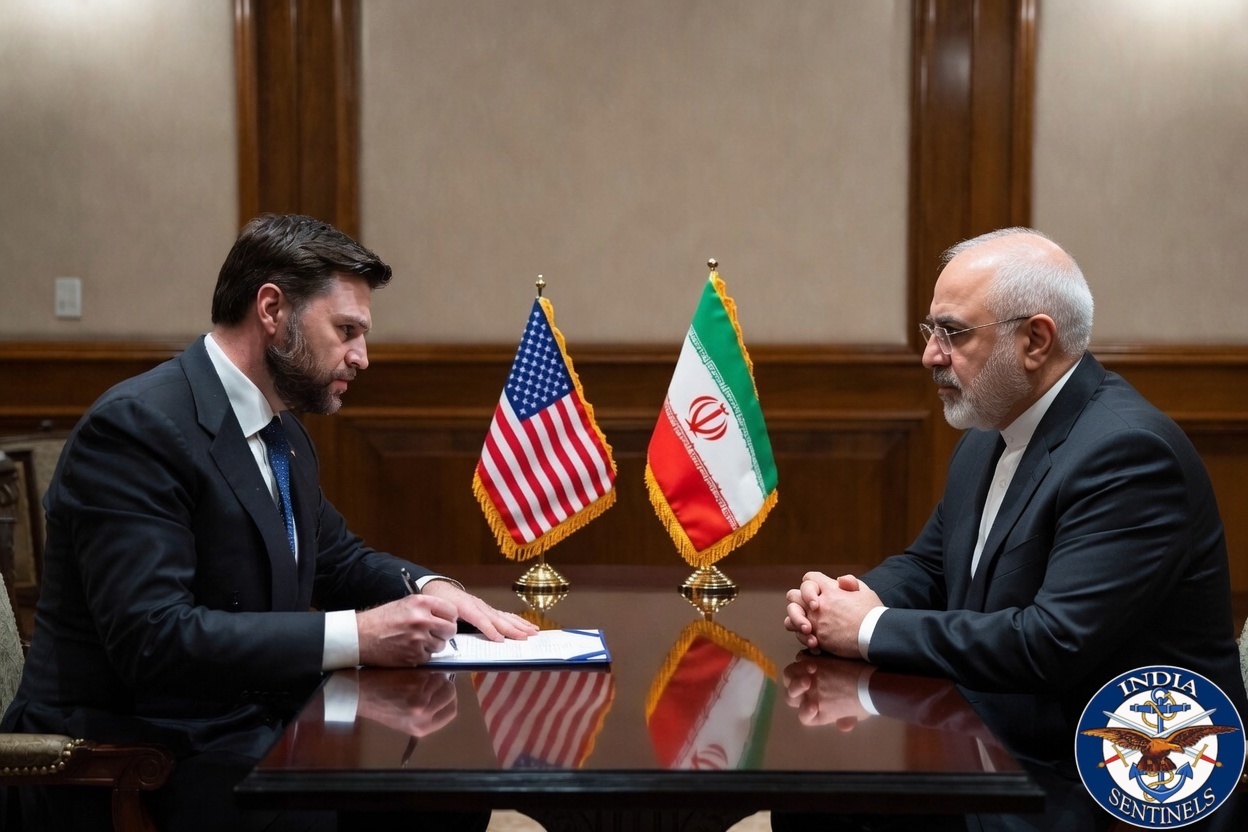
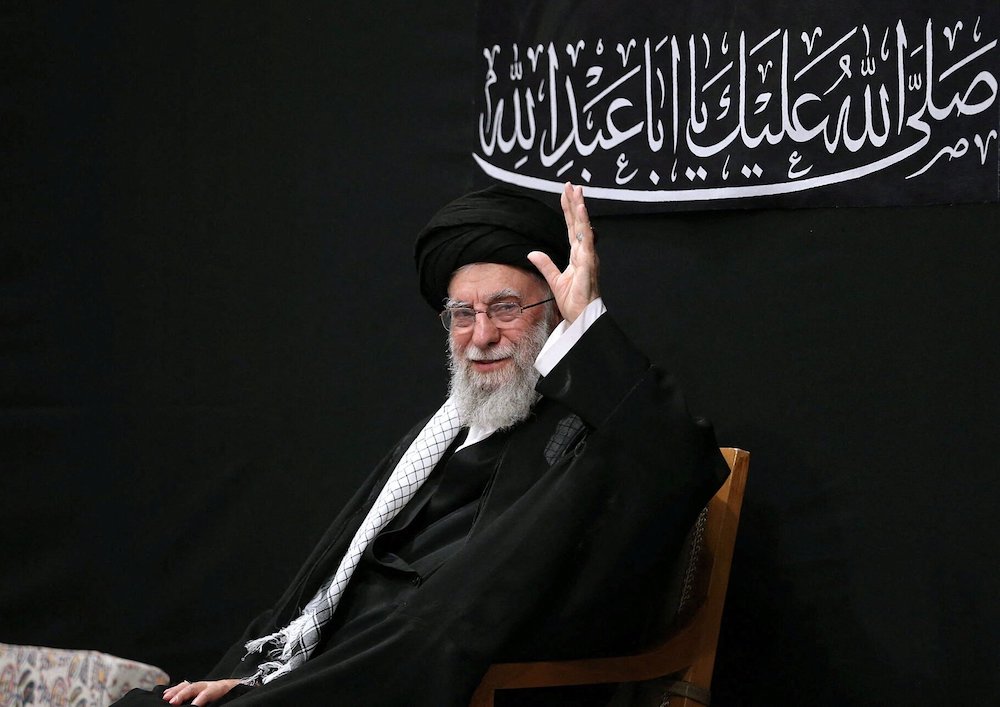
 Ali Hosseini Khamenei (April 19, 1939 – February 28, 2026)
New Delhi: A coordinated United States and Israeli air campaign killed Iran’s supreme leader, Ali Hosseini Khamenei, along with several of the country’s most senior military and political figures, on Saturday. This plunged West Asia into its most severe crisis in decades and drawing furious condemnation from Russia, China and several other countries.
Iran confirmed Khamenei’s death on Sunday, declared 40 days of national mourning, and launched retaliatory missile and drone strikes against Israel and American military bases across the Gulf. By Sunday midnight, the region was in open conflict, with casualty tolls still rising and diplomatic ruptures deepening by the hour.
Read also: Netanyahu’s War, America’s Blood – The trap being set in the Persian Gulf
The Strikes
As India Sentinels reported on Saturday, the US and Israel launched what multiple news organizations described as the largest joint bombardment of Iran in decades. The Israeli Air Force initiated what it called Operation Roaring Lion, targeting sites in Tehran and several other cities, while the US military simultaneously began Operation Epic Fury, deploying cruise missiles, long-range aircraft and naval assets.
Explosions were reported in Tehran, Isfahan, Qom, Karaj, and Kermanshah, with strikes also hitting missile, air-defence and nuclear-linked facilities. An assessment by the Washington-based Institute for the Study of War and the Critical Threats Project, drawing on satellite imagery and military sources, estimated that the combined force conducted roughly 900 strikes in the first 12 hours alone, with the Israel Defence Forces (IDF) claiming to have hit around 500 sites.
Iranian state and semi-official media acknowledged widespread damage to Islamic Revolutionary Guard Corps (IRGC) bases and airbases, but accused Washington and Tel Aviv of deliberately targeting leadership sites and civilian infrastructure while hiding behind concerns over Iran’s nuclear programme.
Khamenei confirmed killed
Among the most heavily bombed locations on Saturday was the complex associated with Khamenei’s office and residence in central Tehran. Satellite imagery circulated by commercial providers, and cited by major news outlets, showed plumes of black smoke rising from several buildings and extensive structural damage.
For much of Saturday, Khamenei’s fate remained disputed. An Iranian foreign ministry spokesman told international media that he was safe and had been moved to a secure location. At roughly the same time, the prime minister of Israel, Benjamin Netanyahu, said in a nationally televised address that “there are growing signs that the tyrant is no longer alive.” Unnamed Israeli officials, speaking to the Associated Press and CNN on background, went further, saying that Khamenei’s body had been located in the rubble, though no independent visual evidence was released.
By early Sunday, Iran’s position had shifted decisively. State broadcaster Islamic Republic of Iran Broadcasting (IRIB), the semi-official Tasnim agency and Fars News all announced that Khamenei, 86, had “attained martyrdom” in what they described as a joint American-Israeli strike on his office. The country’s Supreme National Security Council confirmed his death and declared 40 days of national mourning and seven public holidays.
Iranian outlets also reported that several members of Khamenei’s immediate family, including a daughter, a son-in-law and a grandchild, had been killed.
Foreign correspondents and social media footage documented thousands of mourners in black gathering in Tehran’s Enghelab (Revolution) Square, chanting slogans against the US and Israel. At the same time, smaller groups in some neighbourhoods of Tehran, Karaj, and Isfahan were filmed setting off fireworks and playing celebratory music – a reflection of Iran’s certain internal divisions.
Leadership decapitated
Even before Tehran formally confirmed Khamenei’s death, both Israeli and US officials were briefing that the opening strikes had killed a significant number of senior Iranian figures. IDF spokesperson Brigadier General Effie Defrin said on Saturday that the strikes in Tehran had killed the IRGC commander, Mohammad Pakpour; the defence minister, Amir Nasirzadeh; the Supreme National Security Council secretary, Ali Shamkhani; and chief of staff of the country’s armed forces, Mohammad Bagheri.
US-based reports, citing unnamed officials, suggested that as many as 48 Iranian leaders – senior officers and political figures – were killed in the opening hours of Operation Epic Fury, although this figure could not be independently verified by Sunday. Iran’s Tasnim agency later indicated that additional high-ranking IRGC officers were missing, presumed dead.
Taken together, the available reporting indicates that the Saturday strike package was designed not only to degrade Iran’s military infrastructure but to attempt a systematic decapitation of Tehran’s decision-making core.
The killing prompted immediate speculation about succession. Analysts noted that Iran’s political system had never experienced the violent removal of a supreme leader in wartime and that, while the constitution provided for an interim arrangement through the country’s “Assembly of Experts”, no clear successor with Khamenei’s authority existed. Commentators pointed to the IRGC and the security apparatus as likely to dominate any transitional arrangement, raising the prospect of further militarization rather than political liberalization.
Over 100 young schoolgirls killed
The most shocking civilian casualty incident in the first 48 hours of the campaign was the destruction of the Shajareh Tayyebeh Girls’ Elementary School in Minab, a town in Iran’s southern Hormozgan province near the Strait of Hormuz.
According to the Iranian judiciary news agency Mizan, cited by The Hindu’s Frontline and the French daily Le Monde, a missile struck the school during morning classes on February 28, killing at least 108 people, most of them girls aged between 7 and 12. Iranian state and local health officials, reported over 100 children dead, while cautioning that the toll could rise further.
Red Crescent figures, reported an initial count later revised by national broadcaster IRIB to 85 dead and 93 injured. Iranian state media subsequently spoke of up to 180 killed at Minab, which, if accurate, would make it the largest single-event mass killing of civilians in the entire campaign – though no independent human rights organization had verified that figure by Sunday, and foreign media generally cited the 80–108 range.
Iranian officials said the school stood next to a Revolutionary Guards barracks and accused Washington of using Tomahawk cruise missiles to hit the area. Hossein Kermanpour, a spokesman for Iran’s health ministry, described the bombing as “the most bitter news of the conflict so far.”
Minab was not the only school hit. Iranian and international rights groups reported that Hedayat High School in western Tehran was also struck on Saturday, killing at least two students.
Women volleyball players killed in Lamerd
Within hours of the Minab bombing, a further atrocity was reported from Lamerd, a town in Fars province in southern Iran. Iranian state media and local officials said an airstrike on a sports hall there killed a group of female volleyball players and other civilians on Saturday afternoon.
Lebanese channel Al Mayadeen, quoting local authorities, reported that 20 women volleyball players were killed when a missile struck the gymnasium where they were training. A detailed ground report by independent outlet Dropsite News, based on interviews with survivors and rescue workers, described dozens of teenage girls in the hall for volleyball, basketball and gymnastics when a missile hit the building at around 5pm local time, also damaging adjacent residential areas and a hall next to a school.
That account put the death toll in Lamerd at at least 18 civilians, with scores more injured.
IRIB separately reported that children were also in the building at the time of the strike. As with Minab, neither the US nor Israel had accepted responsibility for the Lamerd strike by Sunday, and no independent forensic confirmation of the weapon system used was available.
Scale of Iranian casualties
Across Iran, the Red Crescent reported on Saturday evening that US-Israeli strikes had killed more than 200 people and injured around 747 across 24 of the country’s 31 provinces. These figures are likely conservative: sweeping internet shutdowns imposed by Iranian authorities significantly hampered both domestic organizing and external reporting throughout the crisis.
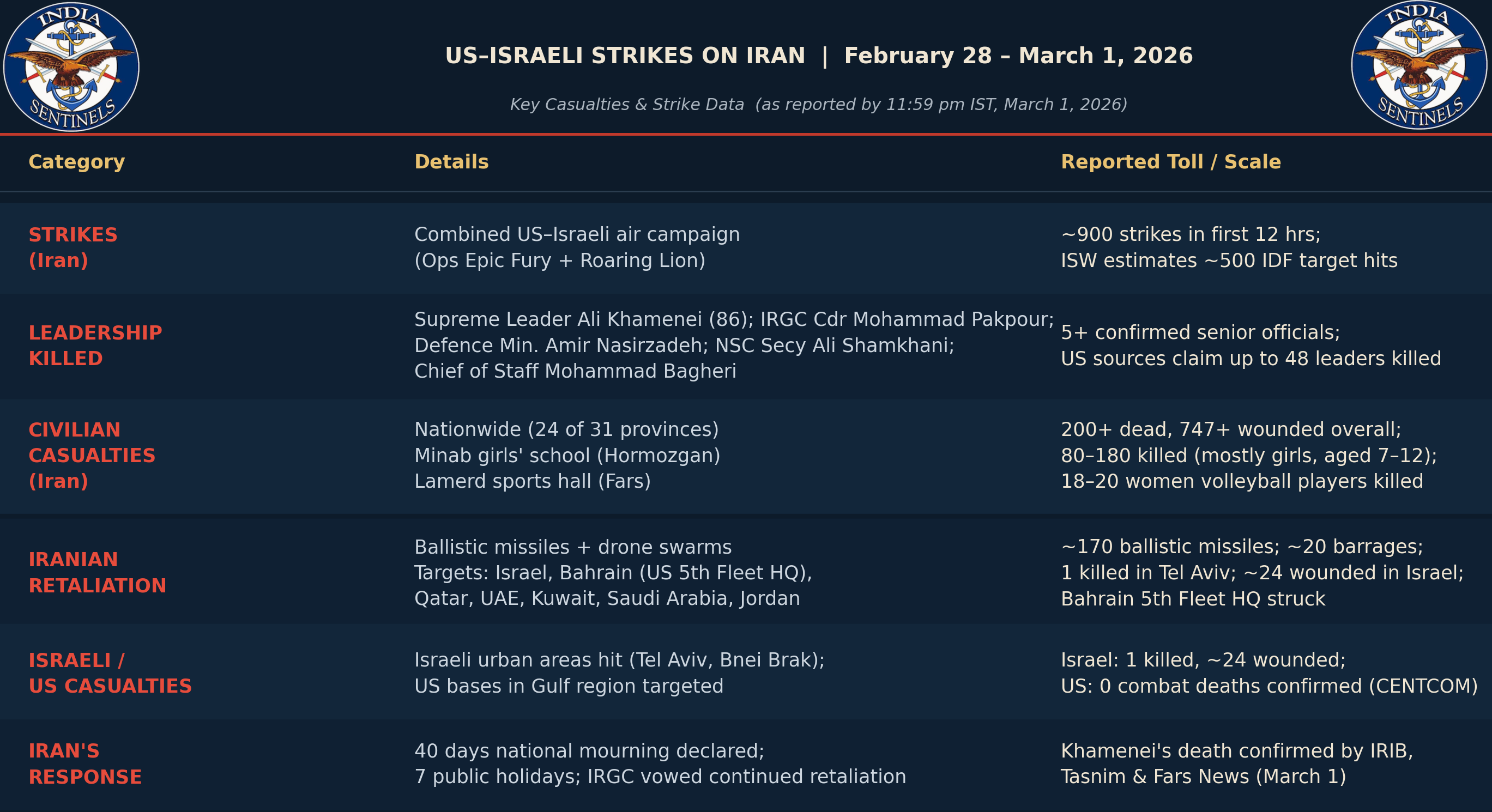 Data on Israel-US strikes on Iran, as of February 28 and March 1, 2026. (India Sentinels infographic)
Tehran retaliates across the gulf
Tehran responded to the decapitation strike with a rapid series of missile and drone attacks on Saturday and Sunday, targeting Israel and US military bases across the region. The IRGC announced that “all occupied territories and criminal US bases in the region” had been struck, claiming hits in Israel, Bahrain, Qatar, Kuwait, the United Arab Emirates, Jordan, and Saudi Arabia.
The Institute for the Study of War estimated that Iran launched approximately 170 ballistic missiles at Israel and US military bases in some 20 separate barrages, along with swarms of drones. Israel’s air-defence network and US regional assets intercepted most of them, but at least two Iranian missiles hit Israeli urban areas, killing one person in Tel Aviv and wounding several more in Tel Aviv and Bnei Brak.
In the Gulf, Bahrain acknowledged that a missile attack had targeted the service centre of the US Navy’s Fifth Fleet headquarters in Manama’s Juffair district, with local and international reporters observing smoke rising from the area. Al Jazeera reported Iranian missiles intercepted over Qatar, and explosions were heard in Abu Dhabi, Dubai, Kuwait, and parts of Saudi Arabia as Gulf states deployed their air defences.
One person was reported killed in Abu Dhabi, and widespread airspace closures disrupted civilian air traffic across the region.
The US Central Command said its forces and regional partners had successfully defended against hundreds of Iranian missile and drone attacks and confirmed that no US service member had been killed or wounded in either the initial strikes or the Iranian retaliation. Analysts noted that the pre-emptive destruction of many Iranian launchers and missile stockpiles in the opening hours of Operation Epic Fury had significantly constrained the scale and precision of Tehran’s response.
Trump, Netanyahu claim ownership
The president of the United States, Donald Trump, moved quickly to claim political ownership of the campaign. In a video posted on social media on Saturday, he announced that the US and Israel were undertaking “major combat operations in Iran,” describing Khamenei as “one of the most evil people in history.” He later wrote on his Truth Social platform that Khamenei had been unable to evade “our intelligence and highly sophisticated tracking systems.”
Trump said the campaign’s goals included eliminating “imminent threats” from the Iranian regime and preventing Iran from ever acquiring nuclear weapons, but also signalled a broader regime-change objective, urging Iranians to “take over your government – it will be yours to take once the bombing stopped.” He acknowledged the possibility of American casualties, saying “that often happens in war,” and promised that “heavy and pinpoint bombing” would continue “throughout the week or as long as necessary”.
Netanyahu, in his televised address on Saturday, said that Israel and the US had struck Khamenei’s compound and other leadership targets to “remove a clear and present danger.” Both leaders portrayed the operation as a necessary escalation following Iran’s violent anti-government protests in January and what they described as the failure of nuclear negotiations in Geneva. Their rhetoric, particularly Trump’s open call for regime change, drew criticism from commentators and governments who warned that it risked locking all parties into an escalatory spiral.
Russia, China condemn attack on Iran
The killing of Khamenei drew immediate and coordinated condemnation from Moscow and Beijing. The president of Russia, Vladimir Putin, described the assassination as “a cynical violation of all norms of human morality and international law” in a condolence message to Iran’s president, Masoud Pezeshkian. Russia’s foreign ministry called the US-Israeli strikes “a preplanned and unprovoked act of armed aggression against a sovereign and independent UN member state” and accused Washington and Tel Aviv of pursuing regime change while hiding behind nuclear concerns.
Moscow warned that the attacks risked triggering “a humanitarian, economic and possibly radiological catastrophe” in the Middle East. Russian foreign minister Sergey Lavrov spoke by phone with his Iranian counterpart, Abbas Araghchi, pledging to seek an urgent United Nations security council meeting. At the emergency session, Russia’s ambassador to the UN, Vassily Nebenzia, told the council that Iran had been “stabbed in the back” while de-escalation efforts were going on.
China issued equally strong language. Its foreign ministry said the killing of Iran’s supreme leader was “a grave violation of Iran’s sovereignty and security that tramples on the purposes and principles of the UN Charter and basic norms in international relations.” Chinese state media reported that the country’s foreign minister, Wang Yi, told Lavrov in a phone call that the “blatant killing of a sovereign leader and the incitement of regime change” was unacceptable. Beijing also urged its citizens to leave Iran as soon as possible via land borders, underlining its assessment of the conflict’s volatility.
At the security council emergency meeting, both Russia and China denounced the strikes as violations of Iranian sovereignty, while the US ambassador defended Operation Epic Fury as a “lawful and proportionate response” to Iranian threats and regional aggression.
Regional and global fallout
Beyond Moscow and Beijing, reactions were mixed but tense. Several European governments and Nato allies expressed concern about the risk of regional escalation and called for restraint, even as some individually condemned Iran’s human rights record and nuclear activities. The UN secretary general, António Guterres, said the use of force by the US and Israel against Iran, combined with Iran’s retaliatory strikes across the region, “jeopardizes international peace and security”. He urged all parties to cease hostilities and return to diplomacy.
The Gulf Arab states hosting US bases – Bahrain, Qatar, the UAE and Kuwait – found themselves in an uncomfortable position: simultaneously condemning Iranian missile attacks on their own territory while avoiding explicit endorsement of the original decapitation strike on Tehran, mindful of domestic public opinion and the risk of being drawn deeper into the conflict. The UAE described Iran’s missile barrage as “a brazen assault” after intercepting multiple projectiles, but remained cautious in its public commentary about the strikes that had triggered it.
For India, which has significant energy, trade and diaspora connections with both the Gulf and Iran, mainstream outlets focused coverage on the scale of the US-Israeli operation, the unprecedented killing of Khamenei and the risks to Indian nationals and to shipping through the Gulf. As of late Sunday, there was no detailed public statement from New Delhi comparable in weight to the Russian or Chinese responses, although the government was reported to be monitoring the situation closely.
The Narendra Modi government’s silence on the attack on Iran in violation of international law and the killing of Khamenei drew sharp criticism from some sections of media and the commentariat on social media.
What was known by Sunday midnight
By Sunday night, the broad outlines of the crisis were clear even as many operational details and casualty figures remained contested.
Khamenei’s death in the Saturday strike on his Tehran compound had been confirmed by Iranian state institutions and widely accepted by foreign governments and media, though publicly available forensic verification – imagery of his body, for instance – was absent. Multiple senior Iranian security and military leaders were also reported killed, though the exact list varied by source.
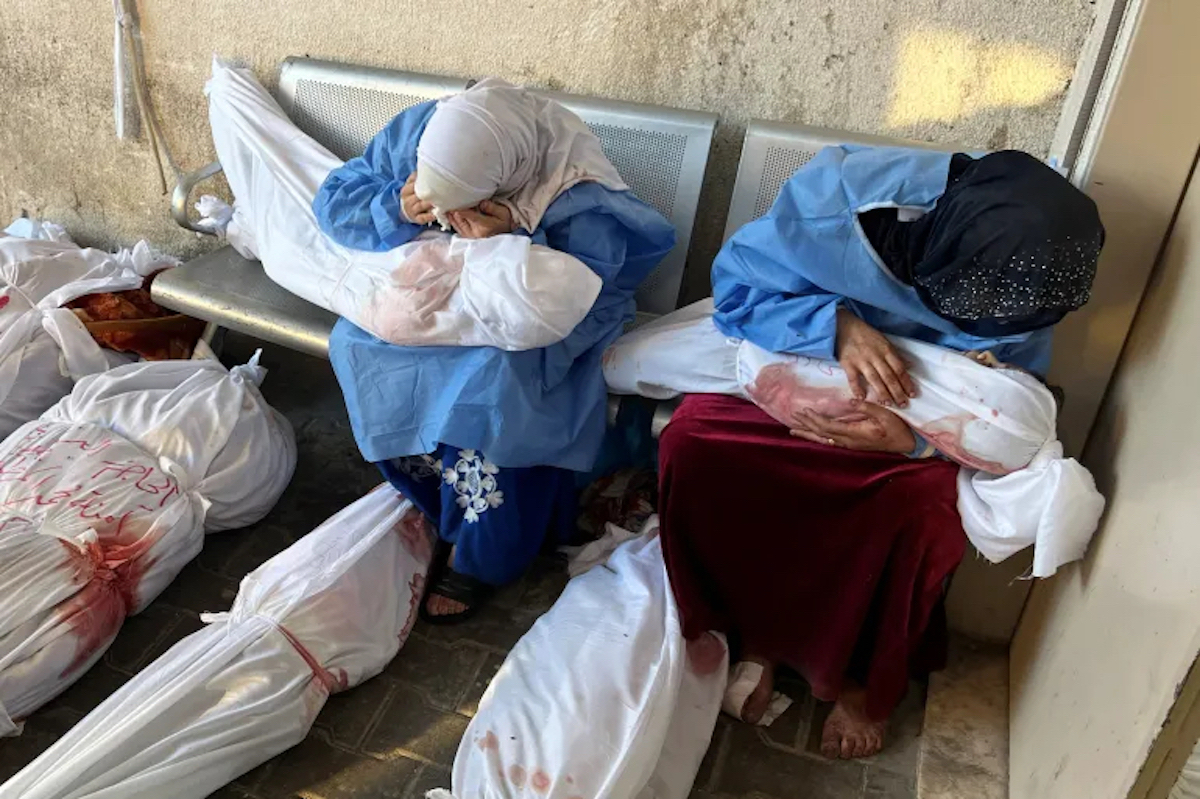
Civilian casualties from the initial US-Israeli bombardment appeared to be at least in the low hundreds, with the single worst incident at the Minab girls’ school – where between 80 and 180 people, overwhelmingly schoolgirls, were reported killed depending on the source – and the Lamerd sports hall adding to the sense that young women and children were paying a disproportionate price.
Iran’s missile and drone retaliation demonstrated both Tehran’s willingness to extend the conflict to US assets and Gulf Arab states, and the effectiveness of allied missile defences. Iran claimed widespread strikes across the region, but the US Central Command and open-source assessments indicated limited physical damage to US military infrastructure and no American combat deaths in the first 48 hours.
The diplomatic clash at the UN and the statements from Russia and China confirmed that the operation had deepened global geopolitical divides, with Moscow and Beijing framing the decapitation strike as an unlawful act of regime change and warning of systemic risks to the international order.
Throughout, the information environment remained acutely constrained. Iranian authorities enforced sweeping internet shutdowns that hindered both internal organizing and external reporting, and much of the most detailed situational picture came from open-source intelligence analysts piecing together commercial satellite imagery, aircraft- and missile-tracking data, and fragments of social media video – all of them stressing the provisional nature of their conclusions.
Note: This article was last updated at 8.30am IST, Monday, March 2, 2026.
Follow us on social media for quick updates, new photos, videos, and more.
X: https://x.com/indiasentinels
Facebook: https://facebook.com/indiasentinels
Instagram: https://instagram.com/indiasentinels
YouTube: https://youtube.com/indiasentinels
© India Sentinels 2025-26