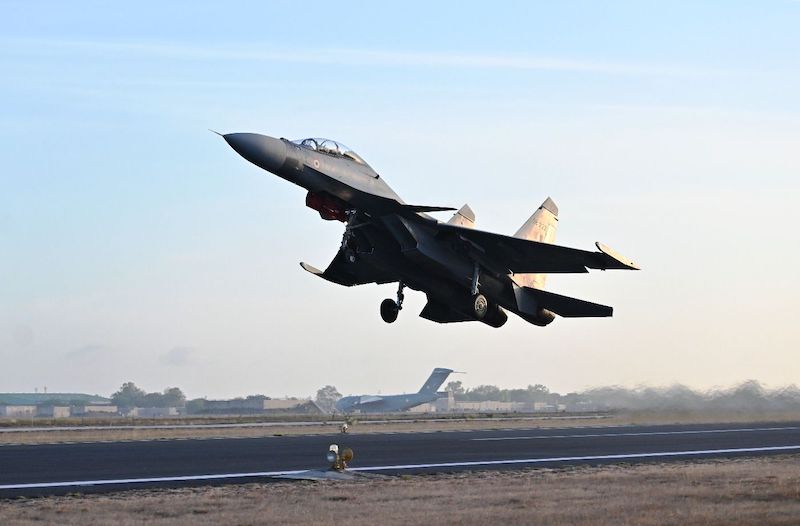
 An IAF Sukhoi-30MKI. (File photo)
New Delhi: The Ministry of Defence has issued a request for proposal to fit all 258 Sukhoi-30MKI fighter jets of the Indian Air Force with an advanced anti-jamming, anti-spoofing navigation system. This procurement move underscores the military’s mounting concerns about electronic-warfare threats from both China and Pakistan.
The tender, restricted to only Indian companies, requires suppliers to design, deliver, and install a multi-constellation GPS antenna electronic unit across the Air Force’s entire Su-30MKI fleet – the country’s primary air superiority platform. The move comes as GPS jamming and signal spoofing have emerged as standard tools of modern aerial warfare, used extensively in theatres from eastern Europe to the Middle East.
The military concerns on two fronts make the timing pointed. A prolonged border standoff with China in Ladakh and Arunachal Pradesh, combined with a sharp military exchange with Pakistan during Operation Sindoor in May last year following the Pahalgam terror attack, have sharpened attention on electronic warfare vulnerabilities. Both adversaries operate capable jamming systems.
In any aerial conflict, disrupting an opponent’s navigational accuracy – particularly for strike missions – offers a significant tactical advantage. The Su-30MKI, built under licence by Hindustan Aeronautics Limited from a Russian design, forms the core of India’s strike capability, and navigational degradation of this fleet would carry serious operational consequences.
Technical specifications
The antenna electronic unit will draw simultaneously from six satellite navigation networks: India’s own NaVIC, the American GPS, Russia’s GLONASS, China’s BeiDou, Europe’s Galileo, and GAGAN, India’s satellite-based augmentation system. Tapping multiple independent constellations makes it considerably harder for a jammer to blind the aircraft entirely.
The specifications are demanding. The antenna must suppress a single jamming source by up to 85 decibels and handle multiple simultaneous interference sources with a rejection of up to 80dB – figures in line with the upper range of current military-grade anti-jam technology. The unit must also operate across the Su-30MKI’s full flight envelope: altitudes up to 21 kilometres, speeds up to Mach 1.5, and G-loads ranging from -2G to 9G.
The contract calls for delivery of 300 antenna units – sufficient to equip all 258 aircraft with spares – along with 50 field-level testers and 10 base-level testers. The winning firm will also be required to carry out certification trials on two aircraft, manage fleet-wide installation, and provide structured training for Air Force technical personnel at 9 TETTRA School, the service’s technical training establishment.
The entire programme must be completed within 24 months of the contract being signed. Online bids are due by June 22, 2026, with technical bids scheduled to open the following day.
Indigenous mandate
Participation is limited to Indian companies, consistent with the government’s defence indigenization drive. Over the past several years, procurement rules have progressively reduced the eligibility of foreign firms for contracts covering critical subsystems, nudging development of navigation electronics, radar components, and electronic warfare hardware towards domestic industry.
Public-sector firm Bharat Electronics Limited and a cluster of private defence electronics companies have been building capacity in GPS signal processing and anti-jam antenna design. The ministry has not disclosed the estimated contract value.
The Sukhoi-30MKI has been the subject of incremental upgrades since it entered Air Force service in the early 2000s. India operates the largest fleet of the type outside Russia, making it the single most consequential platform in any effort to modernize the Air Force’s electronic warfare resilience.