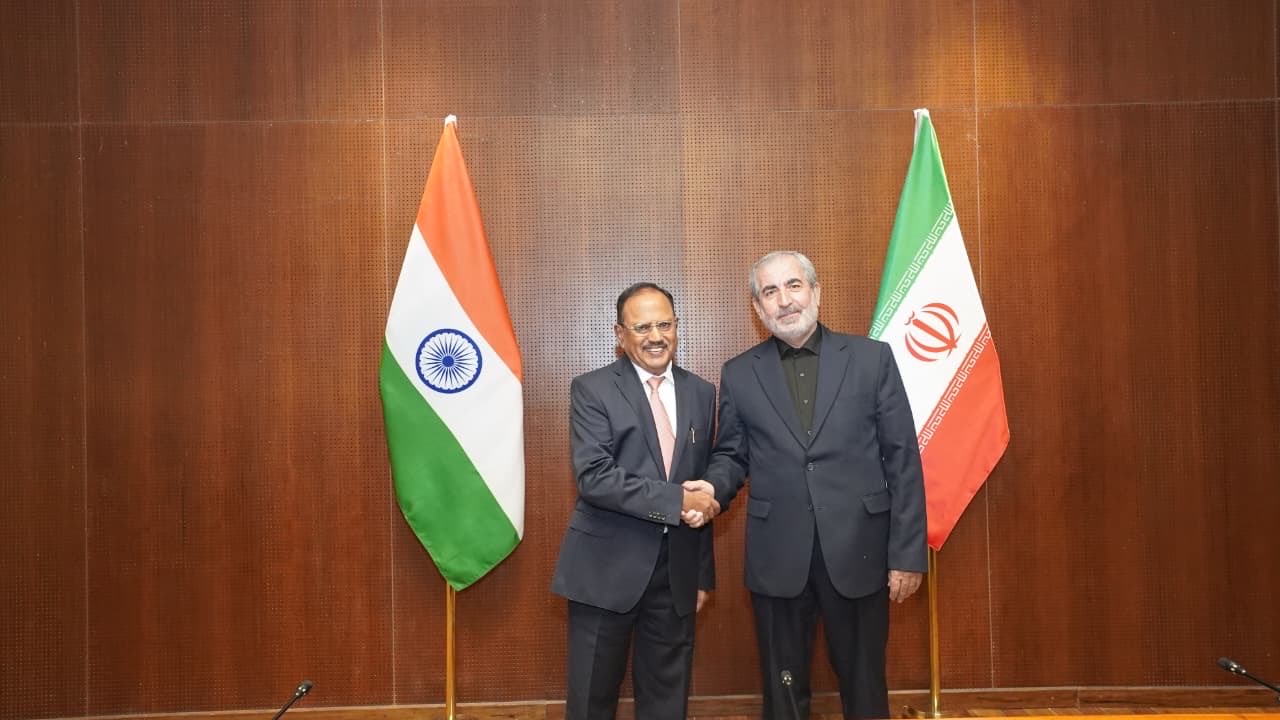
 NSA Ajit Doval (L) with Iran's top security envoy Ghadir Nezamipour in Delhi. (Photo: MEA)
New Delhi: The national security advisor, Ajit Doval, met Ghadir Nezamipour, the deputy secretary for defence affairs of Iran’s Supreme National Security Council (SNSC), in New Delhi on Monday. The two top security officials reviewed the security situation in West Asia and discussed bilateral ties and multilateral cooperation.
The meeting took place on the margins of the two-day BRICS National Security Advisers’ Meeting being hosted by India in the capital – an event chaired by Doval and themed around non-traditional security challenges confronting the world today.
Neither side issued a detailed readout of the Doval-Nezamipour talks, but officials confirmed that the discussion ranged across regional developments in West Asia, India-Iran bilateral relations, and cooperation within BRICS and other multilateral frameworks.
The timing is significant. West Asia remains on edge following months of military exchanges involving Iran, Israel and the United States. The volatility has sharpened concerns over energy supplies, maritime trade security and the broader risk of a wider regional conflagration – all issues of direct consequence for India.
New Delhi has maintained a publicly consistent position of urging restraint. The Ministry of External Affairs, in a statement issued earlier this month, said India deeply regretted renewed attacks in the region, calling on all parties to immediately de-escalate, protect civilians and pursue a diplomatic solution.
Doval himself has framed the stakes in economic and strategic terms. At an international security forum in Moscow in May, he flagged the imperative of keeping the Strait of Hormuz and the Red Sea open to uninterrupted navigation. He had warned that protracted instability in West Asia would carry far-reaching consequences beyond the region.
NSA Ajit Doval, KC met Deputy Secretary for Defense Affairs of the SNSC of Iran, Ghadir Nezamipour on 22 June 2026 on the sidelines of the 16th BRICS NSAs Meeting.
— Randhir Jaiswal (@MEAIndia) June 22, 2026
Both sides reviewed the ongoing situation in West Asia. They also discussed cooperation under the BRICS platform… pic.twitter.com/UNtwxqPY0k
India’s engagement with Tehran, despite the shadow of western sanctions, is grounded in durable strategic interests. The two countries cooperate on regional connectivity – including the International North-South Transport Corridor, in which Iran is a critical link – as well as energy security, developments in Afghanistan and shared maritime concerns in the Indian Ocean and the Gulf of Oman. Iran also remains a significant node in India’s effort to secure overland access to Central Asia, bypassing Pakistan.
For Tehran, the presence of a senior SNSC official at the BRICS meeting underscores Iran’s growing orientation toward multilateral forums outside the Western-led international order. Since formally joining BRICS in January 2024, Iran has sought to leverage the grouping as a platform for diplomatic rehabilitation and economic diversification.
The West Asia security situation is expected to feature prominently in the broader BRICS conclave, where member countries’ security chiefs are also deliberating on counterterrorism cooperation, cybersecurity, information security and the governance of emerging technologies.
India’s approach at the meeting is expected to emphasize action-oriented cooperation against terrorism and an honest exchange of assessments on major ongoing crises – positions New Delhi has consistently articulated in multilateral security settings.
The Indian subcontinent’s stake in Gulf stability is structural, not incidental. The region is home to roughly nine million Indian nationals, provides a substantial share of India’s crude oil and natural gas imports, and lies along the principal sea lanes through which a large portion of India’s merchandise trade moves. Any prolonged military escalation in West Asia translates into immediate exposure – for Indian workers, for energy prices and for supply chains.
No joint communiqué followed the bilateral meeting, but officials from both sides underlined the value of sustained communication at a moment when much of the wider region remains in flux.