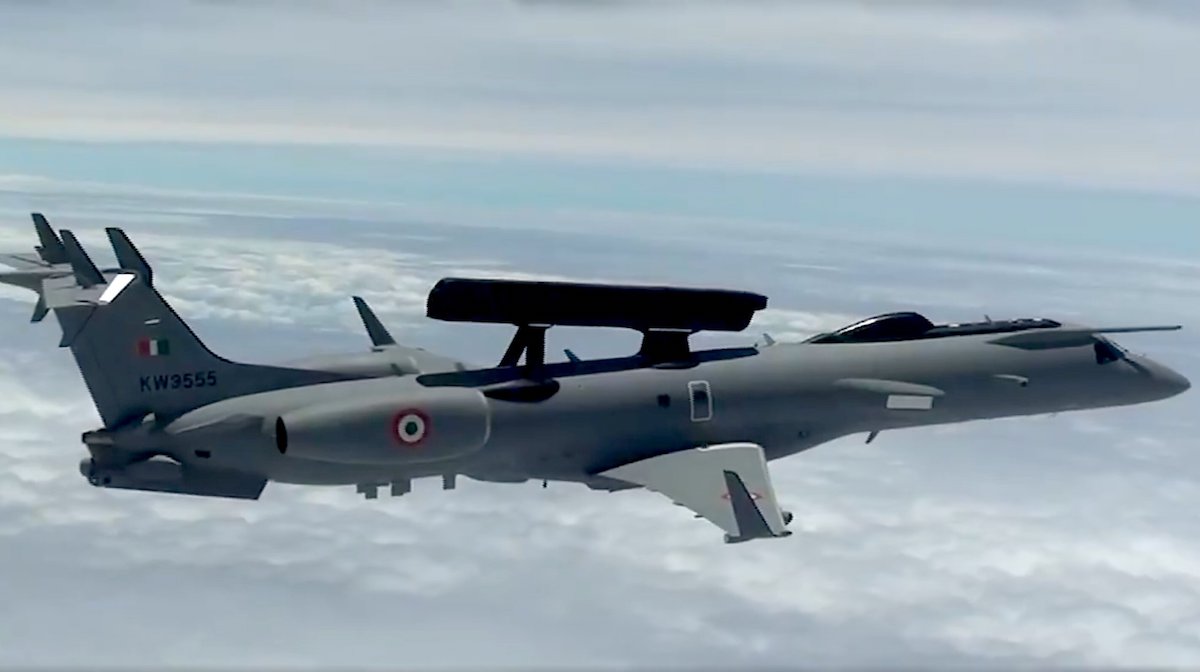
 Netra AEW&C. (Screenshot from IAF video.)
New Delhi/Bengaluru: India’s indigenous airborne early warning programme reached a definitive milestone on Wednesday when the Defence Research and Development Organisation (DRDO) formally handed over the final operational clearance (FOC) certificate for the Netra airborne early warning and control (AEW&C) system to the Indian Air Force, as India Sentinels had reported earlier. The handover of the FOC certificate took place at a ceremony hosted by DRDO’s Centre for Airborne Systems (CABS) in Bengaluru.
The FOC certificate confirms that Netra is structurally sound, fully mission-capable, and ready for combat operations. That clearance carries particular weight for a platform of Netra’s complexity – one that integrates an active electronically scanned array (AESA) radar, electronic support measures, communication suites, software-defined radios, data links, and a self-protection electronic warfare suite within a single modified airframe. Achieving FOC means the system has met defined performance benchmarks under realistic operating conditions and can now be fielded as a mature military asset.
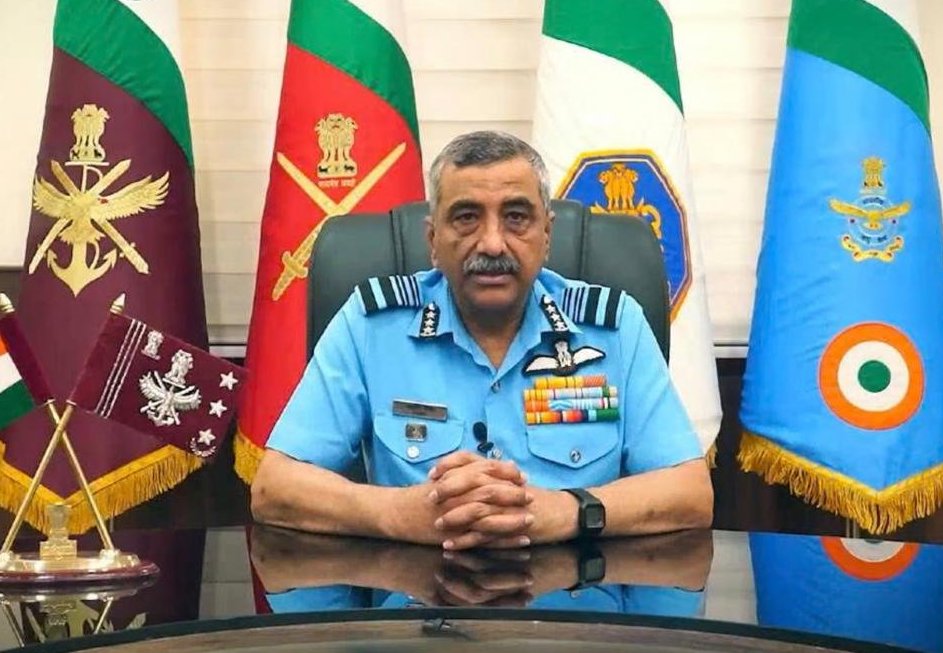
The ceremony was presided over by Air Marshal Awadhesh Kumar Bharti, deputy chief of the air staff. Among those present were former chief of the air staff Air Chief Marshal RKS Bhadauria (retired), former DRDO chairman Dr S Christopher, Centre for Airborne Systems (CABS) director and outstanding scientist P Santhya, outstanding scientist and chief executive (airworthiness) APVS Prasad, and scientist G and Netra FOC programme head AS Kumaran, alongside senior officials from DRDO, the Air Force, and industry partners.
A ceremony for the declaration of Final Operational Clearance (FOC) of Netra Airborne Early Warning and Control (AEW&C) System is planned on 25 June 2026 at Centre for Airborne Systems (CABS), DRDO, Bengaluru. The FOC is a major milestone achieved for an indigenous system of… pic.twitter.com/wD90TAEyTO
— DRDO (@DRDO_India) June 12, 2026
Journey from concept to combat
The origins of the Netra programme trace back to 2003, when the Air Force and DRDO jointly assessed the feasibility of developing an indigenous AEW&C system. Following government approval, CABS was designated as the nodal agency for design, system integration, and testing. Four other DRDO laboratories contributed to the effort: the Electronics and Radar Development Establishment developed the primary radar, the Defence Electronics Application Laboratory handled communication systems and data links, the Defence Avionics Research Establishment worked on the self-protection suite and electronic warfare measures, and the Defence Electronics Research Laboratory provided communication support.
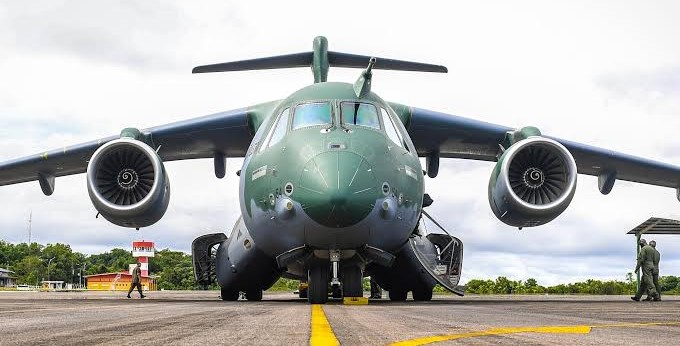
Three ERJ-145 aircraft were procured from Embraer of Brazil and extensively modified to meet military requirements. These modifications included in-flight refuelling capability, satellite communication systems, advanced avionics, electrical upgrades, and aerodynamic and structural changes. The first Netra aircraft was delivered to the IAF in February 2017 and received its initial operational clearance (IOC) in October 2017 after trial runs at Bhisiana Air Force Station. The second and third aircraft were received by the IAF in 2019 and 2023 respectively.
The Netra Mk1 is built on a modified Embraer ERJ-145 twin-engine aircraft and features an indigenously developed AESA radar system. The dorsal-mounted radar provides 240-degree electronic scan coverage with a detection range of approximately 250–300 kilometres, capable of tracking targets deep inside adversary territory without breaching international borders.
The system is also equipped with a secondary surveillance radar, electronic and communication countermeasures, line-of-sight and beyond-line-of-sight data links, and secure voice communication systems. Its endurance of over eight hours, extendable via in-flight refuelling, further enhances its operational reach.
India is among only four countries in the world to have indigenously developed an AEW&C system of this type. The three aircraft are based at Bhisiana Air Force Station near Bathinda in Punjab, with No. 200 Squadron.
Baptism by fire
The FOC is not a bureaucratic formality for a system that has seen combat. In fact, Netra played a pivotal behind-the-scenes role in the Balakot surgical strikes in February 2019, providing crucial surveillance cover during the pre-dawn aerial attack. During the retaliatory operation the following day, when Pakistan Air Force F-16 combat jets attempted to violate Indian airspace, it was the indigenous AEW&C that alerted MiG-21s and other fighters on air patrol about the incoming F-16s, resulting in the aerial engagement that followed.
During Operation Sindoor on May 7, 2025, the Air Force deployed the Netra-Mk1A testbed – originally developed by DRDO for testing purposes – in an operational role. Sources within the Air Force confirmed that the system performed flawlessly, playing a key role in the operation. The Netra aircraft were also deployed during the India-China border standoff in 2020.
In his address at Wednesday’s ceremony, Air Marshal Bharti specifically referenced the system’s operational record during Operation Sindoor and the Balakot strikes, noting that indigenous systems offer the services the flexibility to adapt platforms to an evolving warfighting environment through modifications – a degree of autonomy that imported systems do not readily afford.
Distinguished scientist and director general of DRDO’s aeronautics cluster, Dr K Rajalakshmi Menon, recounted the programme’s journey, acknowledging the challenges encountered and the decisions that enabled the team to deliver a combat-capable system. She noted the particular role that systems engineering discipline played in planning and executing the flight test programme.
Distinguished scientist and director general of DRDO’s electronics cluster, Dr BK Das, described the Netra AEW&C as a demonstration of what coordinated effort among operational users, scientific agencies, and defence production establishments can produce.
What it does, and why it matters
The AEW&C system consists of sensors mounted on an aircraft that provide early warning of airborne and sea surface targets, as well as detection of hostile emissions. The system is designed to provide comprehensive situational information to controllers aboard the aircraft and to ground-based stations, enabling coordinated air defence operations.
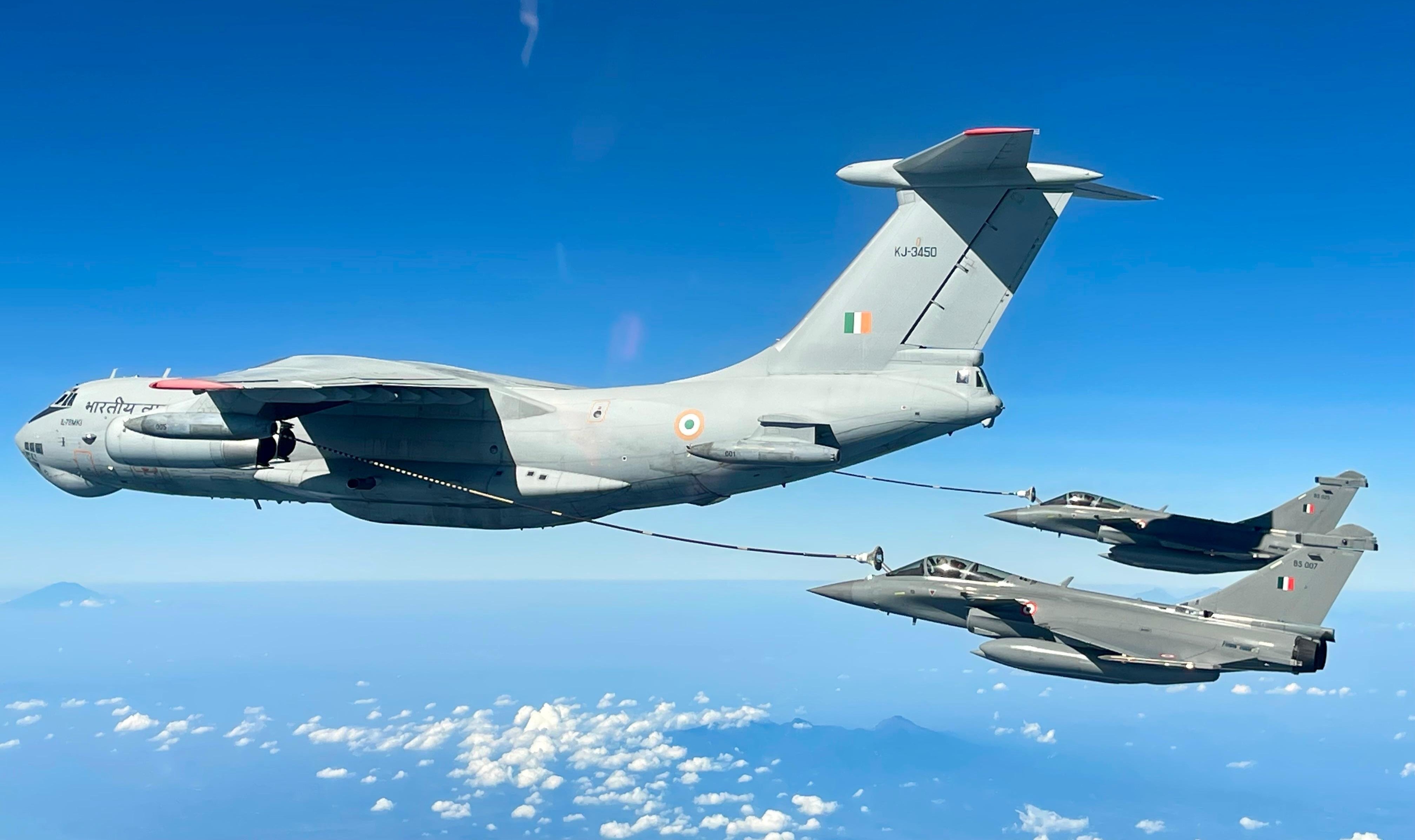
By operating at high altitudes, AEW&C aircraft can detect incoming threats much earlier than ground-based radar systems. Before Netra’s development, India relied heavily on imported airborne warning systems, such as the larger Phalcon AWACS mounted on Russian IL-76 aircraft. The Air Force continues to operate three Beriev A-50 airborne warning and control systems based on the Russian IL-76 platform alongside the Netra fleet. While the Phalcon platforms offer 360-degree coverage and longer endurance, Netra fills a complementary role as a lighter, more flexible, and entirely domestically developed capability.
Over 75 per cent of Netra’s mission suite comprises indigenous content – a figure that underlines the depth of the technology base DRDO has built over the course of the programme.
What comes next
The FOC for the Mk1 fleet is not the end of India’s AEW&C ambitions – it is arguably the launchpad for a significantly more capable generation of platforms.
The central government has approved the development of six additional Netra AEW&C aircraft of the Mk1A variant, which would be more advanced, with an enhanced mission suite, upgraded sensors, and longer-range radar for effective detection of low-observability aircraft such as drones and stealth jets, as well as better human-machine interface and tighter integration with Air Force systems. The Netra Mk1A aircraft will feature significant improvements, including new gallium nitride-based transmit/receive modules for their radars.
In parallel, the Cabinet Committee on Security approved, in July last year, a ₹19,000 crore project for the development and induction of six next-generation AEW&C aircraft based on the Airbus A321 platform. Six Airbus A321 aircraft have been procured from Air India for the project.
The Netra-Mk2’s advanced radar, a derivative of the indigenous Uttam AESA, will offer improved resolution and countermeasure resistance, enabling simultaneous tracking of multiple targets at ranges exceeding 450 kilometres. The aircraft will also incorporate a ballistic missile tracking capability, relaying real-time data to ground stations and enhancing India’s ballistic missile defence architecture.
DRDO will collaborate with Airbus Defence and Space in Spain to modify and upgrade the jet platforms to military standards, alongside several Indian firms, to equip the Netra Mk2 with a mission control system and an indigenous AESA radar atop a dorsal fin-mounted antenna providing 300–360-degree coverage.
The success of the Netra programme is expected to feed into India’s next-generation airborne surveillance ambitions, with DRDO also working on larger and more capable AEW&C platforms that could provide all-round radar coverage and enhanced endurance for the Air Force.
The FOC handed over in Bengaluru on Wednesday closes one chapter. The harder work of building a denser, more capable, and entirely self-reliant airborne surveillance architecture is the chapter that follows.
Follow us on social media for quick updates, new photos, videos, and more.
X: https://x.com/indiasentinels
Facebook: https://facebook.com/indiasentinels
Instagram: https://instagram.com/indiasentinels
YouTube: https://youtube.com/indiasentinels
© India Sentinels 2026-27