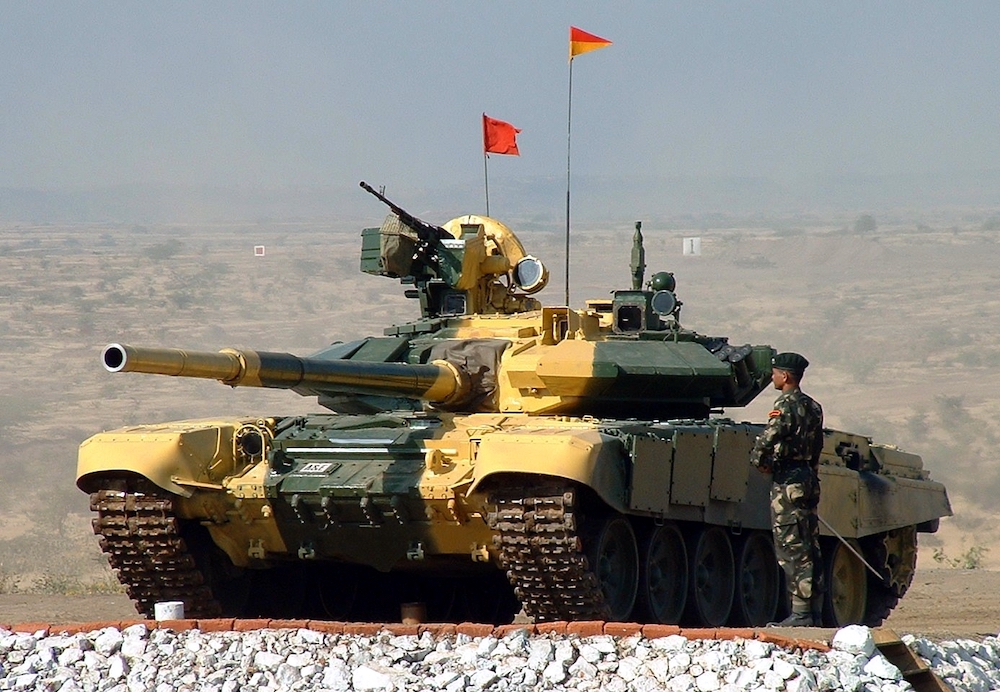
 An Indian Army T-90 Bhishma tank at a field firing range. (File photo)
New Delhi: The Ministry of Defence has issued a request for information (RFI) to source approximately 50 basic gunnery simulators (BGS) for the Army’s T-90 Bhishma tank fleet. This is seen as a major push to modernize the country’s armoured warfare training through artificial intelligence and high-fidelity replication technology.
The simulators are intended to allow gunners to complete the full training cycle without live-range exercises – a step that would reduce costs, improve safety, and allow training to be conducted across varied operational environments.
Key requirements
According to the RFI, the equipment must replicate the T-90 gunner’s station in full – covering the 125mm main gun, the 7.62mm co-axial machine gun, the Invar anti-tank guided missile system, and smoke grenade launchers. The trainee must be able to practise the entire firing sequence: spotting, identifying, tracking, ranging, aiming, and firing, all from within a physical replica of the gunner’s compartment.
Physical authenticity is a firm requirement. The simulator must reproduce the autoloader conveyor action, the brow-pad recoil effect, interior lighting conditions, and the physical jolt of a 125mm round being discharged. The fire control system simulation must cover the TISAS/TIFCS suite – the T-90’s thermal imaging and fire control architecture – across normal, manual, and emergency modes, with accurate ballistic solutions for high-explosive, HEAT, and armour-piercing fin-stabilized discarding sabot (APFSDS) ammunition.
Recoil and muzzle flash are to be CGI-rendered, while the audio environment must reproduce engine noise, autoloader cycling, incoming fire, and broader battlefield sounds, as specified in the RFI.
AI at centre of training design
The RFI places artificial intelligence firmly at the core of the training architecture. Enemy forces within the simulation must increase in difficulty with each successive exercise or be manually calibrated by an instructor. Vendors are being asked whether their software can support both single-player and multiplayer combat missions set in terrain modelled on India’s western and northern borders – encompassing the international boundary, the line of control (LoC) with Pakistan, and the line of actual control (LAC) with China.
The AI layer must also assess trainees automatically, identifying errors in technique and feeding corrections back into the training cycle without requiring instructor intervention. A conventional instructor console would handle malfunction injection, scenario programming, performance recording, and engagement replay, with an external display allowing crew members in waiting to observe live sessions.
Specifications
The ministry has set demanding physical parameters. The simulator must be transportable within an Ashok Leyland Stallion truck – a footprint of roughly 5.2 metres by 2.4 metres, a height of just under four metres, and a maximum weight of approximately 6.5 tonnes.
Operational endurance requirements are equally stringent. The system must function in temperatures ranging from -10°C to 45°C, sustain 12 to 16 hours of daily operation, and carry 30 minutes of uninterrupted power supply backup. A service life of 15 years is mandated, with a condition that vendors provide two years’ notice before closing the production line – allowing the government sufficient time to stockpile spare parts.
Background
The T-90 Bhishma is the backbone of India’s armoured strike corps, with the Army operating well over 1,000 units. Russia began supplying the tanks in the early 2000s, and India has since assembled a substantial number domestically under licence through Heavy Vehicles Factory, Avadi. Simulator-based gunnery training, common in Nato armies for decades, has gained fresh urgency in India as the Army seeks to reduce dependence on costly live ammunition and range infrastructure while maintaining operational readiness along two active contested borders.
The RFI is a preliminary market survey and does not constitute a formal tender. Procurement will follow the defence acquisition procedure if the ministry proceeds to the next stage.
Follow us on social media for quick updates, new photos, videos, and more.
X: https://x.com/indiasentinels
Facebook: https://facebook.com/indiasentinels
Instagram: https://instagram.com/indiasentinels
YouTube: https://youtube.com/indiasentinels
© India Sentinels 2026-27