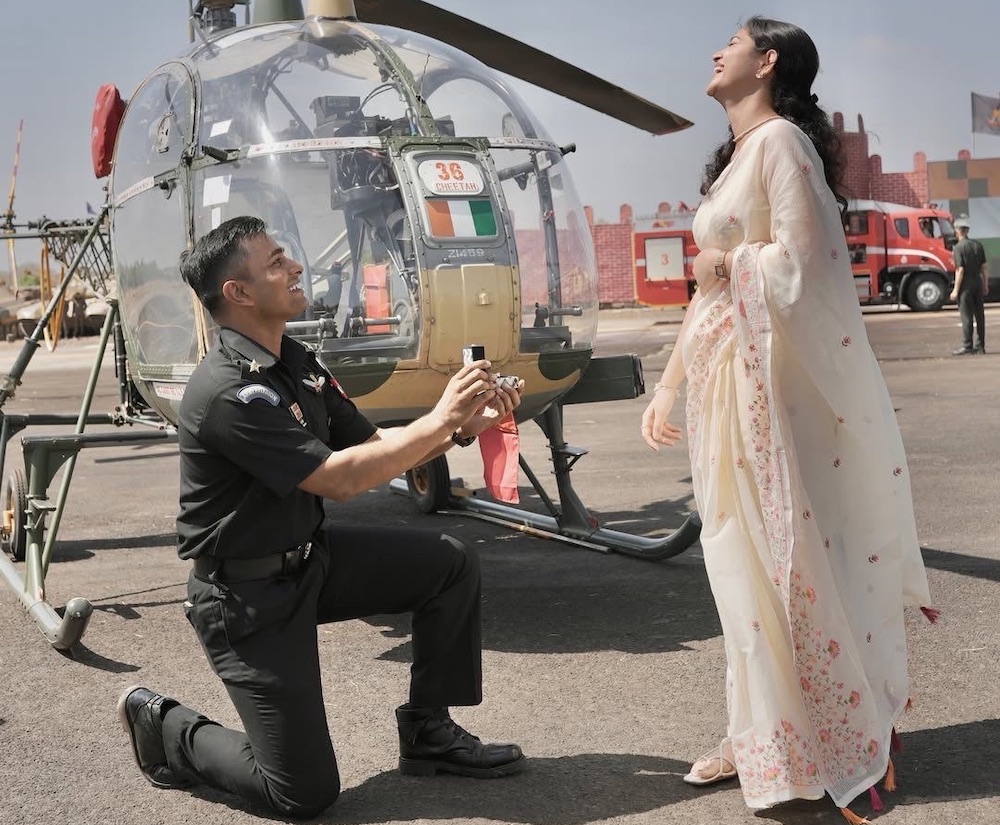
 Capt Bharat Bhardwaj proposing to his fiancée Arushi. (Viral photo via X)
New Delhi: At the Combat Army Aviation Training School (CAATS) in Nashik, Army Aviation Corps pilot Captain Bharat Bhardwaj did something on Tuesday that no regulation manual quite prepared his superiors for. After the passing-out parade following the completion of his flight training at CAATS, Capt Bhardwaj walked onto the tarmac in his ceremonial uniform, knelt before his partner, Arushi, and presented her with an engagement ring, with an Army helicopter parked nearby providing a dramatic backdrop to the occasion.
She said yes. The crowd of family, fellow officers, and instructors cheered. And within hours, the moment had travelled far beyond Nashik – going viral across social media platforms and igniting a national conversation about where military life ends and personal expression begins.
The proposal was, by all accounts, carefully considered. Capt Bhardwaj later explained why he chose the graduation ceremony: “I don’t think that there is any better day than this to propose marriage to her. I wanted to make this day memorable for my fiancée too. That was the whole idea.” He added that the couple had known each other for five years, and that the occasion, on which he and his fellow trainees had earned their wings as pilots and instructors, was already the proudest day of his life.
The Army, however, saw it differently. Army authorities in New Delhi conveyed their displeasure to the young captain’s commanding officer, although sources clarified that a written note had not been issued, with the rebuke delivered verbally. “There is no bar for an officer proposing to his lady love while wearing a uniform,” sources noted, “however, such proposals cannot be made at official functions like a passing-out parade.”
Some media outlets reported that a show-cause notice may be issued, while some others stated the displeasure remains verbal so far. Formal disciplinary action is considered unlikely given his status as a young officer and the nature of the infraction. His command has reportedly been tasked with counselling him on expected conduct.
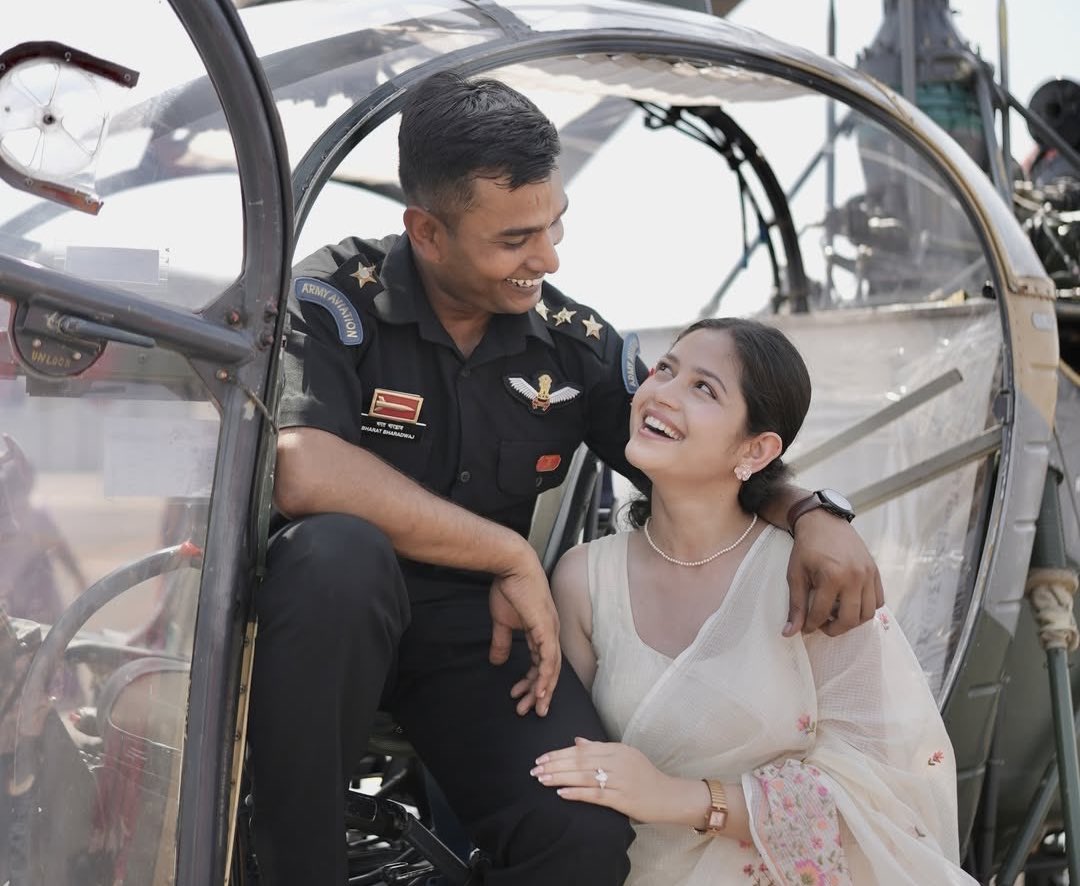 Capt Bharat Bhardwaj and Arushi. (Viral photo via X)
The institutional position is understandable on its own terms. Passing-out parades are solemn affairs – moments of collective achievement and institutional pride, attended by senior officers and conducted with a precision that the Army holds sacred. The CAATS passing-out parade marked the successful completion of training for officers from helicopter, pilot-observer, instructor, and remotely piloted aircraft system (RPAS) courses – a rigorous programme whose graduates go on to fly and fight in some of the most demanding operational environments the Army faces. To use the event as a backdrop for a personal moment, officials argue, is to blur lines that the institution has drawn for good reason.
Yet the episode raises a broader question that the Army’s response alone cannot fully settle: does a romantic gesture, offered spontaneously by a young officer to a woman who had waited through years of his demanding training, genuinely undermine the dignity of the occasion – or does it, in some measure, humanize it?
Across the world’s armed forces, the boundary between formal ceremony and personal expression has never been entirely rigid. At the 2021 Bastille Day parade in Paris, a cadet from the French Land Corps knelt to propose to his partner [archived link] on the Champs-Élysées as marching troops passed by, with the crowd and fellow troopers cheering the couple – a moment that drew widespread admiration rather than official censure. In the United States, military romance is institutionalized in ways that suggest the two are not inherently incompatible. The Arch of Sabers [archived link] – a tradition conducted outdoors immediately following the wedding ceremony at West Point – dates back to the 19th century and is specifically designed to welcome couples into the Army as a joint institution.
Military weddings across various nations are understood to place marriage within a framework of structure and honour – a reminder that love flourishes not in spite of duty, but frequently because of it.
Capt Bhardwaj’s proposal was not a wedding. It was not a planned ceremony embedded within the official schedule. It was a young man, standing at the highest point of a years-long professional journey, choosing to mark it with a gesture toward the person who had shared that journey from the outside. It was also not entirely without precedent in India. A similar proposal was made [archived link] in 2018 by Lieutenant Thakur Chandresh Singh after his graduation from the Officers Training Academy (OTA) in Chennai, when he proposed to his partner upon becoming an officer of the Rajputana Rifles, to widespread public support.
None of this is to suggest that military protocol is merely decorative, or that individual officers ought to feel free to choreograph personal events at institutional ceremonies. The Army’s concern about the sanctity of official functions is legitimate, and passing-out parades carry a weight that deserves to be protected. The discipline that makes the Indian Army effective does not emerge from nowhere – it is built through thousands of small acts of deference to institution over self.
But there is a difference between indiscipline and exuberance, between a breach of protocol and a moment of human joy that simply overflowed its appointed hour. Bhardwaj did not disrupt the ceremony; he acted after it concluded, on the same tarmac, in the same uniform, wearing the same pride. The question of whether that constitutes a punishable offence – or simply an occasion for a quiet word from his CO – is one the Army will now have to answer, with the entire country watching.
What is beyond dispute is that the images from CAATS Nashik on June 2 captured something genuinely moving: an officer, trained to operate in the most demanding of conditions, going down on one knee in front of a helicopter and asking someone to share his life. In a profession defined by sacrifice and separation, that is not a small thing. It may not have followed the rulebook. But it spoke, unmistakably, to something the rulebook was never designed to contain.
Follow us on social media for quick updates, new photos, videos, and more.
X: https://x.com/indiasentinels
Facebook: https://facebook.com/indiasentinels
Instagram: https://instagram.com/indiasentinels
YouTube: https://youtube.com/indiasentinels
© India Sentinels 2026-27