 Illustration for representation. (© India Sentinels 2026–27)
New Delhi: The United States trade representative’s office has proposed an additional 12.5% tariff on Indian exports to the country by naming India among 54 nations it says have failed to impose and enforce a legal prohibition on the import of goods made with forced labour. The announcement, made in Washington on Wednesday, comes at a particularly awkward moment as a US trade delegation is simultaneously in New Delhi for talks aimed at finalizing an interim bilateral trade agreement between the two countries.
The investigation was initiated by the US trade representative (USTR) in March and covered economies accounting for 99.4% of US imports. Official findings determined that the failure of 60 economies to effectively enforce prohibitions constitutes an “unreasonable” practice that burdens US commerce, and the investigations and proposed duties are actionable under Section 301(b) of the US Trade Act of 1974.
The 12.5% rate is the higher of two proposed tiers. Countries that have at least partially committed to prohibiting forced-labour goods, including the European Union, Canada, and Mexico, face a lower 10% rate. India finds itself in the same bracket as China, Brazil, Japan, and Saudi Arabia. The USTR has also launched a separate capacity-related Section 301 investigation against 16 countries, including China, Japan, and the EU, meaning India is caught in at least two of these probes.
Read also: How Trump lost India – and why America must win it back
In its report, the USTR flagged India across sectors including aluminium, cotton, cocoa, fish, coffee, nickel, palm oil, and rice. It argued that India imported forced labour-linked inputs in these categories and also exported the same downstream products to the US during 2021–2025.
The US trade representative, Jamieson Greer, framed the action in pointed terms. “The failure of our most important trading partners to address the importation of goods made with forced labour is unacceptable. This creates a dynamic where American workers are forced to compete globally on an unlevel playing field,” Greer said.
India has pushed back. New Delhi denied the allegations and asked the US to end the investigations, with Indian officials requesting that such matters be addressed within the framework of the ongoing bilateral trade negotiations. The Ministry of Commerce and Industry said on Wednesday that India “remains engaged with the US on the matter as part of the Section 301 proceedings” and is simultaneously working towards finalizing the framework agreement announced on February 2.
Read also: Thank you, Trump, for making India understand US like never before
The timing makes the development especially fraught. A US delegation led by Brendan Lynch, the US assistant trade representative, is in India and holding discussions with senior government officials to finalize the bilateral trade agreement between New Delhi and Washington. The two countries had announced a framework for an interim deal in February. For India, the USTR move adds a new compliance layer to trade talks that have already focused on tariffs, market access, non-tariff barriers, and sectoral sensitivities.
The proposed tariffs are not yet final. Stakeholders can submit requests to participate in public hearings by June 22; written comments can be filed until July 6; and public hearings are scheduled for July 7, 2026, after which the USTR will consider the submissions before taking a final decision.
Turbulent backdrop
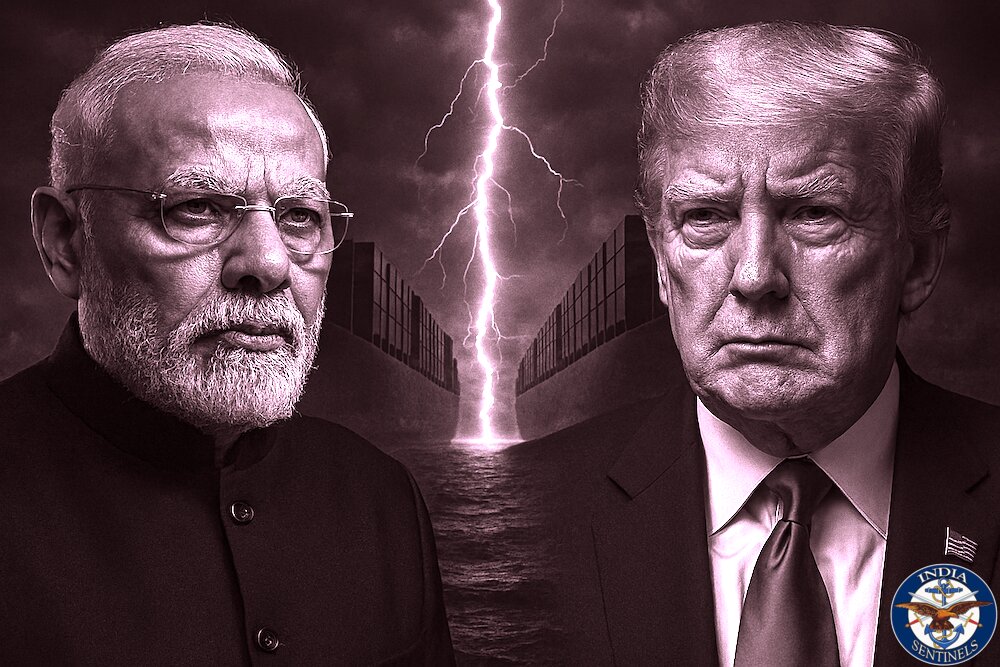
This is not the first time the Trump administration has used tariffs to pressure India. The US–India trade and diplomatic crisis that erupted in August 2025 saw Washington impose sweeping tariffs on Indian exports – initially a 25% reciprocal tariff, followed by an additional 25% penalty tied to India’s continued imports of Russian oil, bringing the total duty to 50%, among the highest imposed on any trading partner. India decried those secondary tariffs as unfair and unjustified, with its commerce ministry stating it would “take all steps necessary to secure national interest.”
Those tariffs, however, ran into a significant legal wall. As reported by India Sentinels in February, the US supreme court ruled, in a 6–3 decision in the “Learning Resources Inc vs Trump” case, that the International Emergency Economic Powers Act (IEEPA) does not authorize the president to impose tariffs. The US chief justice, John Roberts, joined by other US supreme court judges – Sonia Sotomayor, Elena Kagan, Meil McGill Gorsuch, Amy Coney Barrett, and Ketanji Onyika Brown Jackson, held that Trump’s aggressive use of IEEPA – a law reserved for national emergencies – was not permitted. Justices Thomas, Kavanaugh, and Alito dissented.
The court concluded that IEEPA’s grant of authority to “regulate importation” does not include the power to impose tariffs, emphasizing that the power to impose tariffs is a branch of the taxing power reserved for Congress under Article I of the US constitution. The ruling was a rare and significant setback for the administration at a court where it has a 6–3 conservative majority.
Stripped of the IEEPA instrument, the White House moved quickly. Following the supreme court ruling, the USTR launched investigations under different legislation, including the prohibition of trade in goods manufactured by forced labour – which is precisely what has now produced the fresh proposed tariffs on India.
Read also: Trump ‘allows’ India to purchase Russian oil, gives ‘licence’ to New Delhi for 30 days
Irony of ‘forced labour’ charge
India’s domestic legal framework does, in fact, prohibit forced labour – but not as an explicit import prohibition of the kind the USTR demands. Article 23 of the Constitution prohibits trafficking in human beings and all forms of forced labour, while the Bonded Labour System (Abolition) Act, 1976, criminalizes bonded labour. The Bharatiya Nyaya Sanhita, 2023, further criminalizes trafficking and compulsory labour. What India lacks, the USTR argues, is a dedicated statute that specifically bars the import of goods produced elsewhere using forced labour – the standard set by US law under Section 307 of the Tariff Act of 1930. It is a distinction India will need to address, whether through trade negotiations or domestic legislative action, if it wishes to avoid the higher tariff tier.
To partially mitigate supply chain disruptions, the USTR also proposed a specialized textile mechanism that would allow a specific volume of apparel and textile imports from selected economies to enter the US at a reduced tariff rate. Given the significance of textiles in India’s export basket, this carve-out will likely be a focal point in the ongoing trade talks.
For now, New Delhi’s strategy appears to be one of engagement over confrontation – using the bilateral trade negotiations to resolve what it sees as a compliance issue dressed up as a punitive measure. Whether that approach yields results before July 7, when Washington holds its public hearings on the proposed tariffs, will be the immediate test of India’s trade diplomacy.
Follow us on social media for quick updates, new photos, videos, and more.
X: https://x.com/indiasentinels
Facebook: https://facebook.com/indiasentinels
Instagram: https://instagram.com/indiasentinels
YouTube: https://youtube.com/indiasentinels
© India Sentinels 2026-27