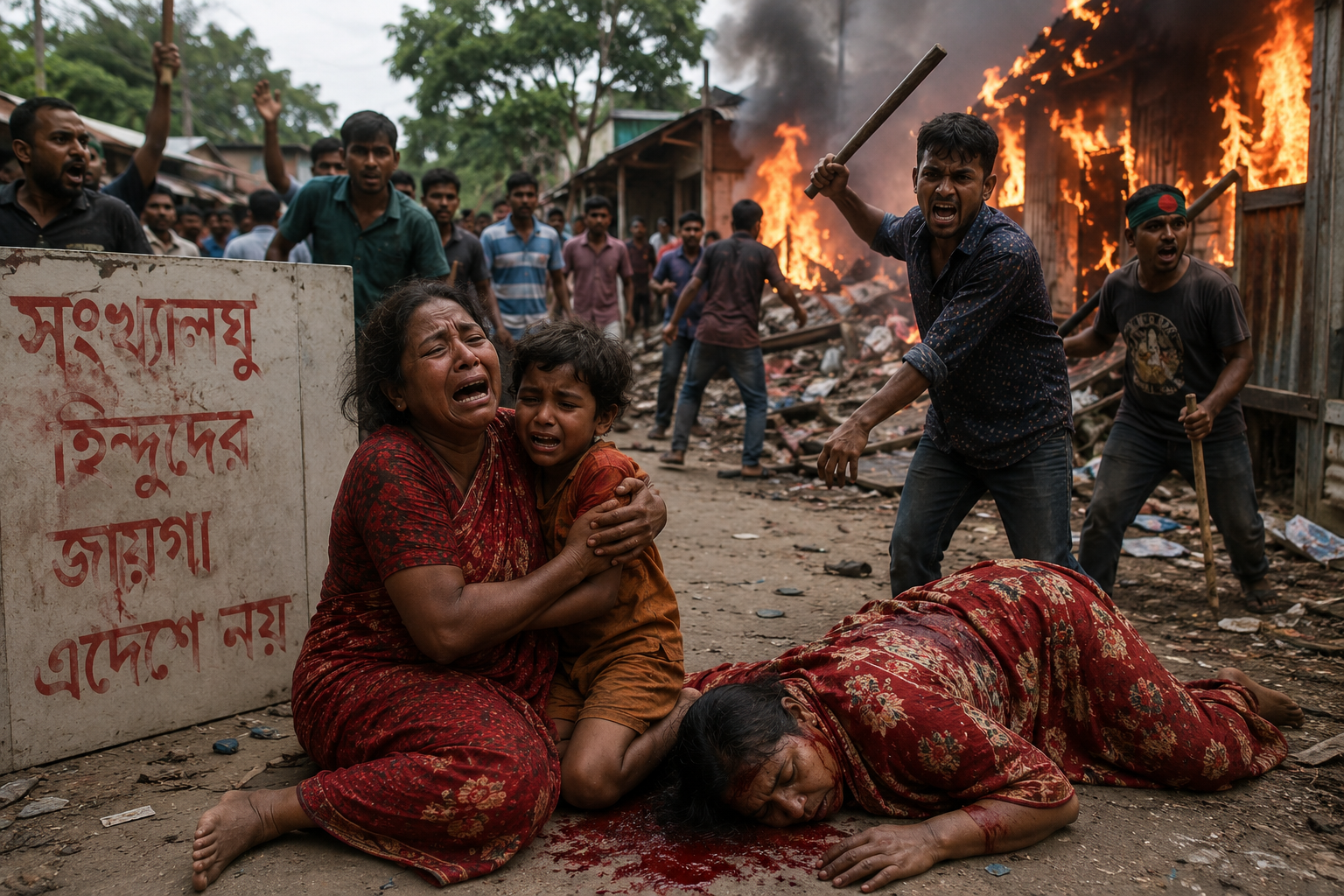
False accusations of blasphemy and “anti-national” activity are no longer spontaneous eruptions of street anger; they are being organised and deployed through social media to prepare the ground for targeted killings of Bangladesh's minorities.
The pre-election violence from Shariatpur to Cox’s Bazar, justified online by branding victims as “Indian agents”, fits a chilling and older pattern of digital incitement followed by real-world bloodshed.
From Rumour to Kill List
Over the past decade, Bangladesh has seen a recurring script: a post or screenshot suddenly appears on Facebook, allegedly insulting Islam or the Quran, and within hours, mobs descend on Hindu, Buddhist or indigenous communities.
Studies of attacks between 2011 and 2022 show how perpetrators consciously use social media as a mobilisation tool, circulating doctored images, hacked accounts and fabricated posts to inflame religious sentiment against minorities.
In Cumilla in 2021, a Muslim man deliberately placed a copy of the Quran at a Durga Puja pandal, where it was photographed and the image shared across social media. He was subsequently identified and arrested. The viral spread of that image set off nationwide vandalism of temples and homes, killing at least seven people and injuring more than 150 across the country.
What has sharpened since then is not the idea of blasphemy itself, but the way digital campaigns now pre-mark specific individuals and localities days before the first stone is thrown. Victims are labelled online as “Indian agents” or “RAW informers”, their photos and addresses circulated in closed WhatsApp groups and public Facebook pages, normalising violence against them as an act of patriotic cleansing rather than a crime. This is not random outrage; it is target selection.
The “Indian Agent” Tag as Digital Death Warrant
The “Indian agent” label cleverly fuses religion and geopolitics, recasting a local Hindu shopkeeper or schoolteacher as an extension of a hostile foreign power. Pakistani and Jamaat-linked networks have repeatedly tried to manufacture anti-India sentiment inside Bangladesh, blaming New Delhi for internal crises while shielding the role of Islamist groups.
Security analysts and media investigations have pointed to the Jamaat-e-Islami ecosystem – including its student wing – as a key vehicle for narratives such as "India Out", amplified through social media campaigns.
Once a minority citizen is branded an “Indian infiltrator” online, any fabricated allegation of blasphemy finds instant traction because the target has already been rhetorically expelled from the national community. In such a climate, a rumour that this “agent” has insulted the Prophet or desecrated the Quran creates a moral panic where violence is framed as both religious duty and nationalist defence. The digital discourse does the ideological work; the mob executes the result.
Blasphemy as Cover for Land Grabs and Demographic Engineering
Documented cases like Ramu (2012), Nasirnagar (2016), Thakurpara (2017), Rangpur (2017) and multiple districts during Durga Puja 2021 show a repeated pattern: incidents alleging insult to Islam are followed by organised attacks on temples, homes and businesses, with land and property of minorities seized in the aftermath.
Human rights groups have recorded thousands of incidents of vandalism, arson and targeted violence against Hindus since 2013, underlining how blasphemy incidents often mask more material motives of dispossession and intimidation.
In places like Bhaluka, Mymensingh, mobs have killed minority members following unverified allegations of religious insult, with entire communities punished collectively, while the original allegation is rarely properly authenticated.
Against this backdrop, the 2026 wave of killings across districts from western Jessore to eastern Cox’s Bazar appears less like an aberration and more like the latest iteration of a tested template. When, immediately after murders, local strongmen and religious fronts move to occupy shops, fields and neighbourhoods left behind by fleeing families, blasphemy looks less like hurt faith and more like a tool of demographic engineering.
The digital campaign creates the moral pretext; those with material interests harvest the fear.
Jamaat, ISI and the Mosque–Student–Social Media Triad
The Pakistan-Jamaat nexus is central to understanding how online narratives are being synchronised with street-level violence, according to security analysts tracking the 2026 Bangladesh crisis. Jamaat-e-Islami Bangladesh and its student wing have a long history of organisational discipline, campus penetration and cadre-based mobilisation, and recent reporting suggests deep links between Jamaat networks and Pakistan's intelligence agency.
Indian and Bangladeshi security assessments indicate that ISI-linked operations have used social media to push anti-India and anti-minority messaging during political crises, though the extent of direct operational control over specific incidents has not been independently confirmed.
Mosques and madrasa circuits, when captured by this ecosystem, become offline amplifiers of what is seeded online: Friday sermons echo the “Indian agent” label, madrasa students are exposed to curated hate content, and Islamist student activists translate digital slogans into street action.
The resulting architecture is hybrid – Facebook posts, encrypted chats, mosque loudspeakers and campus processions all feeding into one ecosystem of fear.
State Inaction and the Normalisation of Pre-Programmed Violence
A consistent feature across episodes from Ramu to Bhola to Cumilla is the sluggish or selective response of law enforcement and the near-total impunity for those who led the mobs. Courts have seen slow trials and few convictions, sending a clear signal that those who weaponise religion online and on the streets can act without serious consequence. This institutional laxity effectively encourages political actors to refine their methods, moving from generic anti-minority riots to finely targeted killings that appear “spontaneous” but are, in fact, digitally pre-organised.
When police move swiftly against alleged blasphemers rather than against those who spread fake posts, the state is not neutral – it is participating in the script written on social media. In an election year, such selective enforcement serves an additional purpose: it terrorises minorities and secular voters, depresses turnout in key constituencies and pushes the polity toward more hardline outcomes.
What the 2026 violence exposes is not merely communal hatred but a sophisticated convergence of technology, ideology and political manipulation. Facebook and other platforms have long known that their weak moderation in Bangla and poor response to hate speech have inflamed communal tensions in Bangladesh, yet meaningful structural reform has lagged behind.
Academic and rights-based research clearly shows that minorities experience social media more as a zone of fear than of free expression, leading to self-censorship and withdrawal from digital public life.
Breaking this cycle requires treating digital incitement – not just physical attacks – as the first crime in a chain of atrocities. That means criminal accountability for those who design and disseminate false “Indian agent” and blasphemy narratives, and strict oversight of platforms captured by extremist messaging. Unless these pre-programming mechanisms are dismantled, Bangladesh's minorities will continue to live one viral post away from the next killing.