 Representational image
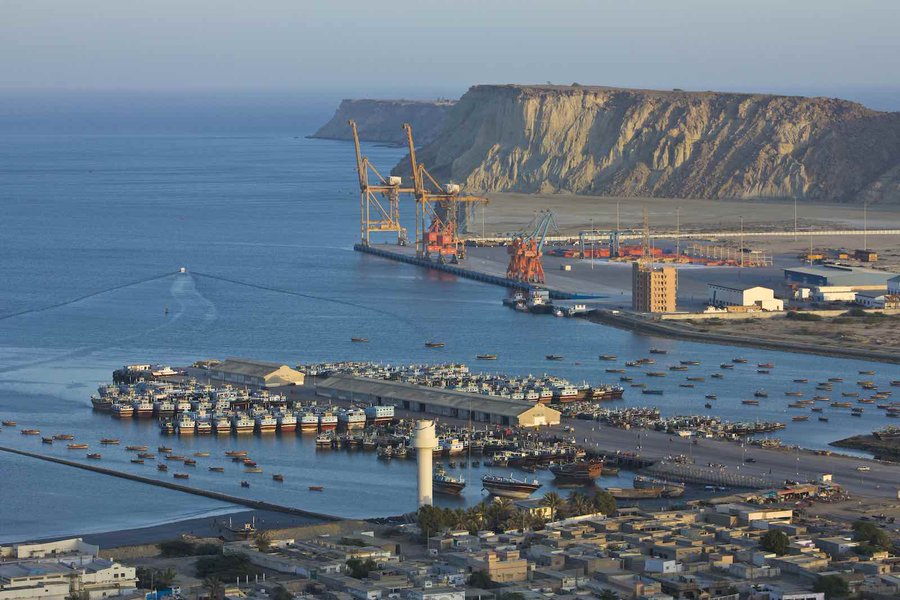
Major military projects typically generate public debate. What makes Gwadar’s naval base planning so striking is the absence of any such discussion. Official planning documents reportedly name a foreign navy as a prospective user of a facility being built on Pakistani sovereign territory.
If strategic infrastructure is being designed with foreign military access as a requirement, not an afterthought, citizens have a right to know and to question it. Without open debate, questions will persist about whose interests are being served, and at what cost.
The Djibouti template
In July 2017, China opened its first overseas military base in Djibouti, framing it as a “support base” for anti-piracy and humanitarian operations. The characterisation was not without basis – China had been contributing to Gulf of Aden patrols since 2008. But the facility expanded substantially. What began as a logistical resupply station grew into an installation capable of supporting China’s largest capital ships, including aircraft carriers, as commercial satellite imagery subsequently confirmed.
A pattern is now well established: a Chinese military foothold justified by anti-piracy rationales, secured through a bilateral arrangement with a state dependent on Chinese financing, then expanded well beyond its original stated scope. The framing shifts; the infrastructure remains and grows.
The Gwadar Naval Base follows this template with uncomfortable precision. The anti-piracy framing is present. The Chinese state-linked firm conducting feasibility work is present. The bilateral financing dependency is present. And the explicit naming of PLA(N) ships as intended users of the base’s logistics facilities is present, not as a hypothetical, but as a design requirement built into the planning documents. Pakistan is not being offered a Chinese military base. It is being guided toward building one itself, on terms that guarantee Chinese naval access, through a process that bypasses public accountability.
The balancing act collapses
Pakistan has historically positioned itself as a country capable of managing simultaneous relationships with competing great powers, extracting strategic rents from multiple sides while preserving room for manoeuvre. This posture has always been more tactical than principled, but it served Islamabad across the Cold War, the post-9/11 entanglements, and the current US–China competition. Pakistan continues to receive American assistance – over $1.1 billion in grants between 2013 and 2024 – and remains embedded in Western-shaped security frameworks.
The Gwadar Naval Base collapses this balancing act. Leaked documents reported in 2024 indicate that Pakistan’s military-backed government privately promised Beijing a Chinese military presence at Gwadar, offered partly as compensation for fraying bilateral relations and as a hedge against Pakistan’s debt exposure to Chinese lenders. In exchange, Pakistan reportedly sought major upgrades in economic and military assistance – assistance intended to insulate Islamabad from the backlash this deal was expected to provoke in Washington.
That backlash is not theoretical. Successive Pentagon reports to Congress have documented China’s push to establish a global logistics and basing network allowing the PLA to project and sustain power at greater distances. Gwadar features explicitly in this assessment. Washington has consistently signalled its opposition to the militarisation of CPEC infrastructure. If formalised PLA (N) access proceeds, the United States faces a binary choice: accept a Chinese naval logistics hub in the northern Arabian Sea, or restructure the bilateral relationship with Pakistan fundamentally.
India’s calculus
For India, the calculation is more direct. The Indian Navy’s primary area of operational responsibility encompasses the northern Arabian Sea, including waters adjacent to Gwadar. A PLA (N)-accessible logistics hub there would enable Chinese naval forces to sustain longer and more capable patrols in waters directly relevant to Indian maritime security, energy supply routes, and commercial shipping through the Strait of Hormuz.
India’s response – accelerated naval modernisation, deepened partnerships with the US and Gulf states, enhanced surveillance of the Makran coast – is both predictable and rational. These are not overreactions to hypothetical threats. They are proportionate responses to infrastructure whose planning documents explicitly name Chinese naval forces as users. The Gwadar Naval Base will not make the Arabian Sea more stable. It will introduce a new axis of strategic competition into waters already under pressure.
The sovereignty question
The question Pakistan’s political and military establishment has conspicuously avoided is whether, in accepting Chinese financing, Chinese feasibility work, and Chinese design requirements for its naval infrastructure at Gwadar, Pakistan has effectively ceded strategic access at one of the world’s most sensitive maritime locations to a foreign power.
The available evidence strongly suggests the answer is yes. The planning documents reportedly acknowledge PLA (N) access. The feasibility study was conducted by a Chinese state-linked firm. The financing structure remains undisclosed. No parliamentary debate has been recorded. And if the leaked documents are accurate, the transaction was made privately by a military-backed government, seeking Chinese support in exchange for a concession whose implications are regional in scale.
Yes, Pakistan has made this concession. No, it was not made with democratic authorisation. No, the Pakistani public was not told. These are not abstract governance concerns. They are the terms on which sovereign territory is being committed to a foreign power’s strategic interests – without parliamentary consent, and without the knowledge of the citizens in whose name all of this was originally justified as development.