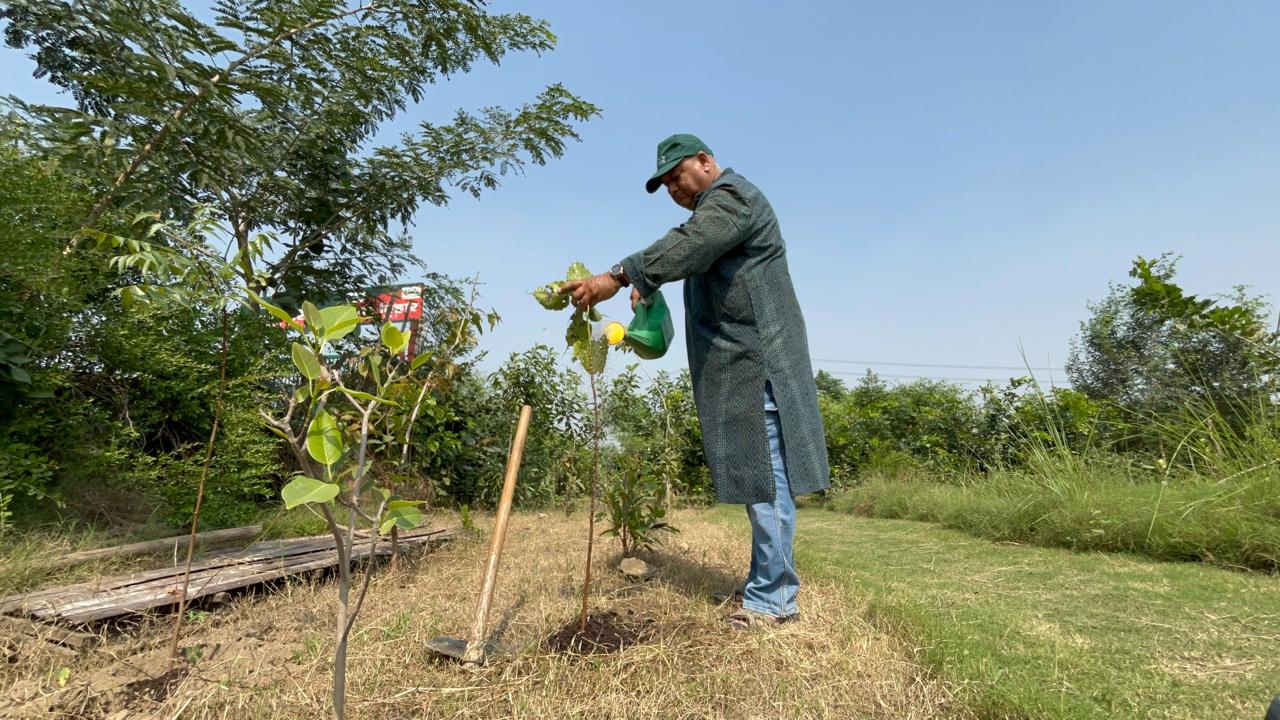
New Delhi: On World Environment Day, Penguin Random House released a book that is part memoir, part conservation chronicle – ‘Ghosts on Peepal Trees’, written by the veteran environmentalist widely known as ‘Peepal Baba’, who has spent 48 years planting, conserving and promoting trees across India. The book was launched at a tree-planting ceremony.
Born out of decades of field notes and diary entries, the book charts how an impulse kindled in an 11-year-old boy – nurtured, by his own account, by a grandmother who introduced him to the forests of Uttarakhand – grew into one of India’s more quietly tenacious green movements.
Peepal Baba says the idea for the book took shape in 2012, but it took more than a decade, and a road accident in November 2024, to finally bring it to completion. Discussions with senior editors at Penguin Books followed his recovery.
“After working at the grassroots level for nearly five decades – restoring vegetation across 270,000 hectares and planting 25 million trees and an equal number of shrubs – I admit that while the change I have brought about may be modest, I did make the effort. That is what matters:” Peepal Baba said.
The scale of the work described in the book is not insignificant. Peepal Baba’s organisation claims to have revegetated 270,000 hectares and planted 25 million trees alongside an equal number of shrubs, working across 226 districts in 22 states. Whether independently verified or not, the figures put it among the larger non-governmental greening efforts in the country. India has in recent years set ambitious forest cover targets under its Nationally Determined Contributions to the Paris Agreement, pledging to create an additional carbon sink of 2.5 to 3 billion tonnes of CO₂ equivalent through forest and tree cover by 2030. Grassroots initiatives of this kind form part of the patchwork on which such national targets depend.
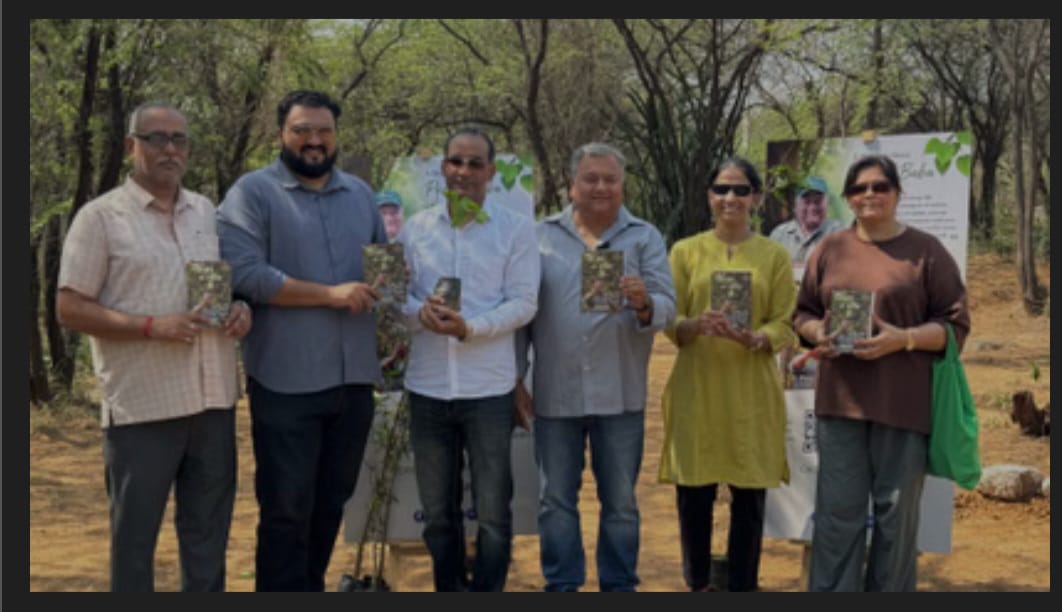
The book draws heavily on Peepal Baba’s childhood, which moved through Kolkata, Dalhousie, Chandigarh and eventually Allahabad. His maternal grandmother – who arrived ostensibly to help at the time of his birth and, by his telling, effectively ran the household until his graduation in 1986 – introduced him to the forests around Corbett, Rajaji, Haridwar, Rishikesh, Uttarkashi and Nainital. That early exposure, he writes, gave him his first lessons in what he calls environmentalism: “that the earth listens, water has a temperament of its own, and a seed is a promise that is never forgotten.”
The narrative is not confined to sentiment. It describes how the campaign adapted its species selection to local conditions – neem in Marathwada, where communities had a particular affinity for it; drought-resistant Aravalli natives such as Lasoda, Baheda, Nirgundi and Karonda in Rajasthan and Gujarat, chosen for their ability to survive extreme heat and their medicinal value. The approach reflects a wider principle that has gained ground among conservationists: that restoration efforts succeed when they respond to local ecology and local culture rather than imposing uniform templates.
Peepal Baba also makes a practical case for urban tree cover. A vendor who sets up under a mature tree, he points out, can avoid paying approximately ₹200 a day in rent for shade, saving around ₹70,000 a year.
The observation is deliberately mundane, aimed at shifting the conversation about trees from the purely ecological to the economically tangible – a rhetorical strategy that conservation communicators have increasingly embraced to broaden public engagement.
Beyond the practical, the book engages with the Peepal tree’s place in Indian cultural and religious life. Ficus religiosa known across South Asia as the Peepal or Bodhi tree carries deep associations in Hindu, Buddhist and Jain traditions.
The Buddha is said to have attained enlightenment beneath one. The tree is revered in Ayurvedic medicine: powdered leaves are used in treatments for asthma, and decoctions from them for cardiac conditions. Peepal Baba uses this pre-existing reverence as an entry point, describing how the word ‘sacred’ opened community doors that appeals to ecology alone might not have.