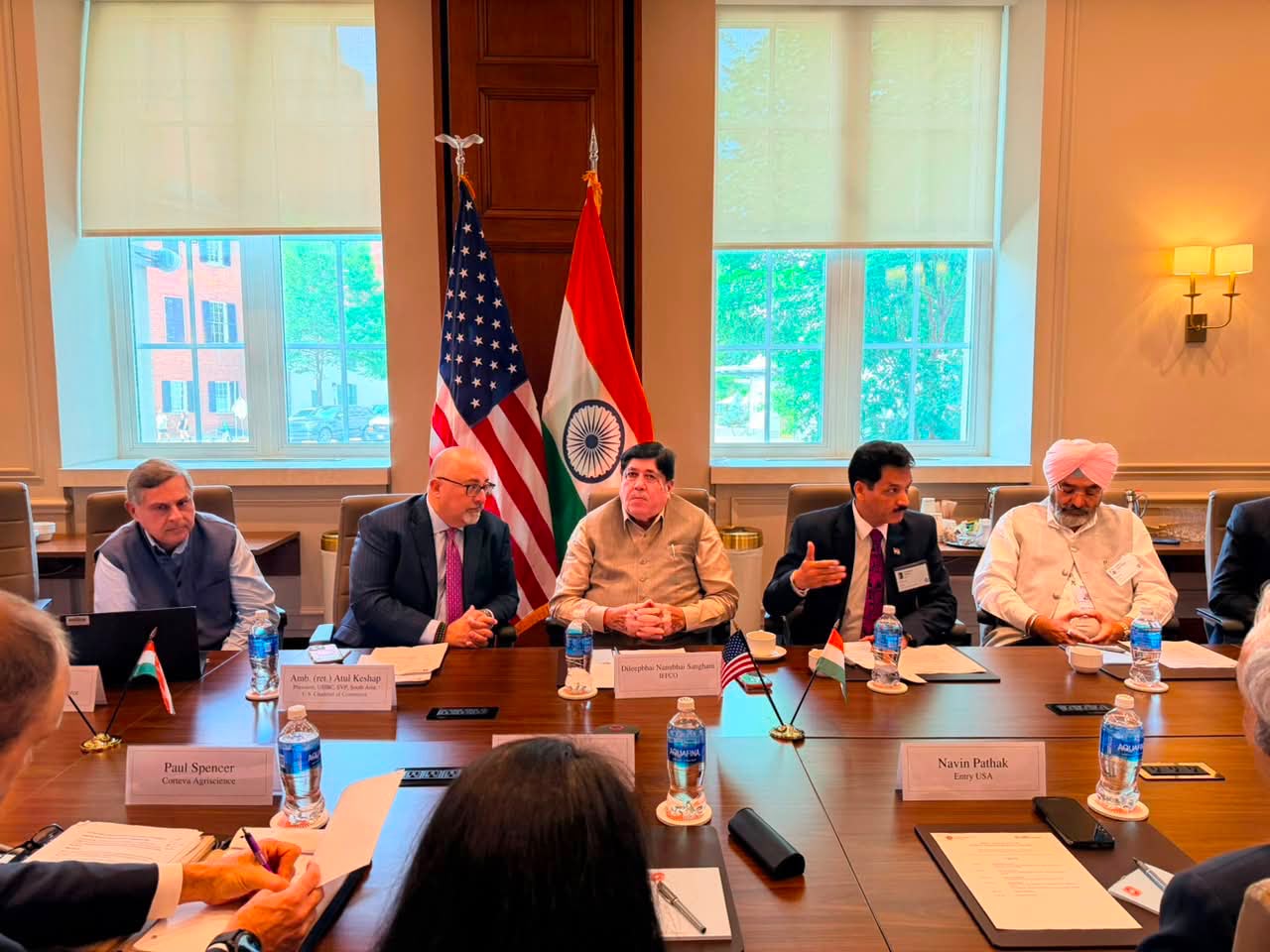
 USIBC hosts PHDCCI delegates in Washington (Photo: IFFCO)
New Delhi: The US-India Business Council (USIBC), the Washington-based advocacy group, hosted a delegation from the PHD Chamber of Commerce and Industry (PHDCCI) on June 2, led by the chairman of the Indian Farmers Fertiliser Cooperative (IFFCO), Dileep Sanghani.
Following the meeting, USIBC flagged the dialogue on its official social media accounts, describing it as a constructive step toward advancing agricultural cooperation between the two countries.
IFFCO, established in 1967, is among the world’s largest fertilizer cooperatives and supplies a significant share of the urea and complex fertilizers consumed by Indian farmers.
Sanghani, a veteran cooperative leader from Gujarat who has served as a member of parliament, has in recent years positioned the organization as an active participant in global agricultural diplomacy, including engagements with multilateral bodies and bilateral forums.
According to IFFCO, the Washington discussions covered a range of subjects: improving farm productivity, expanding the uptake of precision agriculture and other advanced technologies, soil health management, direct technical support to farmers, developing innovation-based agricultural solutions, and strengthening food and nutritional security.
Agricultural experts, policymakers, and industry representatives from both sides took part, though the organization did not identify participants individually or release a formal agenda.
India and the United States have over the past decade significantly expanded their agricultural engagement, with cooperation spanning crop science research, biotechnology regulation, agri-tech investment, and food safety standards.
USIBC, which was founded in 1975 and functions under the U.S. Chamber of Commerce, has played a recurring role in facilitating trade and investment ties between the two countries across sectors including energy, healthcare, and agriculture.
The India-US agricultural trade relationship, valued at over $8 billion annually, covers commodity exports, processed foods, and agri-inputs.
For IFFCO, the meeting is part of a broader international outreach strategy. The cooperative has in recent years forged partnerships with companies in the United States, Israel, Canada, and several European nations for technology transfer and joint research in areas such as nano-fertilizers – a field in which IFFCO has made notable investments domestically.
The organization launched nano-urea commercially in 2021 and has since positioned it as a low-cost, environmentally lower-impact alternative to conventional urea, though independent scientific review of its efficacy remains ongoing.
USIBC’s decision to highlight the meeting publicly is notable if not unusual – the council routinely publicizes high-level engagements as part of its mandate to promote bilateral business ties. Whether the discussions produce concrete agreements or institutional follow-ups remains to be seen; IFFCO did not announce any memoranda of understanding or joint initiatives arising from the meeting.
The PHDCCI, one of India’s older industry chambers with roots in northern India, has maintained a track of international engagement on trade policy and industrial promotion. Its inclusion in the USIBC meeting suggests the discussions were framed in a broader industry-to-industry context rather than as a purely cooperative or government-aligned exercise.
India’s agricultural sector, which employs roughly half the country’s workforce and accounts for around 17 percent of GDP, faces persistent structural challenges including fragmented landholdings, variable monsoon dependence, input cost pressures, and supply chain inefficiencies.
Engagement with American institutions on technology and policy is widely seen in government and industry circles as one avenue – among many – for addressing some of these constraints over the medium to long term.