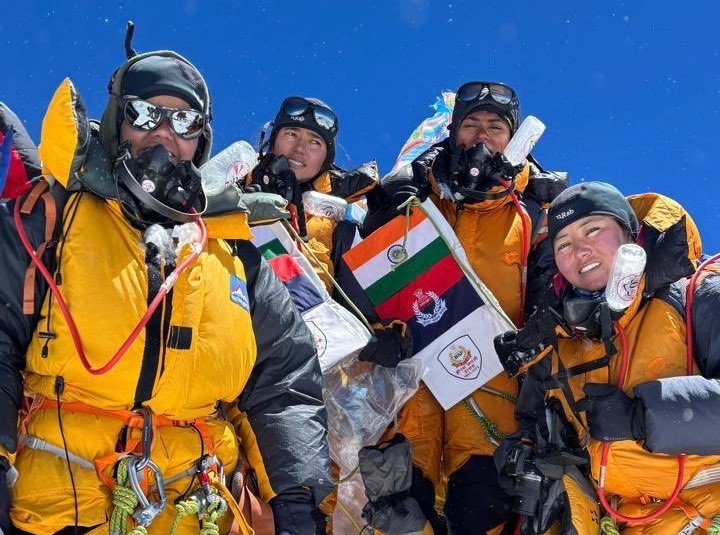
 BSF women mountaineers complete historic Everest bid (Photo: BSF)
The recent successful scaling of Mount Everest by four Border Security Force women personnel is not merely a mountaineering achievement. It is, in many ways, a quiet but profound social statement.
Because history shows us something uncomfortable yet undeniable, for a large part of human civilization, nearly half of humanity was denied the same freedoms, rights and opportunities as the other half. Even societies that today proudly describe themselves as progressive granted women equal political rights only in the relatively recent past. The contradiction was striking, cultures often glorified women symbolically as the “fairer sex”, while simultaneously restricting their agency in law, education, mobility, property rights and public life.
Societies, however, evolve. They must.
Over time, many nations began recognizing an essential truth, no society can fully progress while suppressing the potential of its women. The empowerment of women slowly ceased to be viewed merely as charity or symbolism, it became understood as fundamental to the intellectual, economic and moral health of a civilization itself.
But history also reveals the reverse side of this realization.
If empowering women strengthens societies, then controlling women can become a means of controlling societies.
This pattern repeats itself across eras and geographies. Orthodox structures and authoritarian regimes have often sought influence not merely through political control, but through regulation of women’s lives, their education, movement, visibility, employment, autonomy and even clothing. Because at the level of the family, the foundational unit of society, women and men exist in deep interdependence. Restricting women inevitably reshapes the aspirations, freedoms and psychological climate of entire communities.
One sees this starkly in contemporary examples such as Afghanistan under Taliban rule, where girls’ education, women’s employment and public participation have faced severe curbs. Similar tensions periodically surface in Iran, where questions surrounding women’s autonomy often become flashpoints for larger struggles over identity, morality, and state authority. Such systems instinctively understand that controlling women frequently means shaping the future direction of society itself.
Which is precisely why the image of BSF women soldiers standing atop Everest carries such extraordinary symbolic weight.
These women are not merely climbers. They represent mobility where there was once restriction, confidence where there was once hesitation, and participation where there was once exclusion. They symbolize a society increasingly willing to view women not through fragile or protective lenses alone, but as equal participants in endurance, leadership, discipline, national service, and human aspiration.
And perhaps most importantly, such moments reshape collective imagination.
Young girls watching these images no longer see impossible frontiers. Families begin to see capability differently. Institutions begin to normalize women in spaces once considered inaccessible. The societal imagination itself expands.
That is why milestones like this matter far beyond ceremony or headlines. They are indicators of the direction in which a civilization is moving.
For ultimately, the condition of women is rarely just a “women’s issue”. It is often among the clearest reflections of whether a society is moving towards openness, confidence, and progress, or towards fear, rigidity and control.
Disclaimer: The views expressed in the article are the author’s own and don’t necessarily reflect the views of India Sentinels.
Follow us on social media for quick updates, new photos, videos, and more.
X: https://x.com/indiasentinels
Facebook: https://facebook.com/indiasentinels
Instagram: https://instagram.com/indiasentinels
YouTube: https://youtube.com/indiasentinels
© India Sentinels 2026-27