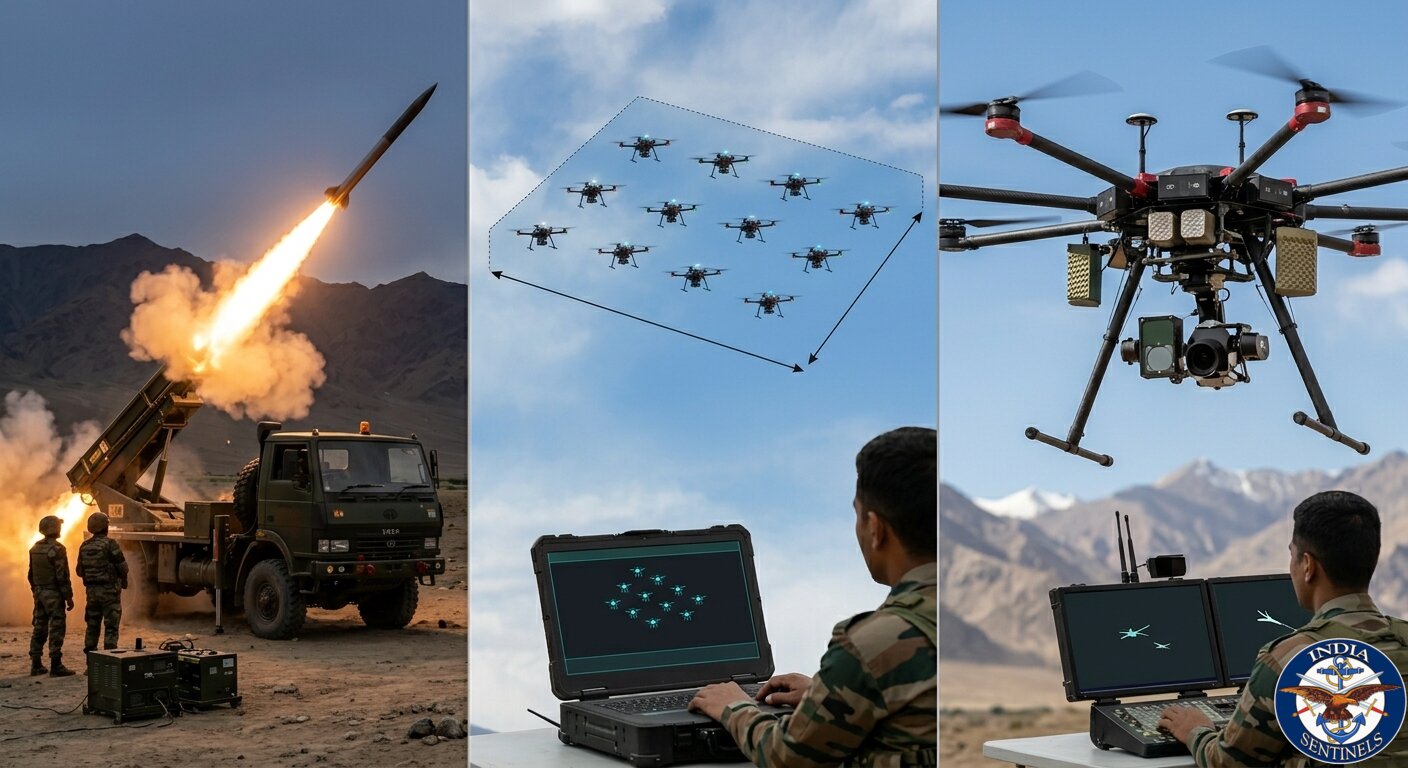
 Illustration for representation. (© India Sentinels 2026–27)
New Delhi: The Indian Army’s Directorate General of Army Air Defence has floated requests for information (RFIs) for three different aerial target systems – an intermediate rocket-based target, a swarm-drone target system, and a multirotor copter target. This move comes as the Army moves to modernize live-fire training for air-defence units in response to the rapidly evolving unmanned aerial threat.
The RFIs, issued last week, are aimed at creating a layered training ecosystem that mirrors the increasingly complex air-threat environment faced by modern militaries. Vendors have been asked to submit responses by August 24, while a pre-submission meeting is scheduled for July 17 at Sena Bhawan in New Delhi.
Taken together, the three requirements indicate the Army’s effort to provide air-defence crews with realistic targets representing a spectrum of threats, from slow-moving drones to swarm attacks and missile-like aerial targets.
Rocket-based intermediate target
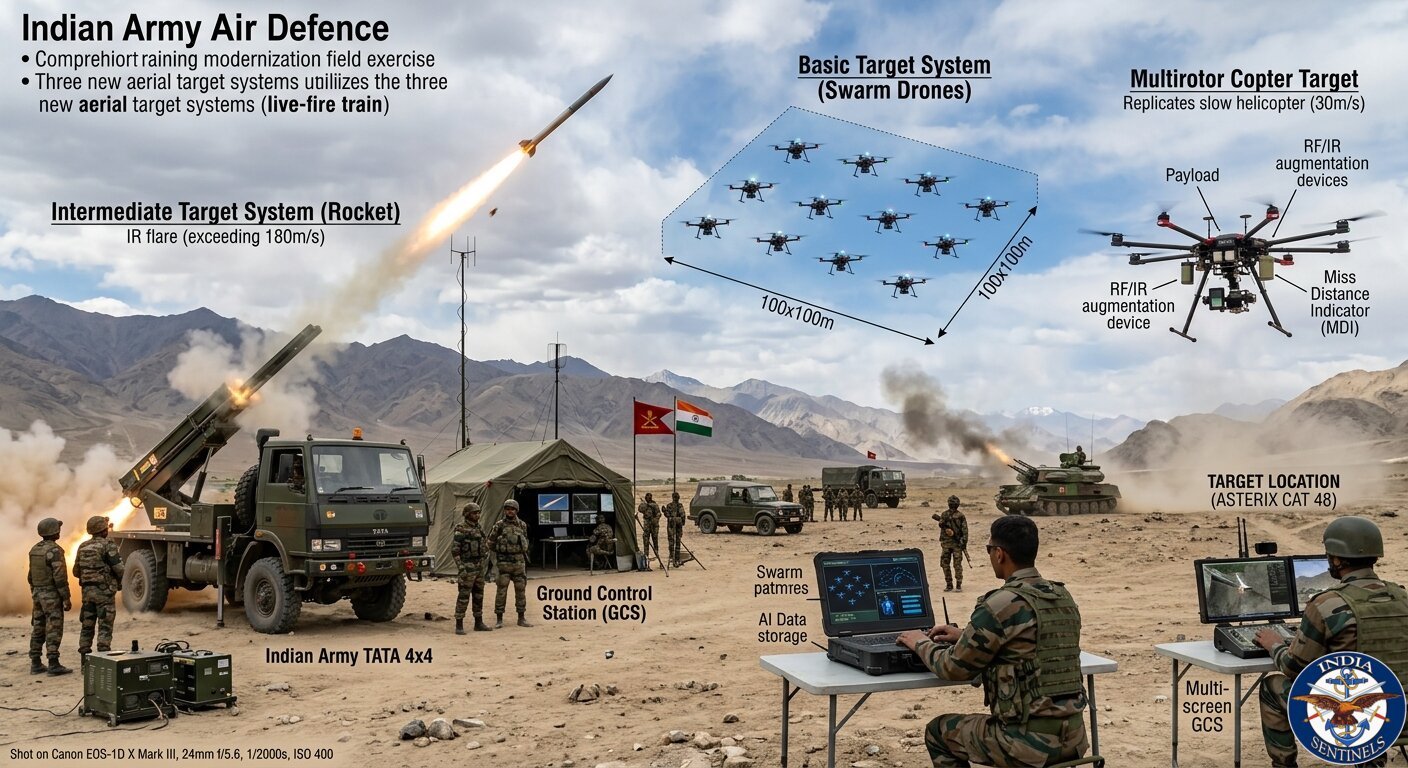
The first RFI seeks an intermediate target system in the form of a rocket that can provide an infrared (IR) signature for missile crews training with IR-homing air-defence weapons.
According to the requirement, the rocket must attain a minimum speed of 180 metres per second, remain airborne for at least 30 seconds, and provide a stable IR signature for a minimum of 20 seconds. It should be capable of operating from launch sites up to 4,200 metres above mean sea level and reach an altitude of at least 1,500 metres above ground level, while covering a range of more than six kilometres.
The Army wants the system to be launched from a rail or tube launcher mounted on a standard 2.5-tonne vehicle or lighter platform. The launcher should be ready for use within 15 minutes. Safety measures include a stainless-steel mesh enclosure around the flare assembly to prevent accidental dropping.
The associated ground control system must be able to record at least two hours of data and provide a minimum storage capacity of 256GB. The system is also required to function in temperatures ranging from –10°C to +45°C and withstand storage conditions from –20°C to +55°C.
The Army has sought pricing for different procurement scales, ranging from up to 50 rockets to more than 150, with separate costs for launchers, support equipment, and individual rockets.
Swarm-drone target system
The second RFI focuses on a basic target system consisting of a swarm of 12 drones designed for training against emerging drone-swarm threats and for engagement by air-defence weapons, including directed-energy systems.
Each drone must be recoverable and reusable if it survives an engagement. The swarm is required to fly at speeds of at least 30 metres per second, remain airborne for a minimum of 30 minutes, and operate at altitudes of 1,000 metres or higher above ground level.
The 12 drones must be capable of coordinated swarm operations within a footprint not exceeding 100 metres by 100 metres and within a 50-metre vertical band. Individual drones should have a radar cross-section of one square metre or less, although vendors may propose methods of increasing radar visibility for training purposes.
The system is expected to include vertical take-off and landing capability, a ground control station with swarm-management functions, mission-planning software, an inbuilt simulator, and post-flight analysis tools.
Significantly, the Army has also sought details on artificial-intelligence compatibility. Vendors have been asked whether their systems can store and manage a month’s worth of sortie data for use in developing AI-based training models. The requirement points to growing interest in incorporating AI into air-defence training and operational analysis.
The Army is seeking cost estimates for sets comprising 12 drones along with associated control and support equipment.
Multirotor target to simulate helicopters
The third RFI concerns a multirotor copter-based aerial target intended to simulate slow-moving helicopter-type threats for air-defence weapon crews.
The platform must support simultaneous control of at least two aerial targets from a single ground control station. It should achieve speeds of up to 30 metres per second and provide endurance ranging from 20 to 45 minutes depending on operating speed.
The system must be capable of operating from launch altitudes up to 4,200 metres above mean sea level, fly up to 1,000 metres above ground level, and remain controllable at ranges of at least 15 kilometres.
A notable feature is its modular payload design. The Army requires the platform to accommodate radar-reflection enhancement, IR-signature augmentation, and a miss-distance indicator capable of measuring engagement accuracy within one to two metres. Such features would allow the system not only to serve as a target but also to help assess the effectiveness of air-defence engagements.
The ground control station must be capable of exporting live target-location data in ASTERIX CAT 48 format, enabling integration with existing air-defence command-and-control networks.
The RFI also specifically asks vendors to disclose whether any Chinese-origin components are used in their systems, reflecting the broader push within India’s defence sector to reduce dependence on Chinese technology and supply chains.
Indigenous procurement
All three RFIs will follow a single two-stage bid process under the Defence Acquisition Procedure 2020, under which technical and commercial bids are submitted separately.
The procurement is being pursued under the Buy (Indian-IDDM) category, requiring a minimum indigenous content of 50%. Vendors shortlisted through technical evaluation will be required to demonstrate their systems during field trials in India on a no-cost, no-commitment basis.
Successful bidders will also have to provide a performance-cum-warranty bond worth 5% of the contract value and comply with other requirements, including defence industrial licensing provisions.
Reflecting lessons from modern conflicts
The Army’s move comes at a time when drones, loitering munitions, cruise missiles, and coordinated swarm attacks are reshaping battlefield dynamics across the world. Conflicts ranging from the Russia-Ukraine war to fighting in West Asia have demonstrated how relatively inexpensive unmanned systems can challenge conventional air-defence networks and impose disproportionate costs on defenders.
For India, the lessons have become increasingly relevant. The armed forces have been accelerating efforts to strengthen counterdrone and air-defence capabilities, while also adapting training methodologies to account for emerging threats. The need is no longer limited to acquiring new weapons; it also extends to ensuring that operators train against realistic targets that replicate modern battlefield conditions.
The experience of Operation Sindoor in May 2025 further underscored the importance of the drone and counterdrone dimension of warfare. As unmanned systems become more sophisticated and widely available, training infrastructure must evolve accordingly. Reusable aerial targets capable of replicating drone swarms, helicopter-type threats, and IR-signatured missile targets are increasingly viewed as essential tools for preparing air-defence units for future combat.
The RFI stage remains exploratory and does not constitute a formal procurement commitment. The Ministry of Defence retains the right to modify, suspend, or withdraw the process at any stage. However, the simultaneous pursuit of three distinct target categories provides a clear indication of the Army’s intent to overhaul air-defence training in line with the realities of contemporary warfare.
Follow us on social media for quick updates, new photos, videos, and more.
X: https://x.com/indiasentinels
Facebook: https://facebook.com/indiasentinels
Instagram: https://instagram.com/indiasentinels
YouTube: https://youtube.com/indiasentinels
© India Sentinels 2026-27