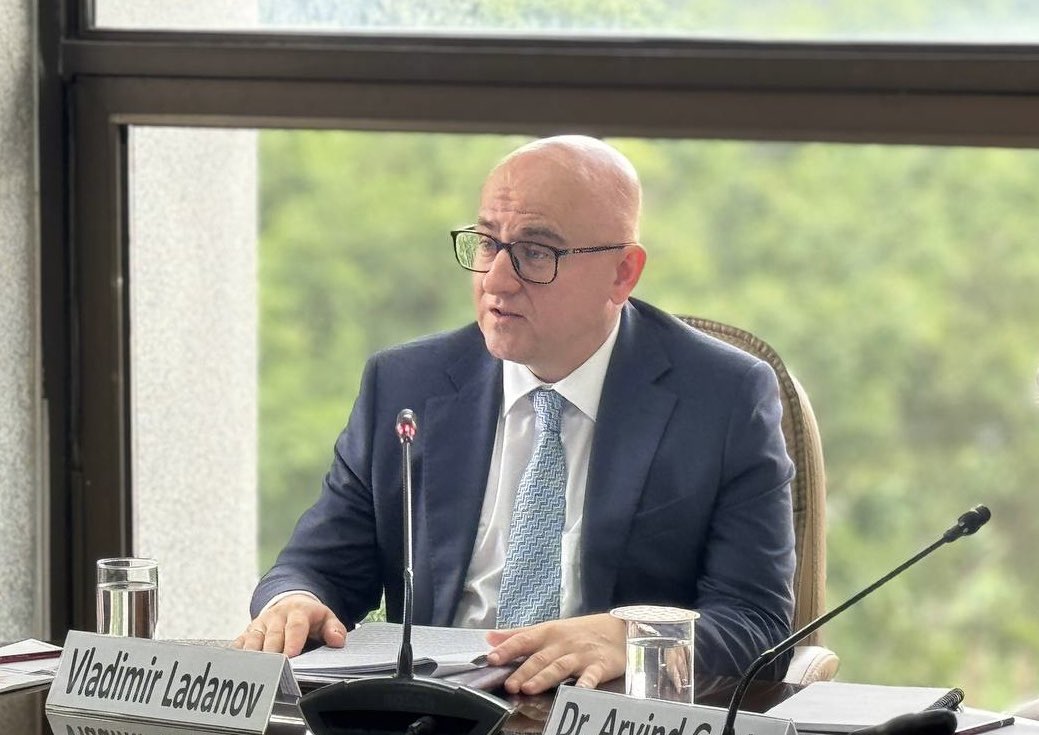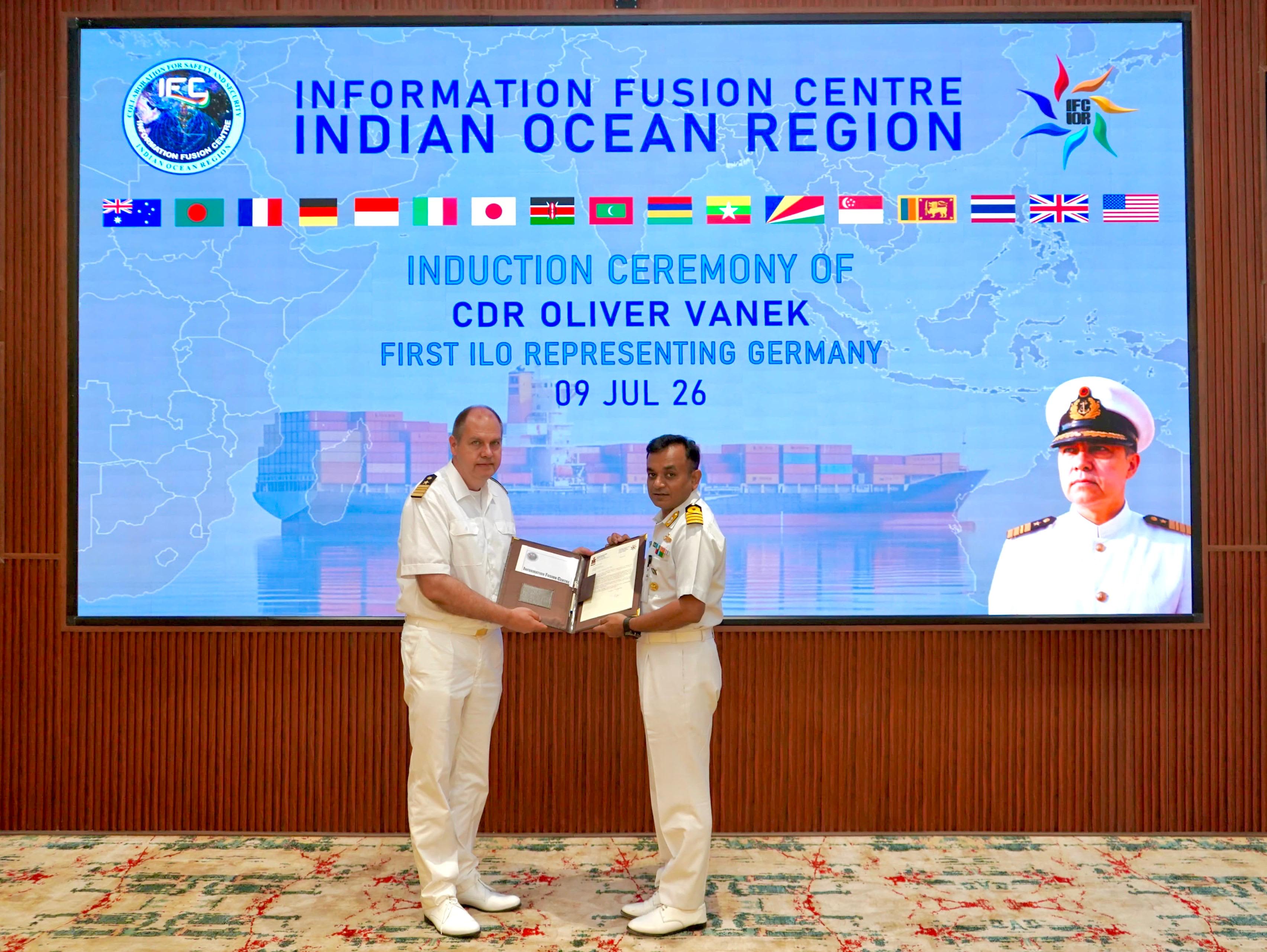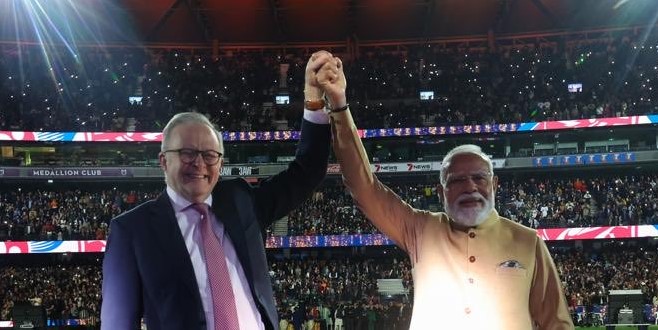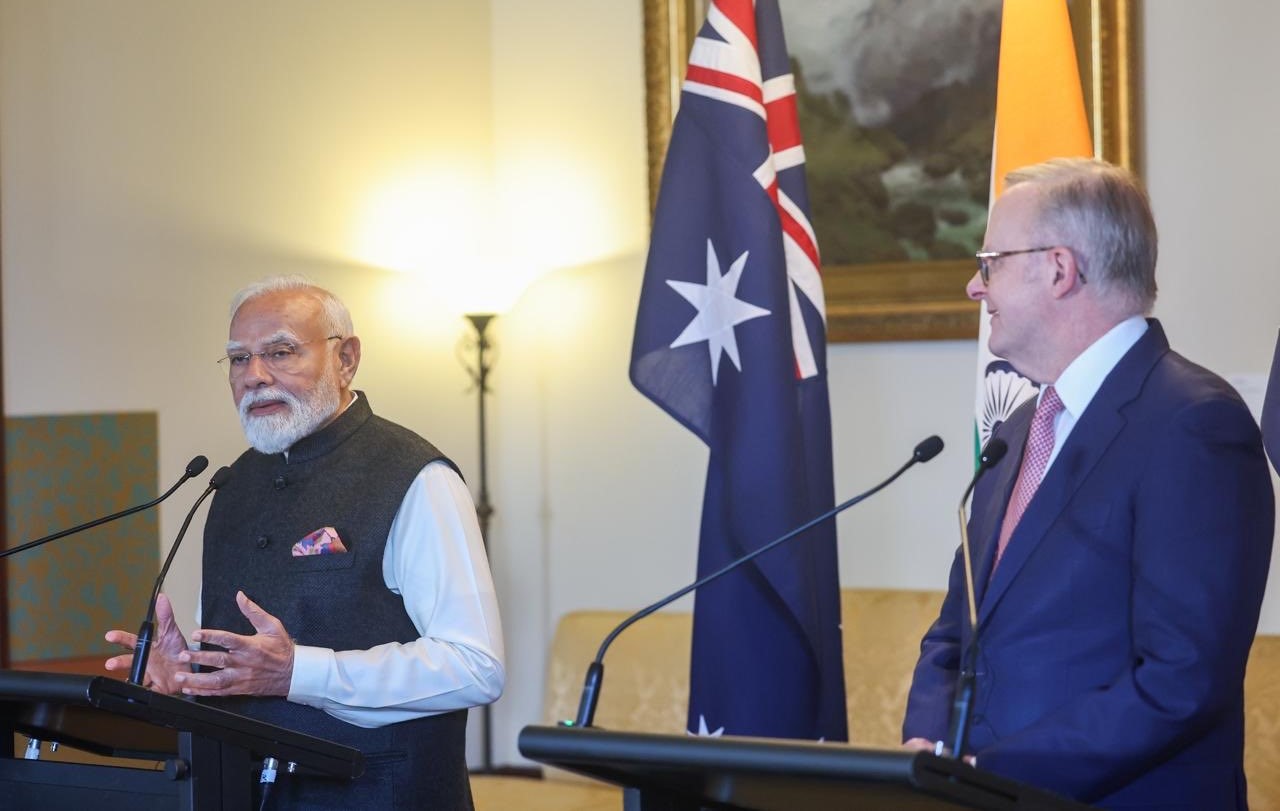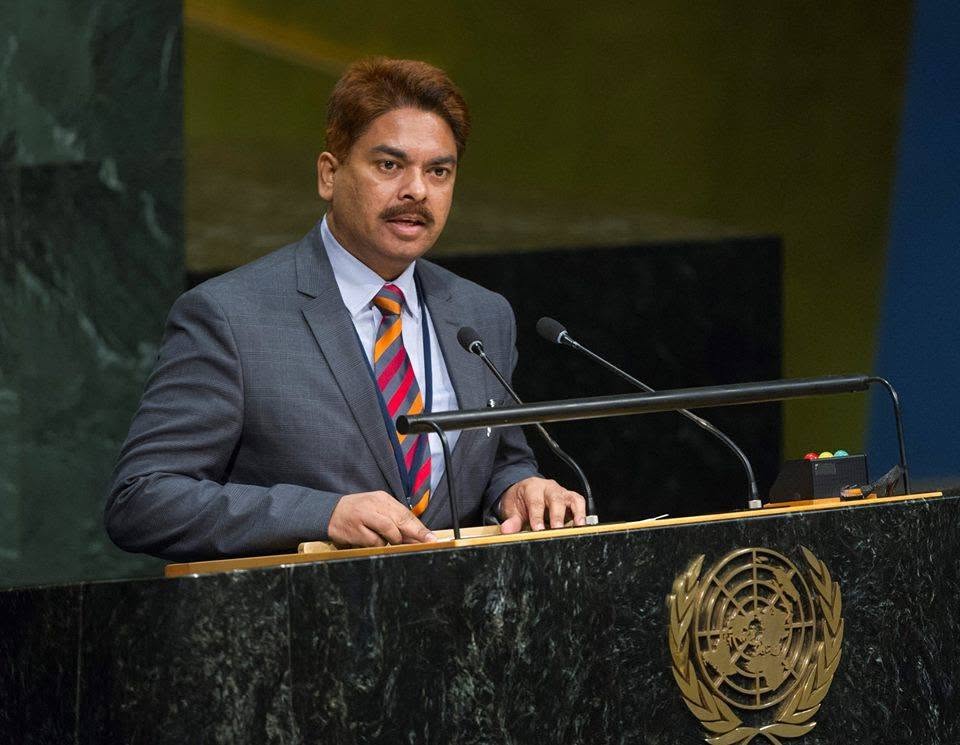
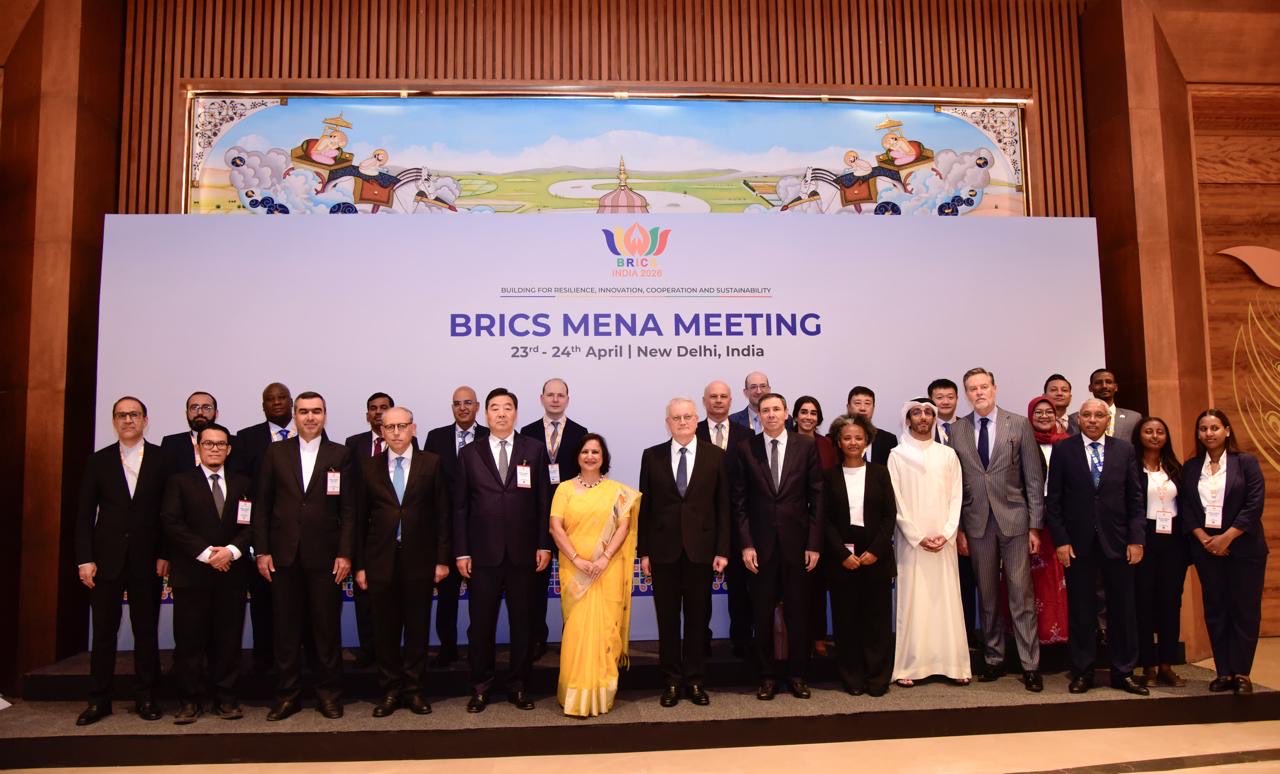
 BRICS diplomats at the BRICS MENA meeting in New Delhi. (Photo: MEA)
New Delhi: A meeting that was meant to project the strength and solidarity of the world’s most consequential emerging-economy bloc ended on Friday, in New Delhi without the one thing that would have signalled unity: a joint statement. The BRICS Middle East and North Africa (MENA) meeting of deputy foreign ministers and special envoys, held on April 23–24 under India’s chairship, concluded with nothing more than a chair’s summary – the diplomatic equivalent of agreeing to disagree.
The meeting was convened against the backdrop of an escalating conflict in West Asia that has consumed the region since February 28, when the United States and Israel launched coordinated strikes on Iranian military and nuclear installations, killing Iran’s Supreme Leader, Ayatollah Ali Khamenei, and several senior military figures. Iran’s retaliatory strikes on American military bases in Bahrain, Kuwait, and across Gulf Cooperation Council countries drew the UAE – itself a BRICS member – directly into the line of fire.
The meeting, therefore, brought together two BRICS members, Iran and the UAE, who are effectively on opposite sides of an active war. That structural tension was always going to make consensus difficult.
The Ministry of External Affairs (MEA) spokesman, Randhir Jaiswal, acknowledged the impasse squarely. “A joint statement was not possible because a general consensus could not be reached among the members regarding the ongoing conflict in West Asia,” Jaiswal said at an inter-ministerial briefing.
The chair’s summary released in lieu of a joint statement said participants had “expressed deep concern on the recent conflict in the Middle East and offered views and assessments on the matter” – language so cautious it borders on meaningless in a region where, according to international humanitarian organizations, tens of thousands of civilians have been killed.
But the Iran-UAE fault line, expected and understood by all parties, is only half the story. The more troubling revelation – reported first by The Wire [archived link] and sourced from multiple anonymous diplomats present at the talks – is that India’s own position on the Israel-Palestine question proved a second, equally significant obstacle to a joint statement.
According to those diplomatic sources, officials from the MEA sought to water down language agreed upon at previous BRICS summits in Brasilia in 2025 and Kazan in 2024. Specifically, India’s negotiating team pushed to soften the language criticising Israel for its bombardment of Gaza and Lebanon, drop a reference to “East Jerusalem” as the designated capital of a future Palestinian state under the two-state solution, and replace direct references to “Israel” in the context of West Bank operations with the vague formulation “occupying power.”
One diplomat, speaking on condition of anonymity to The Wire, expressed frank bewilderment: “We were very surprised as India has agreed to such language at many multilateral fora.”
The reaction from across the BRICS table was unambiguous. Representatives from Russia, China, Brazil, South Africa, Egypt, Ethiopia, Indonesia, the UAE, and Iran – in other words, every other member at the table – found India’s proposed dilutions unacceptable.
Congress leader Jairam Ramesh, the party’s general secretary for communications, was quick to place the episode in political context. In a post on X on Monday, he described India’s position as “shocking and shameful,” adding that India had become “the only major country in the world to continue to show such steadfast solidarity with the Israeli regime.” His remarks, though pointed and partisan, nevertheless identified a diplomatic reality that New Delhi’s own MEA has not convincingly refuted.
The MEA, for its part, pushed back against what it described as “speculative and inaccurate reporting,” and pointed to the India-Arab League Foreign Ministers’ meeting held in New Delhi in January 2026 as evidence of India’s balanced approach – a joint statement from that meeting had, it noted, been endorsed by Palestine itself. However, that response sidestepped the specific allegations regarding BRICS negotiations.
The geopolitical calculus driving India’s current posture is not obscure. As The Diplomat and The Print have each noted, India is navigating a treacherous set of competing pressures: an ongoing tariff negotiation with the Trump administration, deepening defence cooperation with Israel – cemented dramatically by the prime minister, Narendra Modi’s, address to the Israeli Knesset on February 25, just 48 hours before the US-Israel strikes on Iran – and a chronic anxiety about China exploiting any BRICS consensus to advance its own strategic agenda. Professor Srikanth Kondapalli of Jawaharlal Nehru University, speaking to ANI [archived link], has described India’s dilemma plainly: “For India to take side on one as against the other would be problematic given its position on non-alignment and other positions.”
A former military-leader-turned diplomat speaking to India Sentinels on the condition of anonymity said, “To see New Delhi now emerge as the odd nation out in a BRICS room – isolated not by Russia or China, but from them, on the question of Palestinian rights – is, for many who have watched Indian foreign policy over the years, both surprising and, if we are being candid, genuinely saddening.”
He further said the strategic costs is real.
“The energy stakes [India sources nearly 88 per cent of its oil imports from abroad, with the Strait of Hormuz a critical chokepoint] are real. The safety of nearly one crore Indians living and working in the Gulf is real. All of this is understood, and it argues for a degree of caution and balance.”
Other observers are generally in agreement that what is harder to defend is the specific choice to dilute internationally agreed language on Palestinian statehood – language India itself helped negotiate and adopt at Kazan and Brasilia. They say India’s greatest diplomatic asset has long been its capacity to maintain dialogue across divides. That asset is built on credibility, and credibility rests on consistency.
It may be recalled that for decades, India’s position on Palestine was rooted in the Non-Aligned Movement’s foundational convictions, in the memory of Yasser Arafat’s visits to New Delhi, and in a principled rejection of the dispossession of a people from their land.
Follow us on social media for quick updates, new photos, videos, and more.
X: https://x.com/indiasentinels
Facebook: https://facebook.com/indiasentinels
Instagram: https://instagram.com/indiasentinels
YouTube: https://youtube.com/indiasentinels
© India Sentinels 2026-27