New Delhi: Rashmi Group, the Kolkata-headquartered steel and mining conglomerate with annual revenues of roughly $575 million, has signed a memorandum of understanding (MoU) to invest approximately $300 million in Ethiopia’s mining sector.
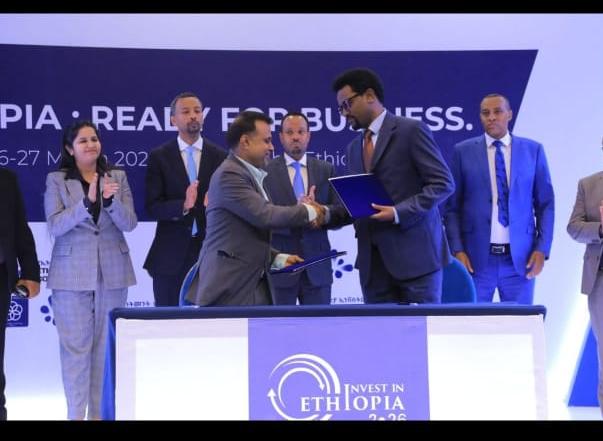
The agreement was concluded at the “Invest in Ethiopia – High-Level Business Forum 2026” in Addis Ababa, where the group also filed applications for gold mining licences in the western regions of Gambela and Benishangul-Gumuz.
The MoU was signed between Sunil Kumar Patwari, the chief executive of Rashmi Group, and Zeleke Temesgen, in the presence of Ahmed Shide and Brook Taye.
The proposed investment covers gold exploration and mine development, as well as the construction of aggregate production and mineral processing facilities aimed at supplying Ethiopia’s infrastructure and construction industries.
Gambela and Benishangul-Gumuz lie within Ethiopia’s western greenstone belt terrain, part of the broader Arabian-Nubian Shield, a vast Precambrian rock formation spanning nine countries from the Nile basin to the Saudi highlands and recognised as one of Africa’s most significant gold-bearing geological structures.
The Benishangul-Gumuz region, in particular the Asosa zone, hosts gold deposits associated with shear-zone-controlled quartz veins and pan-African schist belts, and has historically supported both artisanal and small-scale commercial mining.
Ethiopia’s formal gold sector, however, has largely remained underdeveloped, with output declining sharply from around 12 tonnes in 2013 to under four tonnes by 2018 before a modest recovery driven by artisanal activity during the pandemic years.
The investment comes at a time of deliberate policy liberalization in Ethiopia. Addis Ababa has been rolling out its “Home-Grown Economic Reform Agenda 2.0”, a broad market-opening programme targeting export revenues, foreign direct investment, and private-sector participation in sectors previously dominated by state-owned enterprises.
The broader context for such investment has been strengthened by a diplomatic upgrade. In December 2025, during the prime minister, Narendra Modi’s, bilateral visit to Addis Ababa, his first to Ethiopia, the two countries elevated their relationship to a “strategic partnership” and signed eight agreements covering customs cooperation, digital infrastructure, defence training, and artificial intelligence.
The two-way trade stood at approximately $2.3 billion in 2024–25, with more than 615 Indian companies currently operating in Ethiopia.
Africa as a continent produces close to 800 tonnes of gold annually, representing roughly a quarter of global output, yet refining capacity across the continent outside South Africa is limited. Ethiopia is among the countries seeking to change that equation, though translating policy intent into operational infrastructure has proved slow.
“Ethiopia’s geostrategic location, its economic reforms, and the elevation of India–Ethiopia relations to a strategic partnership all provide additional confidence for Indian investors. According to IMF forecasts for 2026, Ethiopia is expected to grow at 9.2%, making it one of the fastest-growing economies in the world.”
— Anil Kumar Rai, Indian ambassador to Ethiopia
Patwari said the proposed outlay reflected confidence in the Ethiopian market and a longer-term ambition to use the country as a base for wider engagement across Africa.
“Through technology transfer, infrastructure development, mineral processing, and local employment generation, we aim to contribute to Ethiopia’s economic transformation,” he said.