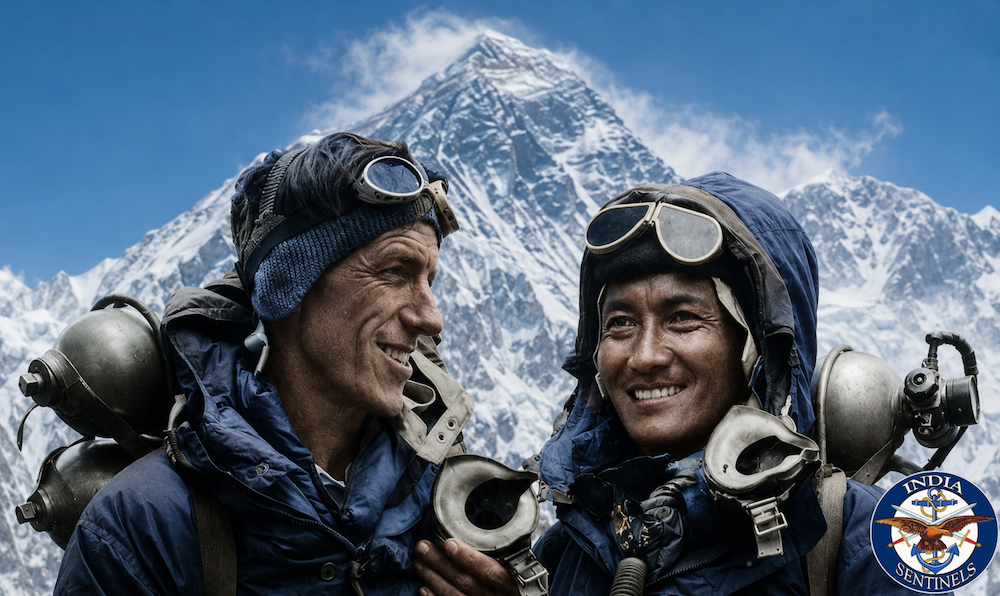
 Edmund Hillary (L) and Tenzin Norgay.
There is a reason Mount Everest is spoken about differently from other mountains, with a fascination that feels almost mythic. More than a peak, Everest has become a mirror to human ambition. The story of Everest is ultimately less about altitude and more about the human mind. The word most often associated with Everest is “conquest”. Perhaps because Everest has never represented merely a mountain. It represents a deeply human urge, the desire to step beyond fear, certainty and limitation.
As the world marks the anniversary of the first confirmed ascent of Mount Everest on May 29, 1953, tributes naturally flow towards Edmund Hillary and Tenzing Norgay. Their achievement altered the history of mountaineering forever. Yet beneath that iconic moment lies another fascinating question, one that says as much about civilization as it does about mountains.
Why did a New Zealander become the first man to summit Everest, despite millions living in the shadow of the Himalayas for centuries? And why did women arrive in mountaineering much later still? The answers perhaps lie not in race or genetics, but in culture, psychology and the way societies shape ambition itself.
Adventure is never only about physical strength. It is also about social permission. Much of the western expeditionary spirit evolved through centuries of ocean voyages, polar exploration, navigation and frontier expansion. Exploration became culturally admired. Risk-taking acquired prestige.
In contrast, many older Asian societies evolved around continuity, survival and social stability. Mountains were often viewed less as challenges to conquer and more as sacred presences to respect. Everest itself was never originally imagined as a sporting objective by the communities living around it. The ambition to climb it emerged largely through the lens of imperial surveys, cartography and exploration culture.
That distinction matters.
A mountain strips away illusion with brutal honesty. Fatigue exposes temperament. Fear reveals character. Exhaustion tests emotional endurance. At altitude, status loses meaning. Wealth cannot negotiate with weather. Nature reduces human beings to their essentials.
That may be why difficult expeditions often transform people so deeply. Those who survive harsh journeys frequently return with altered perspectives. Ordinary anxieties shrink. Confidence becomes earned rather than projected. Gratitude deepens. The conquest becomes inward.
True adventurism is not recklessness. Serious mountaineers survive through discipline, preparation, patience and restraint. Emotional resilience often matters more than physical power. Expeditions fail. Storms intervene. Plans collapse. Sometimes people never return. Everest remains dangerous even today. And yet humanity keeps climbing.
Which brings us to another uncomfortable truth. Women were kept away from this world for generations, not because they lacked courage or capability, but because societies often denied them the freedom to pursue danger itself.
Mountaineering evolved through overwhelmingly male institutions: military clubs, expedition societies and elite exploration circles. Men were encouraged to seek risk and conquest; women were expected to preserve safety, stability and domestic order.
The mountain was never the only obstacle. Society was. And because Everest represents not symbolic danger but real danger, avalanches, frostbite, altitude sickness and death, institutions became even slower in opening those doors. That is why the eventual breakthroughs mattered so deeply.
A woman climbing a mountain in the 20th century was confronting far more than ice, exhaustion or thin air. She was also confronting generations of social conditioning that confined women within narrowly defined expectations. The ascent therefore became psychological and civilizational as much as physical.
Read also: When women scale Everest, societies rise with them
Once barriers began cracking, women repeatedly demonstrated extraordinary endurance in extreme terrain, including remarkable Himalayan expeditions undertaken by forces such as the Border Security Force and the Indo-Tibetan Border Police, including all-women mountaineering teams that challenged long-held assumptions about leadership and resilience at altitude.
Recently four women members of the Border Security Force’s all-women Mount Everest expedition shattered yet another glass ceiling, achieving something even many male climbers haven’t yet attempted. From the summit of Mount Everest, these women sang the complete 194-second rendition of Vande Mataram at an altitude where even breathing feels like a conscious effort and tests the limits of human endurance.
That makes the feat remarkable not merely as a patriotic gesture, but as a powerful demonstration of their resilience. Needless to say, that at an altitude of 8,849 metres, where oxygen levels are brutally thin and survival itself is a challenge, sustaining a full song requires immense physical conditioning, mental steadiness and extraordinary courage.
More importantly, the moment stands as a reminder of the immense capability of Indian women to undertake missions marked by extreme risk, hardship, and unimaginable adventure, and not merely participate in them, but redefine what is considered possible.
Perhaps that is the deeper meaning of Everest Day. Not merely the celebration of a summit achieved in 1953, but a reminder of what adventure reveals about humanity itself. It exposes cultural attitudes toward fear. It reveals who societies encourage to dream dangerously, and who they subtly discourage.
Because history often records not who was capable first, but who was permitted first. Nature drew the mountain long ago. Human beings are still redrawing who gets to stand upon it.
Disclaimer: The views expressed in the article are the author’s own and don’t necessarily reflect the views of India Sentinels.
Follow us on social media for quick updates, new photos, videos, and more.
X: https://x.com/indiasentinels
Facebook: https://facebook.com/indiasentinels
Instagram: https://instagram.com/indiasentinels
YouTube: https://youtube.com/indiasentinels
© India Sentinels 2026-27