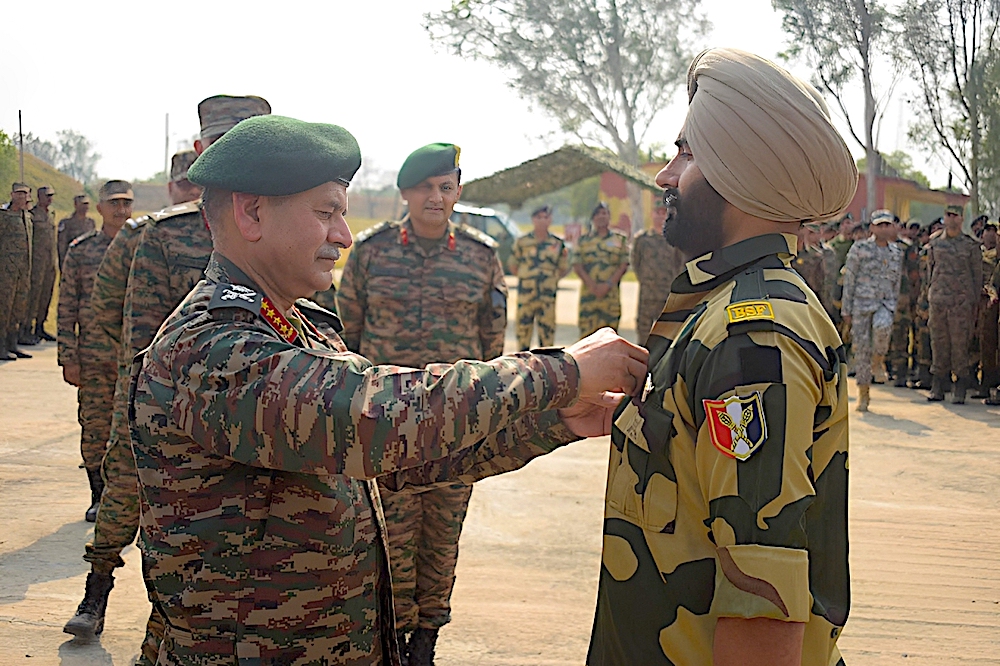
 The Indian Army chief, Gen Upendra Dwivedi, pinning a medal on a BSF soldier for playing an exceptional role during Operation Sindoor, in May 2025. (File photo)
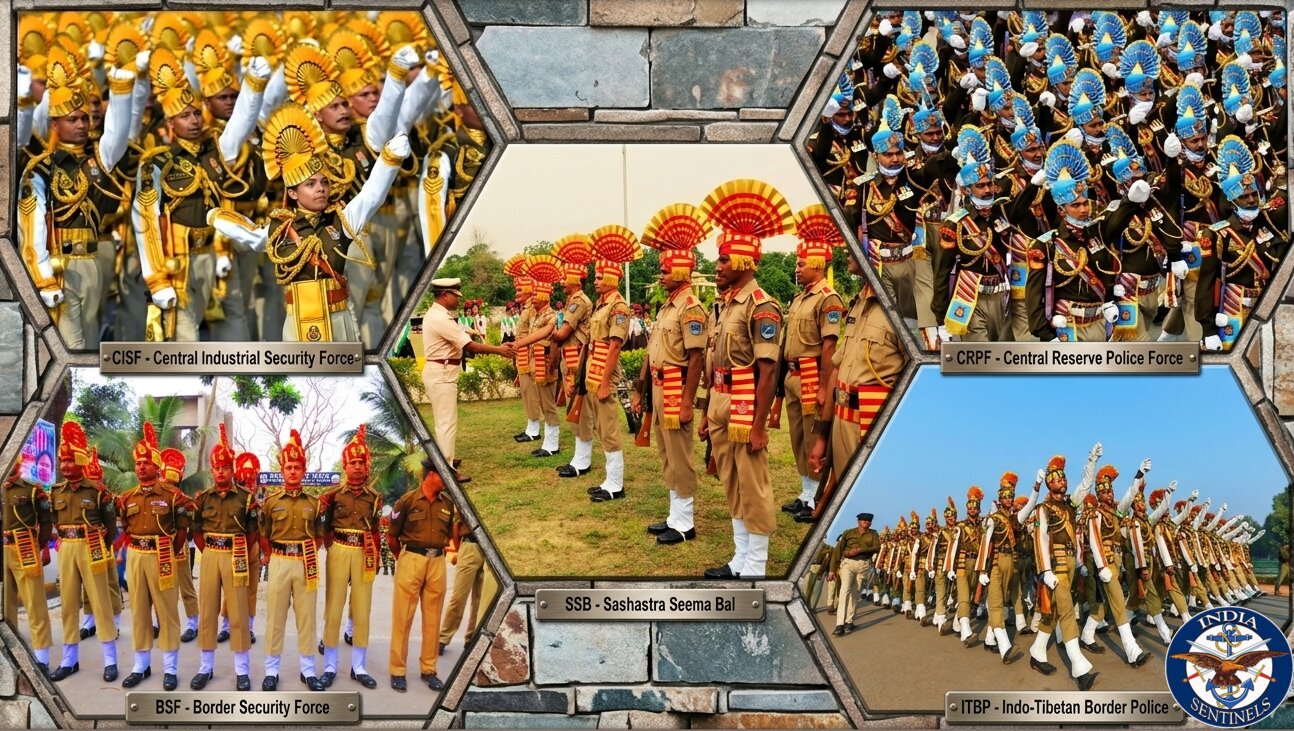
The Border Security Force, the Indo-Tibetan Border Police, and the Sashastra Seema Bal guard the republic’s most dangerous frontiers. The Central Reserve Police Force maintains its internal security, battling insurgents from Kashmir to central India to the northeast. The Central Industrial Security Force, meanwhile, protects the vital infrastructure that keeps the nation running.
Their personnel walk into jungles riddled with Maoist ambushes, man glacial outposts above 17,000 feet, and hold the line along thousands of kilometres of international border. The BSF, in particular, has fought shoulder to shoulder with the Indian Army – in the 1971 war and, more recently, in Operation Sindoor. Many have laid down their lives without the fanfare that typically accompanies military sacrifice.
Yet, for more than a decade, these very officers have had to fight a different kind of battle – one not against a foreign adversary, but against their own government – simply to be recognized for what they already are: the professional backbone of India’s internal- and border-security apparatus.
Read also: Unfenced Borders – Why prioritize jurisdiction over infrastructure?
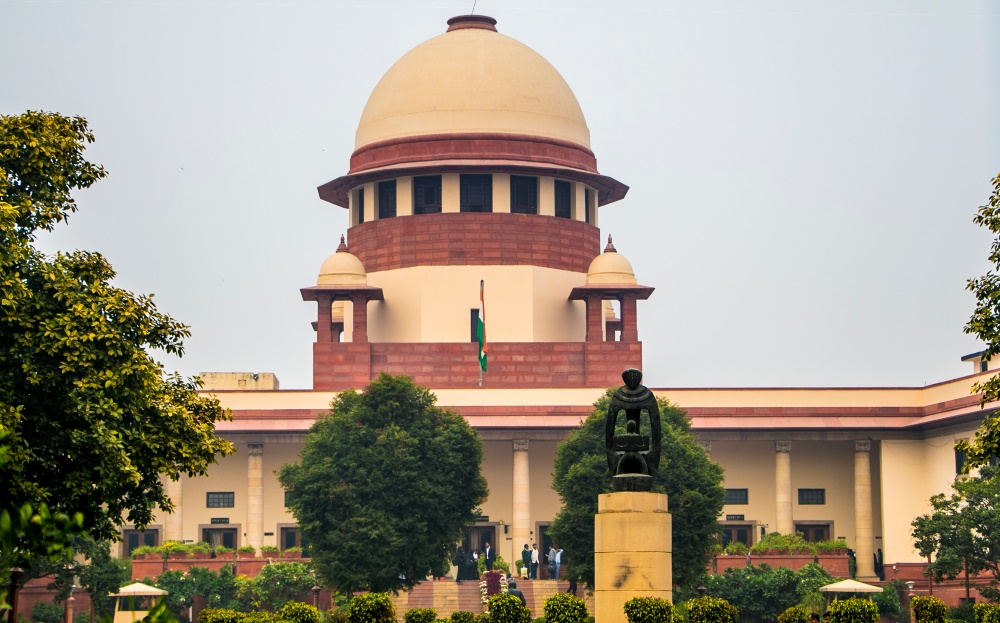
That battle reached a decisive moment on May 23, 2025, when the Supreme Court delivered a landmark judgment granting organized Group “A” service (OGAS) status and non-functional financial upgradation (NFFU) to CAPF cadre officers. The court laid down a time-bound schedule for implementation. The Ministry of Home Affairs (Union home ministry), exercising its legal remedy, filed a review petition – which was dismissed on October 26, 2025, by a bench comprising Chief Justice Surya Kant and Justice Ujjal Bhuyan, giving the judgment full and final constitutional authority.
What should have followed was swift implementation. What followed instead was procrastination – forcing CAPF officers to file a contempt petition before a bench of Justice BV Nagarathna and Justice Ujjal Bhuyan. And then came the revelation that stunned many who had hoped for a dignified resolution: during the contempt hearing, the government signalled its intent to pursue “statutory intervention” – in plain language, to bring a law that would nullify the Supreme Court’s judgment.
Read also: Why 8th pay panel must recognize CAPF personnel as true soldiers
Sovereign Right Weaponized Against Its Own Soldiers
Let there be no ambiguity: the government of India has every constitutional right to pursue statutory intervention. No one disputes that prerogative. However, the exercise of a legal right and the wisdom of exercising it are two very different things.
The fundamental question is not whether the government can do this. The question is whether it should – and whether doing so serves the national interest or merely the institutional interests of a powerful lobby.
Media reports revealed that the Union home ministry is weighing legislation on Indian Police Service officer deputations to CAPFs and has informed the Supreme Court accordingly. The paper reported that the ministry is considering statutory intervention in response to the court’s judgment – specifically to retain the deputation of IPS officers up to the rank of inspector general in CAPFs while limiting the benefits of OGAS and NFFU that the court had ordered.
Read also: Bangladesh in Turmoil – Why BSF must abandon non-lethal tactics now
Notably, the government had only the previous month made a two-year deputation at the rank of superintendent of police or deputy inspector general compulsory for IPS officers seeking empanelment as inspector general of police on central deputation – suggesting a parallel effort to institutionalize, rather than reduce, IPS presence in the CAPFs.
The ministry’s stated rationale – that IPS deputation is necessary for Centre-state coordination and federal comity – was already placed before the Supreme Court. The court heard it, examined it carefully, and did not accept it. That the government now intends to legislate around a reasoning that a constitutional bench found unpersuasive is not just constitutionally awkward; it is a statement about whose interests the Union home ministry is truly serving.
Read also: Radicalization is a national crisis that demands constitutional resolve
Cost of Paradropping IPS Officers in CAPF Commands
To understand what is truly at stake, one must understand how the CAPFs have functioned – and increasingly, how they have been mismanaged.
The early decades of India’s paramilitary forces were defined by a culture of organic leadership. IPS officers who joined these forces did so at the ground level. Padma Shri Chaman Lal joined the BSF as a deputy commandant and wished to stay; DD Gupta came as commandant; Dada Bhai as commandant; T Anantachari as commandant; HP Bhatnagar as DIG, IG, and DG BSF. In the ITBP, DK Arya served as assistant commandant and commandant before eventually becoming director general; DVLN Ramakrishna Rao served as assistant commandant and DIG before heading the same force; IB Negi served as assistant commandant and commandant.
These officers understood their forces from the inside. They knew the terrain, the training culture, the logistic demands, and the human texture of paramilitary life. That era is now largely over.
Read also: Fighting White-Collar Terror – India’s battle begins in the classroom
Today, IPS officers routinely arrive in CAPFs as inspector generals, additional director generals, and director generals – without having served a single day in a paramilitary command at the operational level. They come – as the saying goes – “paradropped”. They are accomplished police officers, no doubt, but they have spent 15 to 20 years in a police culture that is, by design and by tradition, fundamentally different from CAPF functioning.
To expect them to absorb the professional culture, operational doctrines, and human resource realities of these forces at such a late stage of their careers – and in short-tenure postings – is neither realistic nor fair to the officers themselves, let alone to the forces they command.
Prakash Singh, one of India’s most respected voices on police reform and himself a former director general of the BSF, has written in the Indian Express [archived link] that ad hocism in the selection of heads of CAPFs “takes a high toll” and is “harming their discipline, morale and combat potential”. He has noted the deep resentment within these forces when officers with no CAPF experience are paradropped as force commanders. The problem, he has cautioned, is not only continuing but worsening.
Read also: SC judgment on CAPF officers is final. Implementation must begin
Coast Guard Model Worth Emulating
Those who argue that CAPFs cannot function without IPS officers at the top need only look at the Indian Coast Guard.
The Indian Coast Guard was initially dependent on deputation from the Indian Navy. Naval officers occupied its senior command structure for years. Over time, that arrangement was progressively reduced. Today, Coast Guard cadre officers command the organization – and the results speak for themselves. The force has performed its maritime security mandate with distinction, without the complications of dual loyalty, short tenures, or the dissonance of leadership drawn from a different professional tradition.
The argument that IPS deputation is essential for Centre-state coordination is, frankly, a red herring. The Army has conducted countless internal-security operations across states – from Punjab in the 1980s to the northeast to Jammu & Kashmir to Chhattisgarh – without IPS officers embedded in its command structure. Centre-state coordination was achieved through institutional channels, not through the presence of police officers commanding soldiers.
Read also: Democratic Dilemma – How elections compromise border security
If the government genuinely believes that CAPF officers need a coordination mechanism with state police, the solution is straightforward: depute experienced CAPF officers to state police forces for that specific purpose. That is a targeted, proportionate solution. Retaining IPS deputation at the top of CAPF command structures is not a coordination mechanism – it is a hierarchy imposed for reasons that have more to do with cadre politics than national security.
Reform Agenda That Would Actually Work
None of this is to say that IPS officers have no role to play in national security. However, if the government genuinely wishes to draw on the expertise of IPS officers within the CAPFs, the mechanism must be redesigned from the ground up.
The following suggestion from this author deserves serious consideration: IPS officers who wish to serve in CAPFs should be deputed directly after graduating from the Sardar Vallabhbhai Patel National Police Academy in Hyderabad and should serve as company commanders in the BSF, CRPF, ITBP, or SSB for a minimum of three years. This posting would give them genuine exposure to the hostile and difficult operational environments in which these forces function – the border villages, the jungle camps, the glacial posts, the anti-insurgency grids.
Read also: Ladakh Unrest – When promises meet reality on India’s strategic frontier
Only those IPS officers who successfully discharge the responsibilities of a company commander – who have led men in the field, managed supply lines in remote terrain, and earned the respect of their troops – should subsequently be eligible for deputation to CAPFs at the DIG level. And once so deputed, they should continue in that force until retirement, building institutional knowledge rather than passing through on a two-year posting on their way to something else.
This reform would transform IPS deputation from a source of institutional friction into a genuine strategic asset. It would also make the argument for IPS presence in CAPFs far more defensible – because it would be grounded in demonstrated operational competence rather than bureaucratic entitlement.
Read also: My Identity Crisis – The CAPF soldier’s perennial dilemma
Moral Weight of Judgment
Beyond the organizational and operational arguments, there is a moral dimension to this debate that the government would do well to reflect upon. The CAPF cadre officers who fought this 12-year legal battle – through the Delhi high court and then the Supreme Court – were not agitating for power. They were asking to be treated with the same professional dignity as officers in comparable OGASs of the Government of India. They were asking for OGAS status, which would give them a structured, transparent career progression – something that officers in other Group “A” services take for granted.
Read also: Beyond Fencing – Complex reality of India’s most vulnerable border
These are men and women who have patrolled the line of actual control (LAC) in Ladakh in –30°C temperature. Who have walked into Maoist strongholds in Chhattisgarh knowing the odds were not in their favour. Who lost colleagues to terrorist attacks, to enemy fire, to the sheer physical brutality of sustained border duty. Some never came home.
To deny them the fruits of a judgment that the highest court in the land delivered after years of careful examination – through legislative manoeuvre – would be a message that the Indian state sends not just to CAPF officers, but to every uniformed professional who serves in silence.
Choice Before Centre
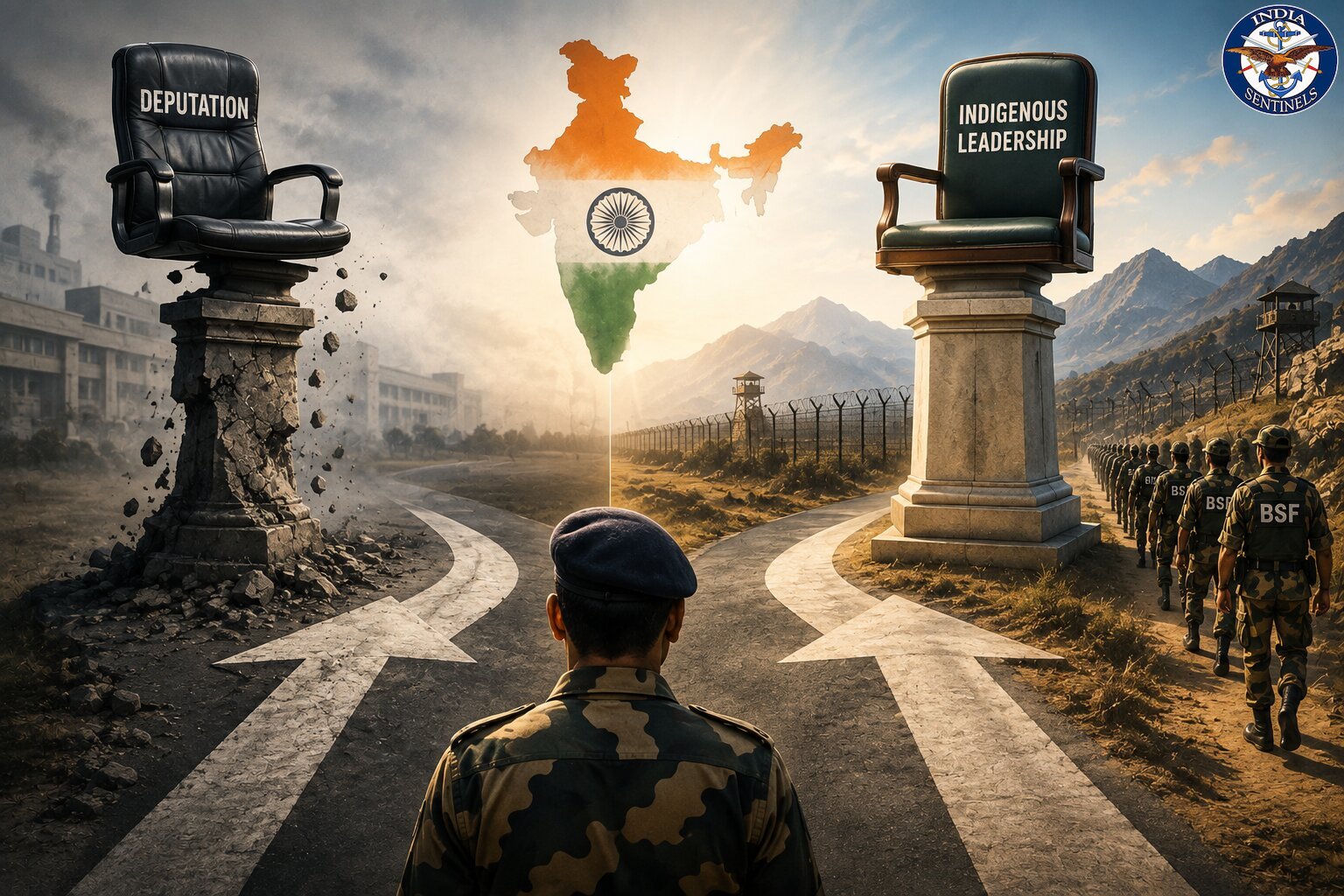
The government, under the prime minister, Narendra Modi, and the Union home minister, Amit Shah, faces a clear choice. It can implement the Supreme Court’s judgment, grant OGAS and NFFU to CAPF cadre officers as ordered, and begin the process of building a more professional, more capable, and more motivated paramilitary leadership. This is the path of institutional wisdom, judicial respect, and national security logic.
Read also: End Colonial Charade – Implement SC ruling on CAPF officers now
Or it can pursue statutory intervention – overriding a reasoned constitutional judgment to preserve a system of deputation and send a demoralizing signal to tens of thousands of CAPF officers who have dedicated their careers to guarding this republic.
The CAPF cadre officers have demonstrated, over decades and across theatres, that they have the professional acumen, the operational experience, and the institutional loyalty to lead these forces. Give them the space the Supreme Court has said they deserve – and they will justify that trust in every border post, every counterinsurgency grid, and every crisis that tests India’s internal security.
The ball is firmly in the Centre’s court. It would do well to play it straight.
Disclaimer: The views expressed in the article are the author’s own and don’t necessarily reflect the views of India Sentinels.
Follow us on social media for quick updates, new photos, videos, and more.
X: https://x.com/indiasentinels
Facebook: https://facebook.com/indiasentinels
Instagram: https://instagram.com/indiasentinels
YouTube: https://youtube.com/indiasentinels
© India Sentinels 2025-26