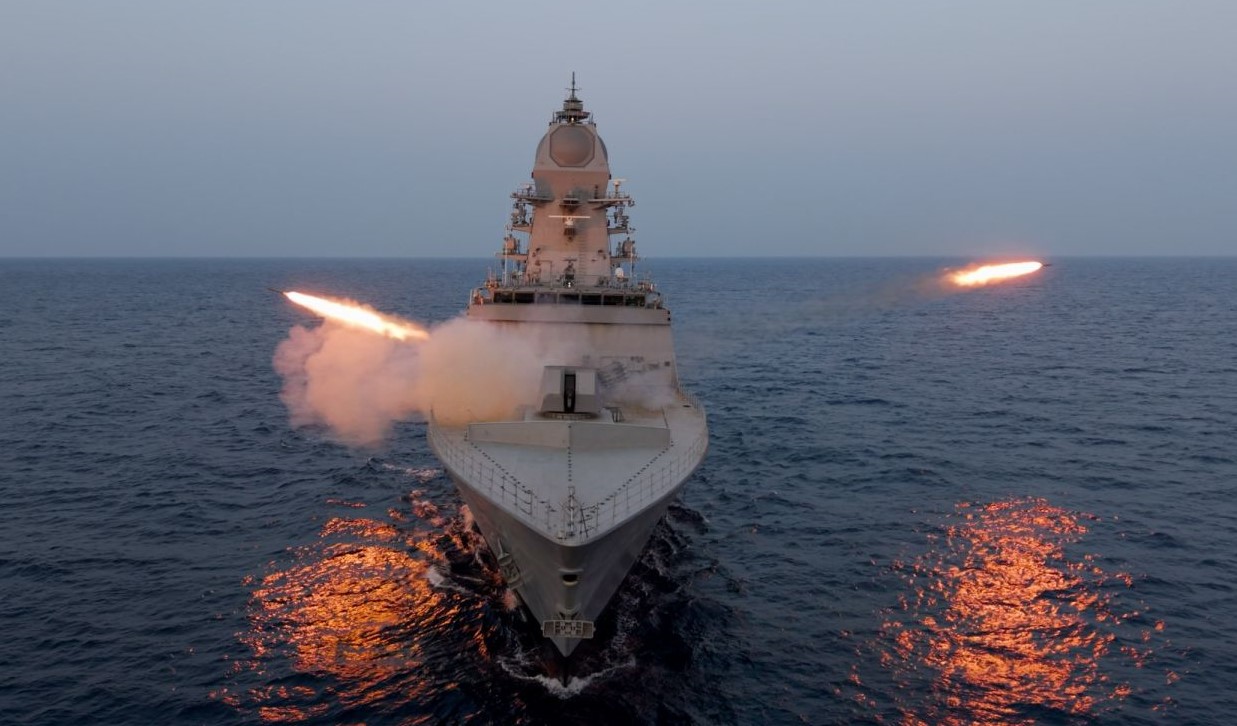
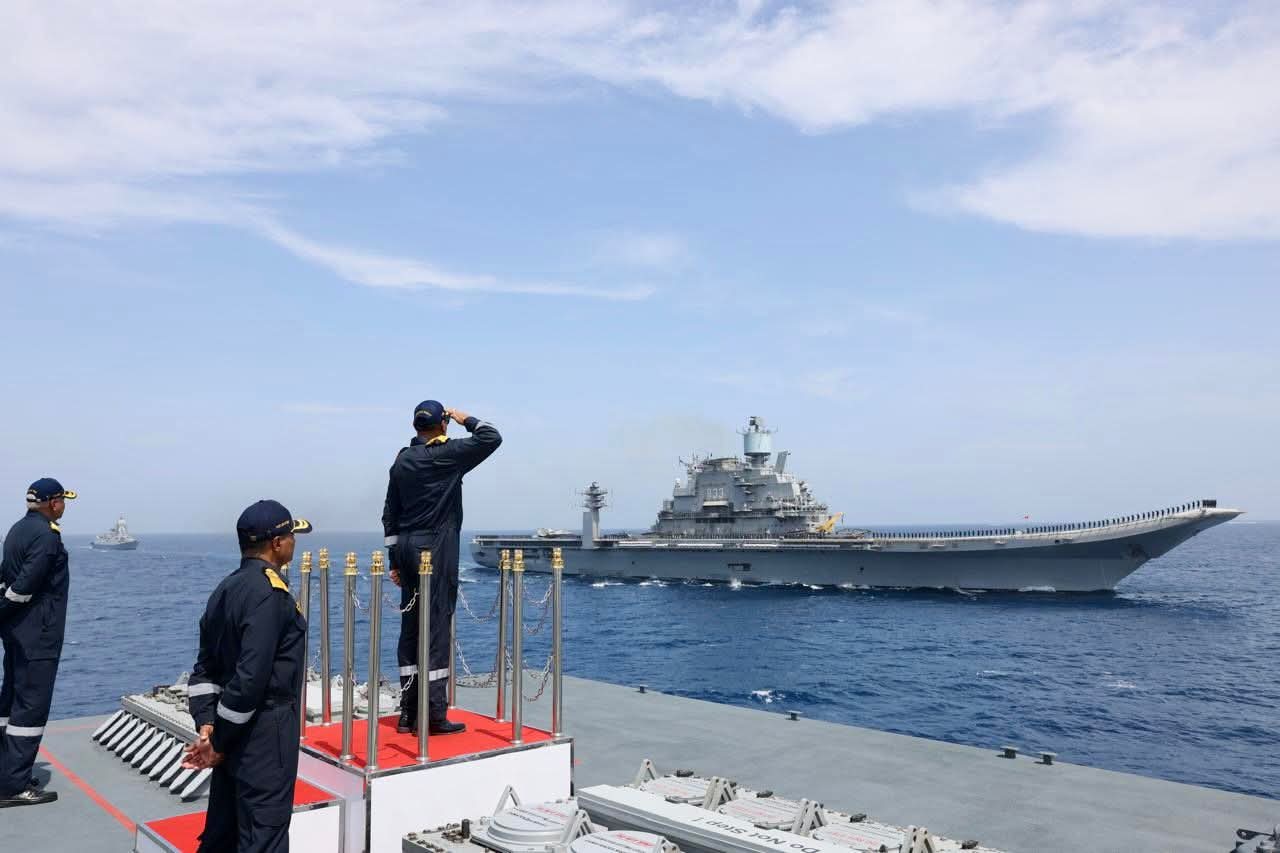
 INS Vikrant
New Delhi: Three years of real-world conflict – the Israel-Hamas war, Israel & US-Iran war, Houthi strikes on commercial shipping, China’s naval build-up – have steadily undermined the argument that missiles and drones made aircraft carriers obsolete. Carriers still matter. Recent events have made that harder to dispute.
For India, this is not abstract. Close to 90 per cent of trade by volume moves through maritime routes. Between 83 and 88 per cent of crude oil imports transit the Strait of Hormuz and the Red Sea – chokepoints where disruption translates quickly into fuel price shocks and slower growth.
What carrier power demonstrated
Recent US carrier deployments were instructive. Enforcing the naval blockade against Iran across the Arabian Sea and Gulf of Oman required the sustained airpower, surveillance, and tactical command that only a carrier group provides. A carrier is not simply a weapons platform. It is a tool for coercion, deterrence, and message-sending – deployed at a time and place of a nation’s choosing.
India fields two carriers – INS Vikramaditya and INS Vikrant – which puts it ahead of most regional navies. But operational realities are unforgiving. Carriers spend months in refit, maintenance, and upgrades. Naval planners have long applied a simple rule: to keep two carriers ready at any moment, you need three.
Vikramaditya faces a structural assessment around 2035 and could leave service as early as 2037. India cannot afford to wait on that outcome before commissioning a successor.
China’s shadow
China sharpens the calculations. Beijing already has three carriers and is pressing toward a larger fleet by 2035. Chinese destroyers, submarines, and research ships appear with growing frequency in waters India once considered its own. The “String of Pearls” – from Djibouti through Gwadar – has turned the Indian Ocean from a quiet backyard into a contested space.
Read also: INS Khanderi to get DRDO’s AIP system by 2026, sea trials from 2027
Experts say carriers give India something no other platform replicates: a mobile airfield that moves with the threat, sustains air superiority far from home, and shows up visibly in ways submarines cannot. They also serve a less-discussed role – carrier groups can deploy helicopters, medical teams, and logistics faster than almost any other asset after Indian Ocean disasters, a capacity that will only grow more valuable as extreme weather intensifies.
The submarine debate
However, critics pointing to submarines and precision missiles as better value are not wrong – India should invest there too. But the two fleets answer different questions, as many others agree.
Read also: India’s Submarine Dream -- Too late to catch up, too important to give up
Submarines deny; carriers project and reassure. Partners and neighbours notice the difference. India’s stated ambitions – Sagar, Quad engagement, net security provider – depend on sustained, visible presence. A navy that goes dark whenever one carrier enters refit cannot anchor a regional security role.
The case for a third carrier is not about prestige. It is operational: maintaining readiness across two seaboards, sustaining deterrence, and keeping India in a position to shape events in the Indian Ocean rather than react to them. Countries that can move air power over oceans still influence crises. Those that cannot, don’t. India’s long-term credibility in the region hinges on making this decision while it remains prudent, not urgent.
Follow us on social media for quick updates, new photos, videos, and more.
X: https://x.com/indiasentinels
Facebook: https://facebook.com/indiasentinels
Instagram: https://instagram.com/indiasentinels
YouTube: https://youtube.com/indiasentinels
© India Sentinels 2026-27