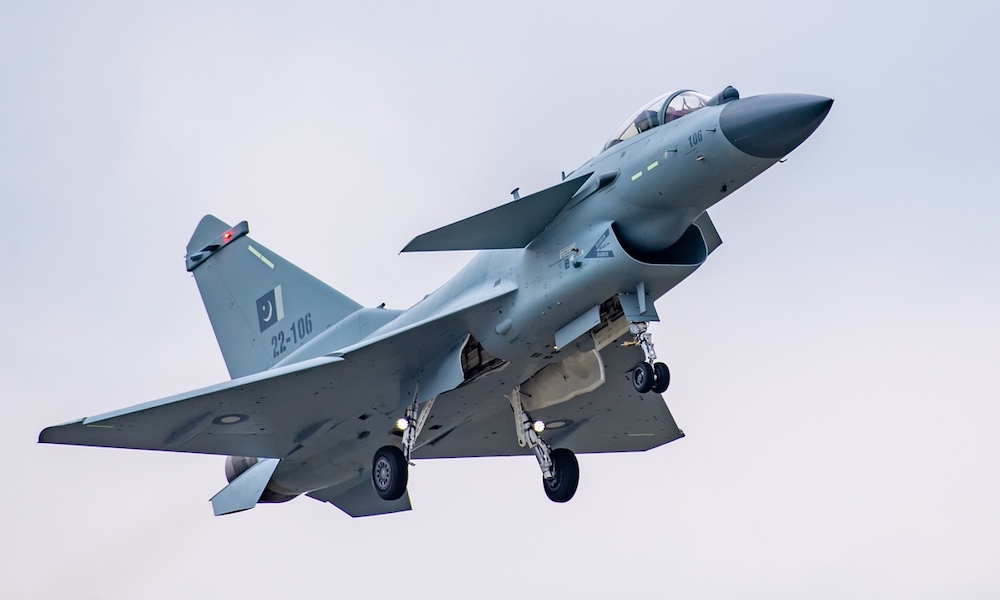
 A Pakistani air force J-10C fighter, supplied by China. (Photo for representation.)
New Delhi: China has officially acknowledged, for the first time, that its engineers were deployed at a Pakistani airbase during last May’s military conflict with India. It corroborated assertions that New Delhi had made repeatedly during and after Operation Sindoor, only to have them dismissed.
The admission came through an unlikely channel: China’s state broadcaster CCTV, which on Thursday aired an interview with Zhang Heng, an engineer at the Chengdu Aircraft Design and Research Institute under the Aviation Industry Corporation of China (AVIC) – the facility responsible for designing some of China’s most advanced combat aircraft, including the J-10 and J-20. Zhang confirmed he had been stationed at a Pakistani air base during the conflict.
In the interview, Zhang described the conditions he faced: extreme heat approaching 50 degrees Celsius by late morning, the constant roar of fighter jets taking off, and the persistent wail of air-raid sirens. “It was a real ordeal for us, both mentally and physically,” he said.
A second AVIC engineer, Xu Da, who was also embedded with Pakistani forces, referred to the J-10CE – the export variant of the J-10C that Pakistan operates – as their “child.” He said the aircraft had been nurtured and handed over to Pakistan and was now facing its most significant test. On the results the jet achieved, he added that they “weren’t very surprised ... it felt inevitable.”
J-10CE and Rafale claim
At the centre of the Chinese account is Pakistan’s fleet of J-10CE fighters – a 4.5-generation platform supplied by China – and a claim that at least one of these aircraft shot down an Indian Air Force Rafale during the conflict. If accurate, it would mark two firsts simultaneously: the J-10CE’s first confirmed air combat kill, and the first time a Rafale has been downed in operational combat anywhere in the world.
India has not officially confirmed any Rafale loss, and independent verification of Pakistani and Chinese combat claims from the May conflict remains limited. What the CCTV report does establish, unambiguously, is that Chinese technical personnel were present at a Pakistani air base while the hostilities were under way – a fact with significant implications for how the conflict is understood.
Pakistan is the only known foreign operator of the J-10C series. It ordered 36 jets along with 250 PL-15 beyond-visual-range air-to-air missiles in 2020. According to the Stockholm International Peace Research Institute, China accounted for roughly 80 per cent of Pakistan’s total arms imports between 2021 and 2025 – a share that reflects a deepening defence relationship that extends well beyond equipment sales.
India had said as much
The CCTV disclosure arrives days after the deputy chief of Army staff, Lieutenant General Rahul R Singh, made unusually direct public remarks about China’s role during Operation Sindoor, as India Sentinels had reported during that time. Speaking at a FICCI event on New Age Military Technologies on July 4, Singh said: “We had one border and two adversaries, actually three. Pakistan was in the front. China was providing all possible support.”
Singh went further, asserting that during director general of military operations-level talks between India and Pakistan, Islamabad had access to real-time intelligence on Indian military movements, fed through Beijing. His remarks were widely noted as the first formal public acknowledgment by an Indian military official of China’s active, real-time support to Pakistan during the conflict.
The Chinese state media broadcast, coming barely 24 hours later, effectively settled the matter from the other side.
Pattern, not aberration
The AVIC engineers’ deployment is consistent with standard Chinese arms-export practice. Beijing routinely provides technical support teams – known informally as “embedded advisers” – alongside major weapons systems sold abroad, particularly in the early operational phase. Their presence at a Pakistani base during active hostilities, however, moves the arrangement into a different category, raising questions about the line between technical support and operational involvement.
China and Pakistan have long described their relationship as an “all-weather strategic cooperative partnership.” For India, the events of May – and now their confirmation in Beijing’s own media – offer a sharper picture of what that partnership looks like when tested.
Follow us on social media for quick updates, new photos, videos, and more.
X: https://x.com/indiasentinels
Facebook: https://facebook.com/indiasentinels
Instagram: https://instagram.com/indiasentinels
YouTube: https://youtube.com/indiasentinels
© India Sentinels 2026-27