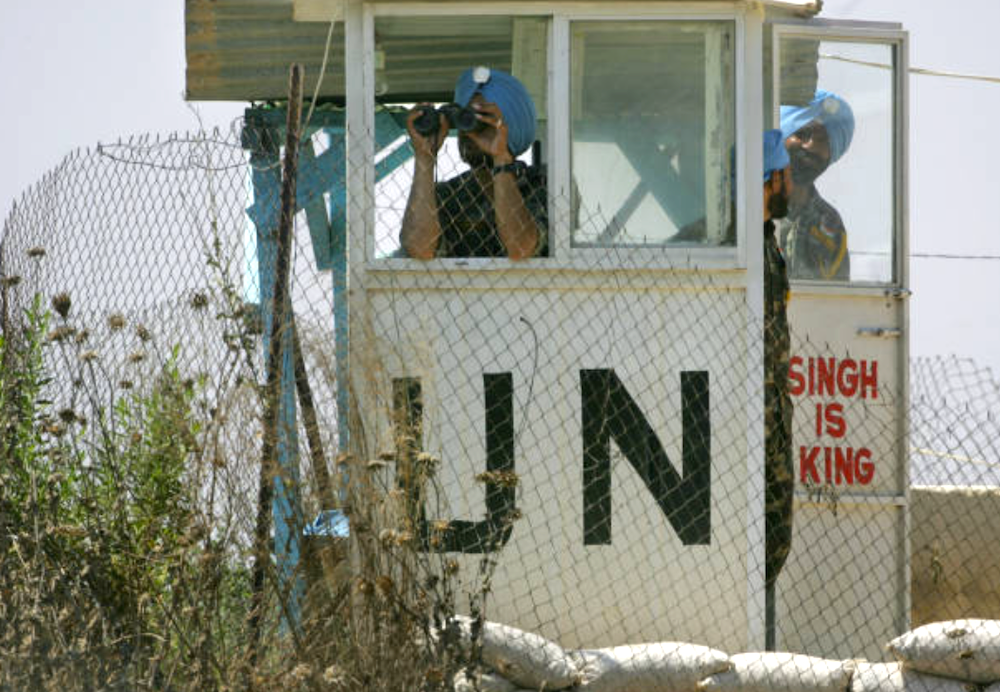
 File photo of Indian troops under Unifil mission in south Lebanon near Israel border.
New Delhi: The number of troops and other personnel deployed on international peacekeeping missions has fallen to its lowest level in at least a quarter century, with geopolitical rivalries among major powers, chronic underfunding, and eroding political will threatening to hollow out the entire multilateral peace architecture, according to a new report [archived link] published on Monday by the Stockholm International Peace Research Institute (Sipri).
The annual assessment, released ahead of the International Day of United Nations Peacekeepers on May 29, found that just 78,633 international personnel were deployed across active peace operations as of December 31, 2025 – a 17 per cent drop from the previous year and 49 per cent below the 2016 peak. It is the steepest single-year decline in the period studied and the lowest absolute figure recorded since at least the year 2000.
The numbers tell only part of the story. Behind the statistics lies a deeper structural crisis: the UN security council increasingly paralyzed by vetoes and hardline demands, regional organizations unable to bridge their own political divides, and a growing tendency among states to bypass established multilateral frameworks in favour of unilateral or ad hoc arrangements that prioritize national interest over collective security.
India holds its ground
For India, the report carries particular significance. The country remained in the top four contributors of military personnel to multilateral peace operations globally in 2025 – a position it has held for decades. Uganda topped the list for the year, followed by Nepal and Bangladesh, with India in fourth place. The remaining top 10 contributors were drawn from sub-Saharan Africa – Rwanda, Ethiopia, Burundi, and Kenya – and Asia-Pacific, specifically Pakistan and Indonesia.
India’s consistent presence in UN peacekeeping operations is both a point of national pride and an expression of its longstanding foreign policy doctrine of support for multilateralism. Indian troops have served in some of the most demanding theatres, including the Democratic Republic of the Congo, South Sudan, and Lebanon. Notably, all of the top 10 military contributors in 2025 were from the global south – a pattern that has become entrenched even as the countries that dominate the security council and control peacekeeping budgets are largely in the global north.
Funding crisis
The financial picture is stark. By July 2025, UN peacekeeping operations were running a shortfall of $2 billion – more than 35 per cent of the total $5.6 billion budget for 2024–25. Several missions were forced to cut personnel as a result. Major donor countries failed to pay their assessed contributions either on time or in full, leaving field operations scrambling to maintain even basic functions.
This is not an accident of circumstances. The United States, which is assessed the largest share of the UN peacekeeping budget, has a long history of withholding or delaying payments, a pattern that has worsened under the political pressures of recent years. The funding crunch has had direct operational consequences, including reduced troop numbers and curtailed civilian capacities in missions already operating in extremely difficult environments.
UNSC’s deadlock
Beyond money, the political dysfunction at the heart of the UN system has deepened. In August 2025, during mandate renewal discussions for the UN Interim Force in Lebanon (Unifil), the United States pushed for the mission’s termination, even as ceasefire violations between Israel and Lebanon continued to mount. A compromise was reached: the security council voted to renew Unifil for a final term, through December 2026. The episode illustrated how the council’s permanent members are increasingly using peacekeeping mandates as leverage in broader geopolitical contests.
In Haiti, the security council authorized the deployment of a “Gang Suppression Force” – an ad hoc coalition rather than a formal UN peacekeeping operation – alongside a new UN Support Office for logistical backing. This was the outcome of a tortured negotiation process in which a US-backed proposal to transform the Multinational Security Support Mission into a full UN-led operation was blocked by China and Russia.
“If things continue in this way, we could see a dramatic weakening of multilateral conflict management and the near-complete sidelining of institutions like the United Nations, due to a perfect storm of funding, political, and geopolitical factors,” said Jair van der Lijn, director of the Sipri Peace Operations and Conflict Management Programme. “The result is likely to be more conflicts, and these conflicts are likely to have even graver impacts on civilians as states abandon long-established norms.”
Regional organizations no substitute
The growing dysfunction of the UN system has prompted calls to rely more heavily on regional organizations such as the African Union, the Economic Community of West African States (Ecowas), and the Organization for Security and Co-operation in Europe (OSCE). But the Sipri report found that these bodies are struggling with the same ailments – underfunding, political deadlock, and geopolitical rivalry – that are undermining the UN.
No new UN-led peacekeeping operation has been mandated since 2014. In the years since, several regional missions have been launched, but 2025 exposed the limits of this model. On Sudan and Ukraine, regional bodies have been unable to mount effective responses, hampered by the same divisions that have paralyzed the Security Council.
“Regional organizations lack key capabilities when it comes to successful, integrated peacebuilding, while they are also plagued by funding shortfalls and inability to reach agreement like the UN,” said Claudia Pfeifer Cruz, senior researcher in the Sipri Peace Operations and Conflict Management Programme. “As UN-led conflict management recedes, it is leaving a growing gap that alternative models are unable to fill.”
The numbers
A total of 58 multilateral peace operations were active across 34 countries and territories in 2025, three fewer than the previous year. Sub-Saharan Africa and Europe each hosted 18 missions; the Middle East and North Africa hosted 14; the Americas, five; and Asia-Pacific, three. Nearly three-quarters (73 per cent) of all deployed personnel were concentrated in just five missions, four of them in sub-Saharan Africa.
Personnel numbers rose in the Americas and Europe but fell across all other regions.
Two new operations were launched during the year: the African Union Support and Stabilization Mission in Somalia (Aussom) and the Gang Suppression Force in Haiti, both of which replaced predecessor missions. Four operations were closed – in the Democratic Republic of the Congo, Haiti, Iraq, and in the Nagorno-Karabakh region of Azerbaijan.
Broad support, narrow action
The report notes an apparent contradiction: despite the institutional breakdown, support for the idea of multilateral peacekeeping remains wide. More than 130 UN member states gathered at a peacekeeping ministerial in Berlin in May 2025 to discuss the future of UN operations. New peace and ceasefire agreements – including the October 2025 Gaza agreement – have continued to envisage multilateral deployment components. Yet when it comes to turning political rhetoric into operational reality, the Security Council and regional bodies have repeatedly come up short.
“The collapse of multilateral conflict management is not inevitable. There is evidently widespread support for UN peace operations in principle,” said Pfeifer Cruz. “However, to sustain multilateral conflict management, states will need to go beyond expressions of support – they will need to provide predictable funding and create enough political space to enable effective multilateral responses.”
The gap between what is said in ministerial conferences and what is done in the security council or in budget negotiations is, at this point, a chasm. And it is a chasm that armed groups, authoritarian governments, and conflict entrepreneurs are increasingly equipped to exploit.
Follow us on social media for quick updates, new photos, videos, and more.
X: https://x.com/indiasentinels
Facebook: https://facebook.com/indiasentinels
Instagram: https://instagram.com/indiasentinels
YouTube: https://youtube.com/indiasentinels
© India Sentinels 2026-27