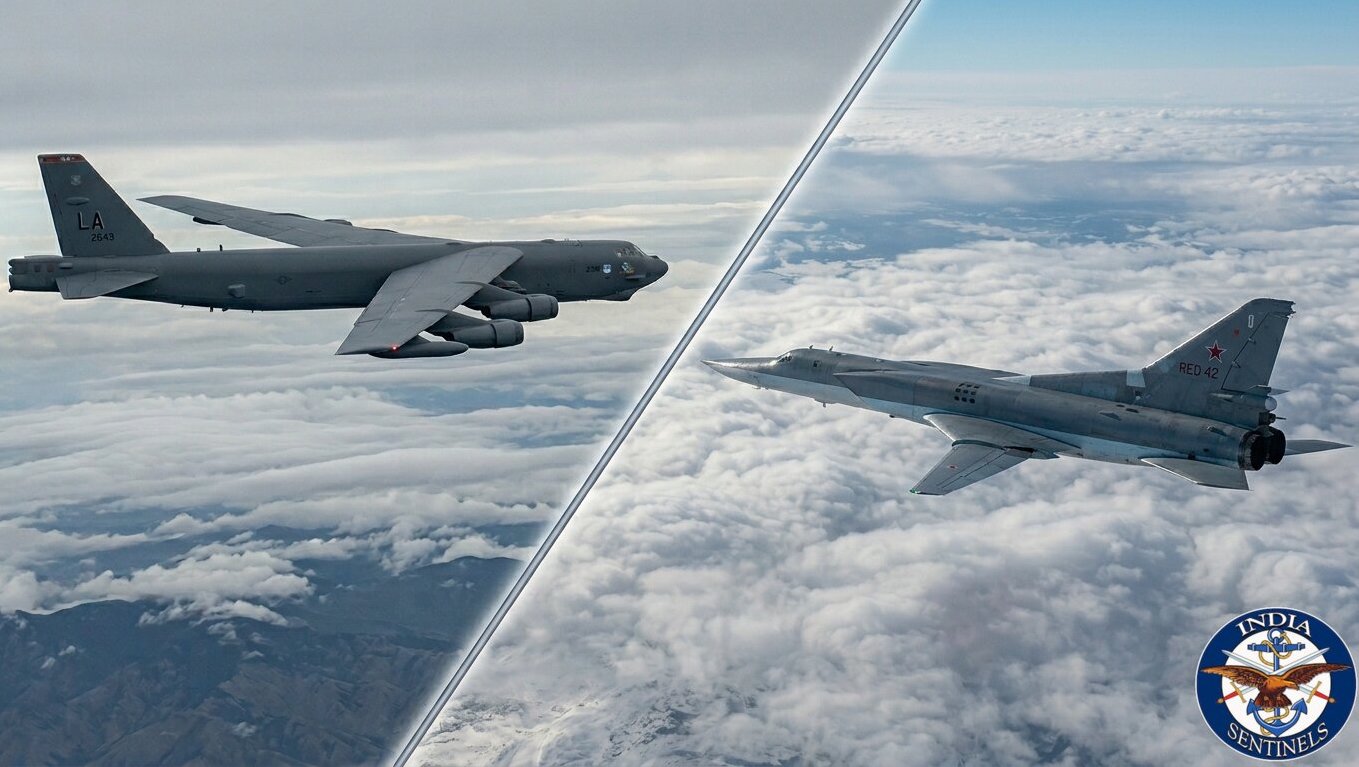
 This illustration for representation shows a US B-52 Stratofortress (L) and a Russian Tu-22M3. (© India Sentinels 2026–27)
New Delhi: In a deadly, one-of-a-kind coincidence involving Cold War-era rival superpowers and still nuclear-armed adversaries, two strategic bombers – one American, one Russian – crashed on the same day, on Monday, on opposite ends of the earth, within hours of each other. A United States Air Force B-52 Stratofortress came down at Edwards Air Force Base in California’s Mojave Desert shortly after lift-off, while a Russian Air Force Tu-22M3 Backfire plunged into a forested stretch of Siberia’s Irkutsk region during a training flight.
Eight people have been reported killed in the B-52 crash while one aviator is confirmed dead in the Tu-22M3 accident.
Both aircraft belong to a class that shaped the contours of nuclear deterrence during the Cold War. That they should crash on the same calendar day – one in the desert of California, the other in the birch forests of Siberia – is the kind of coincidence that history rarely contrives.
The B-52 at Edwards
The B-52 went down at approximately 11.20am local time (11.50pm IST) shortly after take-off. A large column of thick black smoke rose over the Mojave and was reportedly visible for miles, with aerial footage showing a smouldering burn mark on the airfield perimeter. Emergency crews responded immediately, and the base was shut to all traffic, with inbound aircraft diverted and all non-commercial visitor access suspended.
As of the time of writing this, eight people on board the strategic bomber were reported killed. The B-52 typically flies with five crew members – two pilots, a radar navigator, a navigator, and an electronic warfare officer. One detail that compounds the uncertainty is the bomber’s ejection seat configuration: unlike most combat aircraft, where seats fire upward, several crew positions in the B-52 are equipped with downward-firing ejection seats, a design legacy of the aircraft’s origins in the early 1950s.
Whether those systems were activated, and how effectively, has not been confirmed.
Edwards Air Force Base, located roughly 160 kilometres northeast of Los Angeles, is the US’s premier flight test facility, where both the USAF and Nasa conduct trials of developmental and operational aircraft. A B-52 fitted with an upgraded radar system had arrived there in December 2025 to begin test evaluations – one of several modernization programs planned for the Stratofortress fleet. It is not yet known if the crashed aircraft was that specific airframe.
The B-52 is one of the oldest warplanes still in active service anywhere in the world; the USAF fleet averages over 64 years in age, and the service intends to keep flying the type until at least 2050. The last fatal B-52 accident before Monday’s incident was in 2008, when six USAF personnel were killed after their aircraft went down in the Pacific Ocean off Guam while positioning for a ceremonial flyover.
The cause of Monday’s crash is under investigation.
BREAKING: 8 crew members killed in B-52 bomber crash at Edwards Air Force Base https://t.co/Zw8NNAY2Bb pic.twitter.com/dAMk3cGLmf
— Rapid Report (@RapidReport2025) June 15, 2026
The Tu-22M3 in Siberia
The Russian incident unfolded near the village of Kamenka and the town of Svirsk, roughly 50 kilometres northwest of Belaya Air Base in the Irkutsk region – a remote corner of eastern Siberia that has quietly become one of Russia’s most consequential bomber hubs. The Tu-22M3 was on its approach to land when it reportedly entered an uncontrolled dive and struck wooded terrain along the banks of the Angara River. Engine failure has been cited by the Russian defence ministry as the preliminary cause.
All four crew members ejected. Three survived and were hospitalized with non-life-threatening injuries. One pilot died upon landing. An unverified video circulated on social media showed the aircraft in a steep, near-vertical descent before impact; witnesses in the area reported seeing multiple parachutes open before the bomber hit the treeline. The Irkutsk governor, Igor Kobzev, confirmed that fire crews were dispatched to the crash site. Officials stated the aircraft was flying without any weapons load and that there was no ground damage.
The Tu-22M3 – designated “Backfire-C” by Nato – is a Soviet-era variable-geometry swing-wing supersonic bomber, the serial production of which ended in 1993. Despite its vintage, it remains capable of carrying the Kh-22 cruise missile, configurable with either a conventional or a nuclear warhead, as well as the Kh-47M2 Kinzhal hypersonic air-launched missile. Russia has used the type extensively in Ukraine for long-range conventional strikes, and it earlier saw combat deployment in Syria.
Belaya Air Base is home to the 200th Guards and 444th Heavy Bomber Aviation Regiments and operates both Tu-22M3 and Tu-95 aircraft. The base has faced mounting pressure over the past year, having been targeted by Ukrainian long-range drone operations. International defence analysts place Russia’s active Tu-22M3 fleet at fewer than 60 airframes – each loss, therefore, is both costly and irreversible, as no replacement programme exists and production lines have been cold for over three decades.
Monday’s crash is the third recorded Tu-22M3 accident in the Irkutsk region in under two years. A previous incident in the Cheremkhovsky district in August 2024 drew similar attention to the strain on aging Russian bomber fleets operating at an elevated tempo.
Very closeup video of the highly expensive Russian Tu-22M3 strategic bomber crashing today. https://t.co/ds1Oa1ehAD pic.twitter.com/RrVg7eO6H2
— WarMonitor???? (@WarMonitor3) June 15, 2026
An unscripted confluence
The coincidence of the two crashes carries no operational connection. But it lands at a moment when both the B-52 and the Tu-22M3 – symbols of a deterrence architecture built in another century – remain central to the nuclear postures of their respective states. The US plans to keep its B-52 fleet airborne well into the 2050s with progressive upgrades; Russia, by contrast, has no credible replacement for the Tu-22M3 in sight, leaving it reliant on a shrinking pool of increasingly strained airframes.
Both states face, in their own ways, the uncomfortable maths of sustaining legacy fleets in a world that has moved on. Investigations into both crashes are ongoing.
Follow us on social media for quick updates, new photos, videos, and more.
X: https://x.com/indiasentinels
Facebook: https://facebook.com/indiasentinels
Instagram: https://instagram.com/indiasentinels
YouTube: https://youtube.com/indiasentinels
© India Sentinels 2026-27