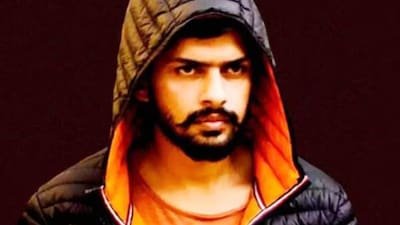
 Lawrence Bishnoi (File photo)
New Delhi: The United States of American authorities have indicated to seek the extradition of jailed Indian gangster Lawrence Bishnoi, after federal prosecutors in Los Angeles unsealed a batch of indictments accusing him of directing murders, extortion rackets and drug trafficking operations spanning three continents – all while locked inside an Indian prison cell.
The case, part of a wide-ranging federal crackdown code-named “Operation Hard Ball”, has resulted in charges against 37 defendants across three separate indictments, targeting syndicates led by Bishnoi, Ravinder Singh Dhanda and Jaggu Bhagwanpuria.
Twenty-four people have already been arrested across the United States, Canada and Europe, with several others still at large. Investigators say the operation also involved the execution of around 50 search warrants and the seizure of more than 1,000 kilograms of narcotics along with a substantial cache of firearms.
At the centre of the case is Lawrence Bishnoi, 33, a native of Punjab who has been in the custody since the mid-2010s. According to the indictment, he continued to run his crime syndicate from behind bars using smuggled mobile handsets and voice-over-internet devices, personally directing killings, kidnappings, extortion and human-smuggling operations carried out by associates around the world.
The document also alleges he cultivated a public image as a nationalist and religious figure through social media, which he used to draw in recruits even as he oversaw the syndicate’s darker operations in private.
The deputy commissioner of the Royal Canadian Mounted Police, Lisa Moreland, told reporters that the racketeering charges filed under American law would pave the way for Bishnoi to be formally sought for extradition from India.
She said dismantling the network’s top two tiers of leadership would be significant in disrupting its operations, adding that the move would have a direct impact on public safety in Canada and abroad.
Perhaps the most consequential element of the indictment is its formal linking of Bishnoi’s network to the June 2023 killing of Hardeep Singh Nijjar, a Sikh separatist leader shot dead outside a gurdwara in Surrey, British Columbia. The indictment alleges that Bishnoi and his North American lieutenant, Satinderjeet Singh – better known as Goldy Brar – ordered the killing, with two unnamed associates carrying it out. The document identifies Nijjar only by his initials, “H.S.N.” but the reference is unambiguous. This marks the first occasion on which the allegation, long aired in Canadian media, has been formally placed before a US federal grand jury.
The Nijjar killing had already strained relations between New Delhi and Ottawa considerably, with Canadian authorities alleging – and India denying – that agents of the Indian state were involved.
A related plot to assassinate another Khalistani campaigner, Gurpatwant Singh Pannun, in New York was thwarted by the FBI; an Indian national, Nikhil Gupta, pleaded guilty earlier this year to conspiring in that plot, while a former Indian government official named in the case, Vikash Yadav, remains a fugitive. Pannun said in a statement that accountability could not stop with the jailed gangsters and intermediaries alone.
The first assistant United States attorney, Bilal Essayli, who led the Los Angeles press conference announcing the charges, said the operation reflected a determination that criminal gangs spreading fear and violence across borders would face the full force of justice and the weight of the federal government.
Essayli also said prosecutors expected a second gang leader named in the case, Jaggu Bhagwanpuria, to be handed over to American custody within weeks.
The RCMP commissioner, Mike Duheme, who also appeared at the briefing, credited the charges with striking at the leadership of three global organized crime networks operating out of India. A separate strand of the indictment details how the rival Bhagwanpuria syndicate, said to run to roughly a thousand members, allegedly colluded with a serving Indian police officer to fabricate murder charges against a family in California as part of an extortion scheme – underscoring investigators' broader concern about institutional corruption feeding into the network's overseas operations.
Moreland confirmed that Indian agencies had cooperated with the investigation, saying enforcement bodies had worked closely alongside the FBI and its partners. Formal extradition proceedings, however, are likely to be a protracted affair, given the scale of the charges and the diplomatic sensitivities involved – not least the unresolved question, raised repeatedly by Canadian officials, of whether elements within the Indian state had any hand in directing violence attributed to the Bishnoi network. New Delhi has previously rejected such suggestions as unsubstantiated.
The case also revives scrutiny of Bishnoi’s wider family network. His brother, Anmol Bishnoi, remains wanted in India in connection with several high-profile killings, including that of Maharashtra politician Baba Siddique, with Mumbai Police having separately pursued extradition proceedings against him after he was tracked to the United States. Whether the latest indictments accelerate any of these parallel processes remains to be seen.