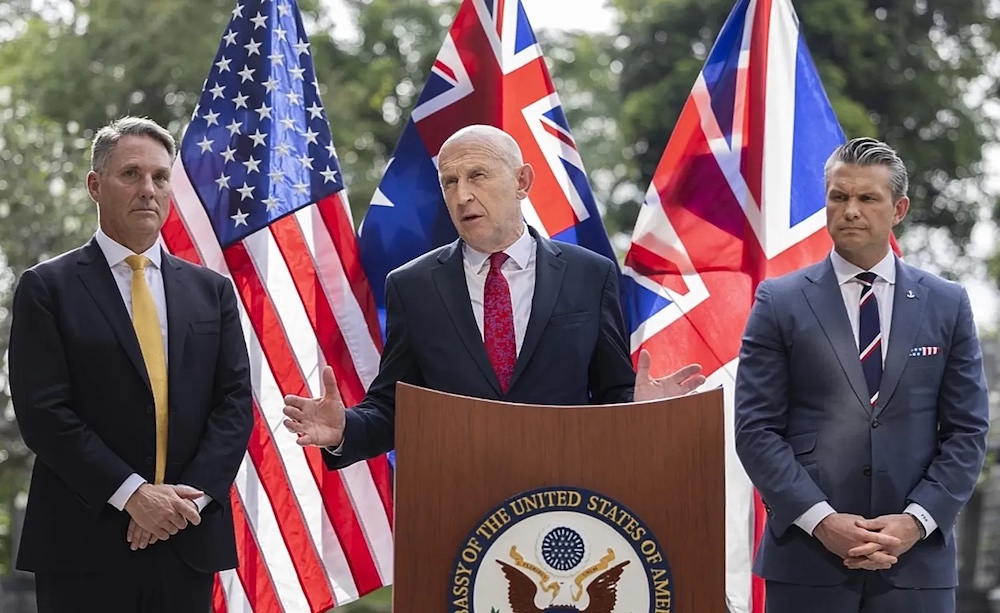
 From left: Richard Marles, John Healey, and Pete Hegseth. (Photo via X/@DefenceHQ)
New Delhi: The trilateral security arrangement between the United States, the United Kingdom, and Australia (Aukus) has announced its most operationally substantive package of initiatives since its founding in 2021, cantering on an undersea drone network and a rotational nuclear-submarine force aimed squarely at countering China’s military expansion in the Indo-Pacific.
The announcements came on May 30 after the US secretary of defence, Pete Hegseth; the UK secretary of state for defence, John Healey; and the Australian deputy prime minister and defence minister, Richard Marles, met at the American embassy in Singapore on the sidelines of the Shangri-La Dialogue.
The centrepiece of the new package is the development of jointly built payloads and enabling systems for unmanned underwater vehicle (UUV) operations – a capability Aukus has designated one of its “signature projects” under Pillar 2 of the partnership. Deliveries are targeted for 2027.
The UUV programme is designed to be operationally broad. A UK government factsheet on the initiative describes payloads that would be interchangeable across partner platforms, potentially including sensors, navigation tools, strike capabilities, and systems enabling data-sharing and coordination between unmanned and crewed platforms. Common control systems are also part of the framework.
The stated ambitions are considerable: protection of critical seabed infrastructure, surveillance and reconnaissance, logistics operations, anti-submarine and anti-surface warfare, mine countermeasures, electronic warfare, and what the joint statement called “contested littoral manoeuvre.”
The US Navy’s chief of naval operations, Admiral Daryl Caudle, has been among the most vocal proponents of unmanned systems as a force multiplier-capable of extending the fleet’s reach while reducing risk to sailors. His “hedge strategy,” unveiled earlier this year, leans heavily on autonomous and robotic systems as a structural answer to the Navy’s capacity constraints.
Two pillars
Aukus operates along two tracks. Pillar 1 covers the nuclear submarine programme for Australia. Pillar 2 – the more expansive and less reported of the two-covers advanced and emerging technologies, including artificial intelligence, quantum computing, hypersonics, counterhypersonics, cyber capabilities, electronic warfare, and information-sharing architecture.
A significant, if understated, element of the May 30 announcement was the commitment to expand Aukus’s “licence-free environment”, which is essentially removing bureaucratic and regulatory barriers to industrial base collaboration between the three countries. The partners said they would take “expeditious and practical steps to narrow the list of excluded technologies,” a direct response to years of frustration over defence export controls slowing down cooperation.
For India, which is deepening its own interoperability with all three Aukus nations under the Quad framework and bilateral defence agreements, the maturing of this technology-sharing architecture is worth watching. The kind of undersea domain awareness and UUV capabilities being developed under Aukus are directly relevant to the Indian Ocean region (IOR), where China’s submarine presence has been growing steadily.
Submarine dimension
On the Pillar 1 side, the US last month authorized the establishment of navy support elements for the Submarine Rotational Force – West (SRF-W) at HMAS Stirling near Perth in Western Australia. The first rotational deployment of American naval personnel to the base is planned for next year.
The SRF-W is designed to accelerate Australia’s practical readiness to operate nuclear-powered submarines and to sustain submarine deployments across the Indo-Pacific more broadly. Australia is also slated to acquire in-service Virginia-class submarines from the US as a bridging capability while its own Aukus-class boats are built-a timeline that stretches into the 2030s and beyond.
Healey struck an unusually candid note at the Shangri-La Dialogue. “For too long in Aukus, we talked too much and delivered too little. That has changed now,” he said – an acknowledgment, rare in diplomatic settings, that the partnership had struggled to translate announcements into hardware in its earlier years.
China concerns
The strategic logic underpinning both pillars is not subtle. Aukus partners are directly concerned about China’s military buildup, its assertive posture in the South China Sea, and the pressure it exerts on US allies and partners in the region. Hegseth told the Shangri-La Dialogue plainly: “The US won’t let China impose hegemony in Asia.”
Beijing has consistently rejected the characterization of its regional behaviour as aggressive and has criticized Aukus, particularly its nuclear submarine component, as destabilizing and inconsistent with non-proliferation norms. The International Atomic Energy Agency (IAEA) is still working through the modalities of safeguards for the transfer of naval nuclear propulsion material-a process with no direct precedent.
Whether Aukus can deliver on its revised ambitions at the pace its defence ministers are now promising will depend as much on industrial capacity and political continuity as on strategic intent. The 2027 UUV-delivery target, in particular, will be an early test of whether the partnership’s new urgency is real.
Follow us on social media for quick updates, new photos, videos, and more.
X: https://x.com/indiasentinels
Facebook: https://facebook.com/indiasentinels
Instagram: https://instagram.com/indiasentinels
YouTube: https://youtube.com/indiasentinels
© India Sentinels 2026-27