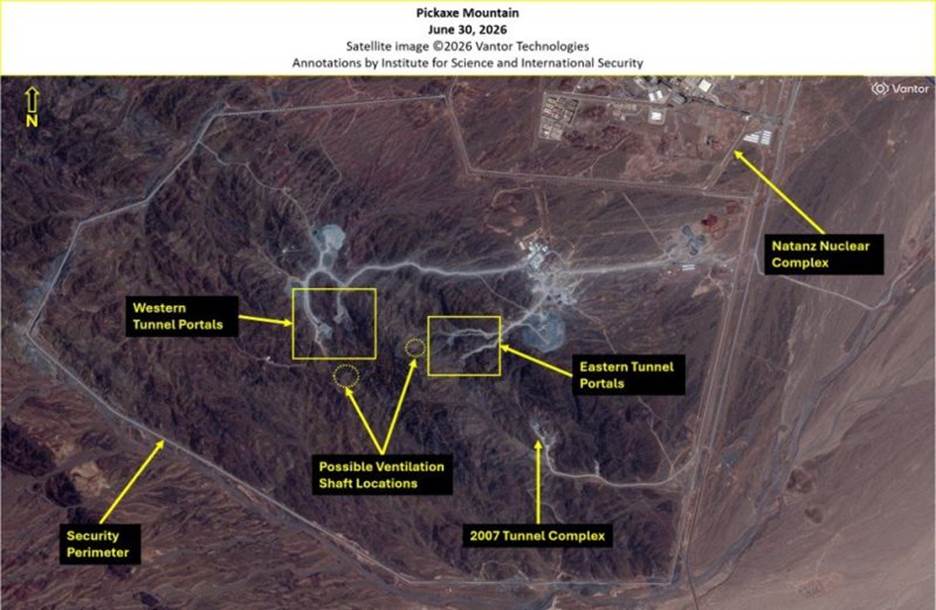
 Vantor Technologies image overview of Pickaxe Mountain. (Photo: Institute for Science and International Security)
The US president, Donald Trump, has trained his sights on a heavily fortified underground facility in Iran known as Pickaxe Mountain, opening up a new flashpoint in Washington’s confrontation with Tehran that has, until now, centred largely on the Strait of Hormuz.
“We’re going to take out Pickaxe Mountain. Tell the Iranians to be ready,” Trump said in an interview on the Hugh Hewitt Show, adding that any strike would come “probably relatively soon”.
The renewed focus on the site follows two rounds of direct conflict between Iran on one side and Israel and the United States on the other: a 12-day war in June 2025, and a shorter war that began on February 28, 2026, before a ceasefire took hold in early April.
Both rounds of fighting targeted Iran's main nuclear installations, including the Natanz enrichment complex, but left the Pickaxe Mountain tunnel facility untouched, according to the Institute for Science and International Security (ISIS), a Washington-based non-proliferation think-tank that has tracked the site through commercial satellite imagery for several years.
Where it and what is it?
Pickaxe Mountain lies inside a mountain called Kuh-e Kolang Gaz La – kolang meaning pickaxe in Farsi, from which the site takes its popular name, about 220 kilometres south of Tehran and roughly two kilometres from the Natanz nuclear complex, whose peak rises to some 1,600 metres above sea level.
Excavation began in 2020, shortly after an explosion that Iran described as sabotage damaged part of the Natanz complex. That September, Iran’s then nuclear chief, Ali Akbar Salehi, said the country had begun building a larger, more advanced underground hall to manufacture centrifuges, to replace the above-ground assembly facility destroyed in the blast.
ISIS says the complex has two pairs of tunnel entrances, believed to lead to a single underground facility located at least 100 metres beneath the mountain.
In a report published on July 14, 2026, based on satellite imagery supplied by Vantor Technologies, the institute said Iran's defences at the site consist chiefly of a large security perimeter and extensively hardened tunnel entrances. Since the wars, the eastern pair of portals has been partially backfilled to obstruct vehicle access, though not sealed outright, while the western entrances remained open as of imagery captured on July 9, 2026.
Is it operational?
Not yet, according to ISIS, whose latest assessment describes the facility as still under construction, with no clear timeline for when it might become operational.
The institute also said it was uncertain whether Iran still intends to install a large-scale centrifuge-assembly line at the site, given the destruction of much of the country’s centrifuge-manufacturing capacity in the recent conflicts. It warned, however, that a smaller assembly unit could still be installed there if Iran manages to rebuild that capability, one that could, in principle, feed into a future weapons programme.
The International Atomic Energy Agency (IAEA), the UN’s nuclear watchdog, has never been allowed to inspect the site. Its director general, Rafael Grossi, said in a March interview with PBS Frontline that Iran had previously informed the agency of its intention to conduct nuclear-related activity there, describing it as part of Tehran’s systematic effort to move its most sensitive facilities underground. Iran has consistently denied pursuing nuclear weapons.
Why now?
Trump’s comments on July 13, 2026 came as Washington said it was closely monitoring the site by satellite. “We see no activity there,” he said.
“They’re not doing well with their nuclear situation. Every time we hear about it, we blow it up. So they don't like talking about it.” His remarks followed reports that Iran's roughly 440-kilogram stockpile of uranium enriched to 60 per cent – a short technical step from weapons grade – remains largely unaccounted for, with some assessments suggesting part of it could have been moved to Fordow, Esfahan or, conceivably, Pickaxe Mountain itself, though none of this has been independently verified.
Defence analysts note that hardened tunnel entrances make the facility considerably harder to destroy with bunker-busting munitions, such as the GBU-57 bombs the US used against Fordow and Natanz last year, and that an effective strike would probably need to target ventilation shafts or power lines rather than the entrances themselves, the method used in earlier strikes on Iran’s Fordow and Shahid Boroujerdi tunnel facilities.
For India, which imports the bulk of its crude oil through the Strait of Hormuz and has traditionally balanced its ties with both Washington and Tehran, any escalation around Iran’s nuclear sites carries a direct stake: renewed conflict risks disrupting shipping lanes and pushing up oil prices, even as New Delhi has largely kept out of the wider US-Iran confrontation.