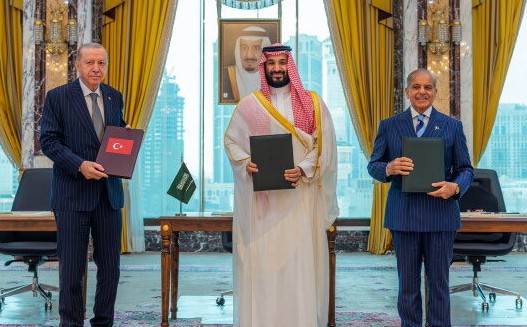
 Saudi Arabia, Pakistan and Türkiye ink Mecca pact. (Photo: X)
New Delhi: Saudi Arabia, Pakistan and Türkiye have signed a trilateral mutual defence agreement in the holy city of Mecca, binding each of the three states to treat an armed attack on any one of them as an attack on all three. The signing brings together two of the Islamic world’s most capable militaries and its largest Arab economy into a single collective-security framework, at a moment when the wider Middle East is still absorbing the shocks of this year’s war between Iran and the American-Israeli alliance.
Named the Mecca Joint Defence Agreement, the pact was signed at the Al-Safa Palace in Mecca by Saudi Arabia’s crown prince and prime minister, Mohammed bin Salman, the president of Türkiye, Recep Tayyip Erdogan, and the prime minister of Pakistan, Shehbaz Sharif, at the conclusion of what the three governments styled the Mecca Al-Mukarramah summit for joint defence.
Officials put the signing date at 24 Safar 1448 on the Islamic calendar. After the ceremony, the leaders and senior officials from all three delegations offered prayers together at Mecca's Grand Mosque, a gesture widely read as an attempt to frame the alliance in terms of Islamic solidarity rather than narrow military calculation.
Sharif had arrived in Saudi Arabia a day earlier, accompanied by army chief Field Marshal Asim Munir, and performed the Umrah pilgrimage before the summit. Erdogan flew in separately on Friday to meet Bin Salman ahead of the signing.
The core commitment
At the heart of the agreement is a single, unadorned clause: any armed attack on Saudi Arabia, Pakistan or Türkiye is to be treated as an attack on all three, alongside a broader commitment to deepen defence cooperation across the board. Pakistan’s Foreign Office, in a statement issued the same day, described the accord as an attempt to institutionalize deterrence at a time when several Gulf capitals feel newly exposed. Neither Pakistan's statement nor the joint communiqué set out the operational mechanics of that commitment, and officials on all sides were careful to avoid naming any specific adversary.
Analysts caution against reading too much into the vagueness. Mansoor Ahmed, who studies strategic affairs at the Australian National University, told Reuters that Pakistan and Türkiye bring functioning, established defence industries into the arrangement, while Saudi Arabia's role is expected to be chiefly that of financier.
Commentary from the Atlantic Council’s Turkey programme went further, describing the pact as an inflection point in an emerging multipolar order across the Middle East and South Asia, and noting that it extends an umbrella Ankara has already opened to Qatar, Syria and Libya.
Pact born of war
The timing is not incidental. Since February 28, 2026, Saudi Arabia has found itself on the periphery of a bruising conflict between the United States and Israel on one side and Iran on the other. The American-led campaign, codenamed Operation Epic Fury, opened with strikes that killed Iran's supreme leader, Ali Khamenei, and several senior aides, and continued for more than two months before winding down in early May.
Iran and allied groups in Iraq and Yemen retaliated with strikes not only against Israel but against American bases and Gulf infrastructure, including targets inside Saudi Arabia itself. Even with the formal operation over, Riyadh has continued to absorb periodic attacks from Tehran's regional allies, a pattern that has visibly sharpened Saudi appetite for security guarantees beyond its traditional reliance on Washington.
Friday’s agreement builds directly on an earlier bilateral pact: the Strategic Mutual Defence Agreement that Pakistan and Saudi Arabia signed in Riyadh on September 17, 2025, during a state visit by Sharif at Bin Salman’s invitation. That agreement contained near-identical language on mutual aggression and was widely interpreted at the time as a hedge by Riyadh against doubts over the durability of its western security umbrella.
Ankara’s interest in a wider arrangement also predates Friday's signing; Türkiye's foreign minister, Hakan Fidan, spoke in January of Ankara’s preference for a broader security platform built around cooperation among Muslim-majority states, as its own relations with Israel deteriorated sharply over the war in Gaza.
Analysts have been at pains to note one limit to the new architecture: it is unlikely to carry any explicit nuclear dimension. Pakistan's arsenal, estimated at about 170 warheads – the only such capability held by a Muslim-majority state – remains oriented towards deterring India rather than extending cover to new partners.
New Delhi’s response
The Ministry of External Affairs said on Friday that it was closely watching the development. Addressing a routine media briefing, the ministry's spokesperson, Randhir Jaiswal, said, "This is also a development that we are closely following, and we shall keep you updated." The line closely mirrors New Delhi's response to last year's bilateral Saudi-Pakistan pact, when Jaiswal said the government remained committed to protecting India's national interests and to comprehensive national security.
The same briefing saw the ministry’s fact-check unit publicly reject a separate, unrelated claim circulating on social media that India had approached Israel for a defence pact of its own in the wake of the Mecca signing. Officials described the report as artificially generated and false, cautioning against posts designed to manufacture fake content.
Separately, the prime minister, Narendra Modi, and Israel’s prime minister, Benjamin Netanyahu, held a telephone conversation on Thursday on deepening the India-Israel special strategic partnership – a call the ministry said Israel had initiated, and which had no connection to the Mecca signing.
Reading the fallout
Within India’s strategic community, the emerging view is that the Mecca pact does not, on its own, amount to a unified anti-India bloc, but it does complicate New Delhi’s calculations on several fronts. Chief among them is defence-industrial asymmetry: accelerated transfers of Turkish weaponry and military technology to Pakistan, financed directly or indirectly by Gulf capital, could narrow the conventional gap between the two militaries along the Line of Control and in the Arabian Sea over time.
A second concern is more diffuse than the pact’s text. Enhanced conventional capability and access to a larger pool of defence finance could give Pakistan's military establishment greater latitude to sustain asymmetric and proxy activity against India, doing so under what it may present as the cover of a broader multilateral alliance – even though Riyadh and Ankara have both framed the pact explicitly as a response to Middle Eastern, not South Asian, threats.
A scenario Indian planners are understood to be studying closely involves the Indus Waters Treaty. Should India modify, suspend or redirect river flows under the treaty during a future crisis with Pakistan, Islamabad would almost certainly turn to its new partners for political and economic backing. Few in New Delhi expect Riyadh to go further than that. Saudi officials have said the pact does not alter the kingdom's strategic relationships with third countries, and Saudi Arabia's substantial economic stake in India – built on decades of energy exports, investment and a deepening defence relationship of its own – makes military involvement in an India-Pakistan confrontation an unlikely proposition.
That reflects what analysts describe as a deliberate dual-track approach in Riyadh: a long-standing security relationship with Pakistan built on manpower and training, running alongside an economic and strategic partnership with India centred on energy, investment and technology. Saudi Arabia is expected to work hard to keep the Mecca pact confined to West Asian concerns – chiefly Iran and its proxies – and to resist any Pakistani attempt to stretch its scope into South Asia.
For New Delhi, the more consequential shift may be Türkiye's formal entry into the arrangement rather than Saudi Arabia's. Ankara has, in recent years, deepened defence-industrial ties with Islamabad, supplying drones and naval platforms, and voiced public support for Pakistan during last year’s Operation Sindoor.
India’s response is likely to run on two tracks of its own: sustained diplomatic engagement with Riyadh to keep the pact’s scope narrow, and an acceleration of India's own strategic and defence partnerships across the Mediterranean and West Asia, with the UAE, Israel, Greece, Cyprus and Armenia all seen as likely beneficiaries of closer Indian attention in response to Türkiye's expanding footprint in South Asia.
Whether the Mecca Joint Defence Agreement settles into a genuinely West Asia-focused security arrangement, or gradually widens into something with sharper implications for South Asia, is likely to depend less on the text signed on Friday than on how its three signatories choose to use it in the months ahead.
Follow us on social media for quick updates, new photos, videos, and more.
X: https://x.com/indiasentinels
Facebook: https://facebook.com/indiasentinels
Instagram: https://instagram.com/indiasentinels
YouTube: https://youtube.com/indiasentinels
© India Sentinels 2026-27