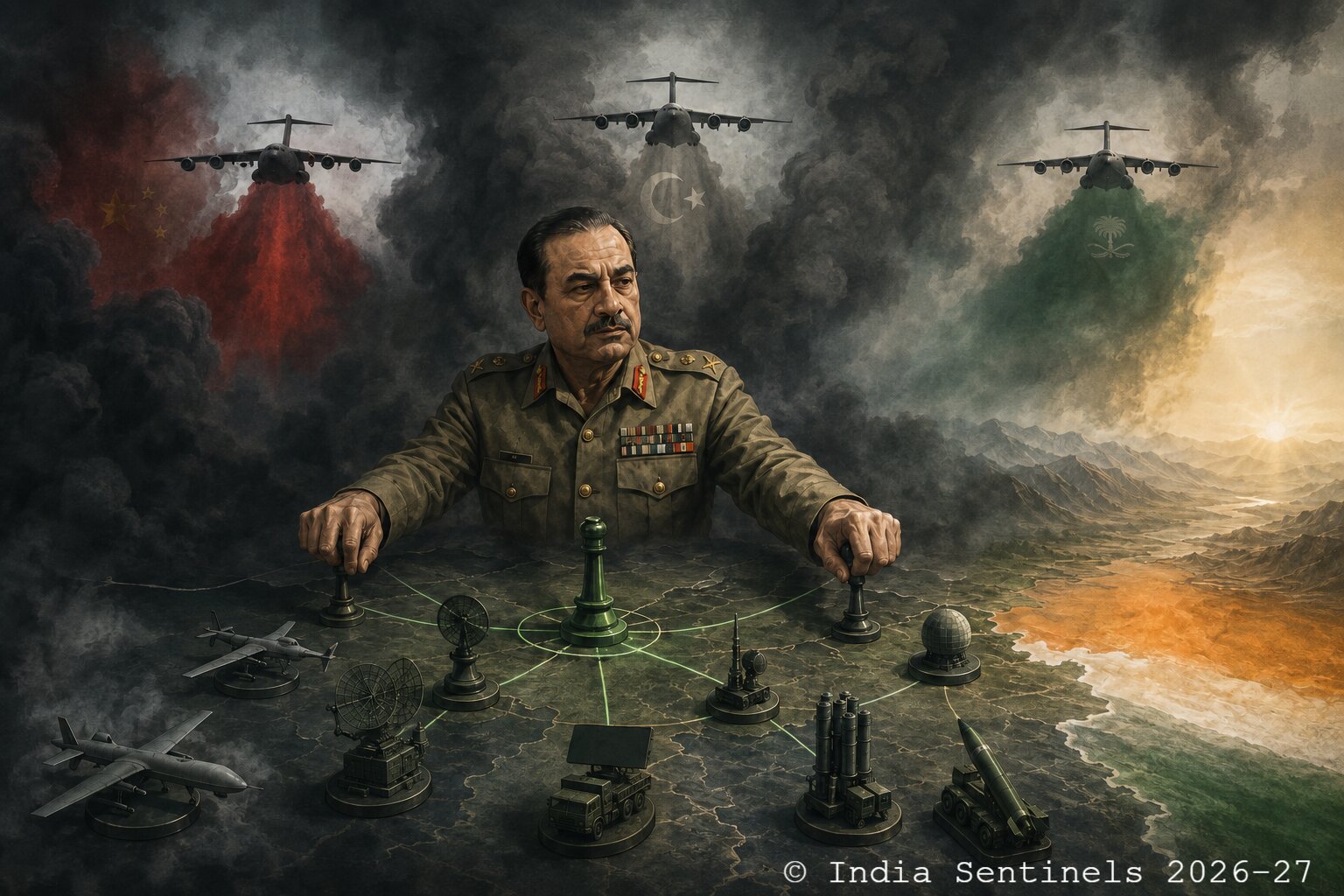
 India Sentinels Illustration for representation. (© India Sentinels 2026-27)
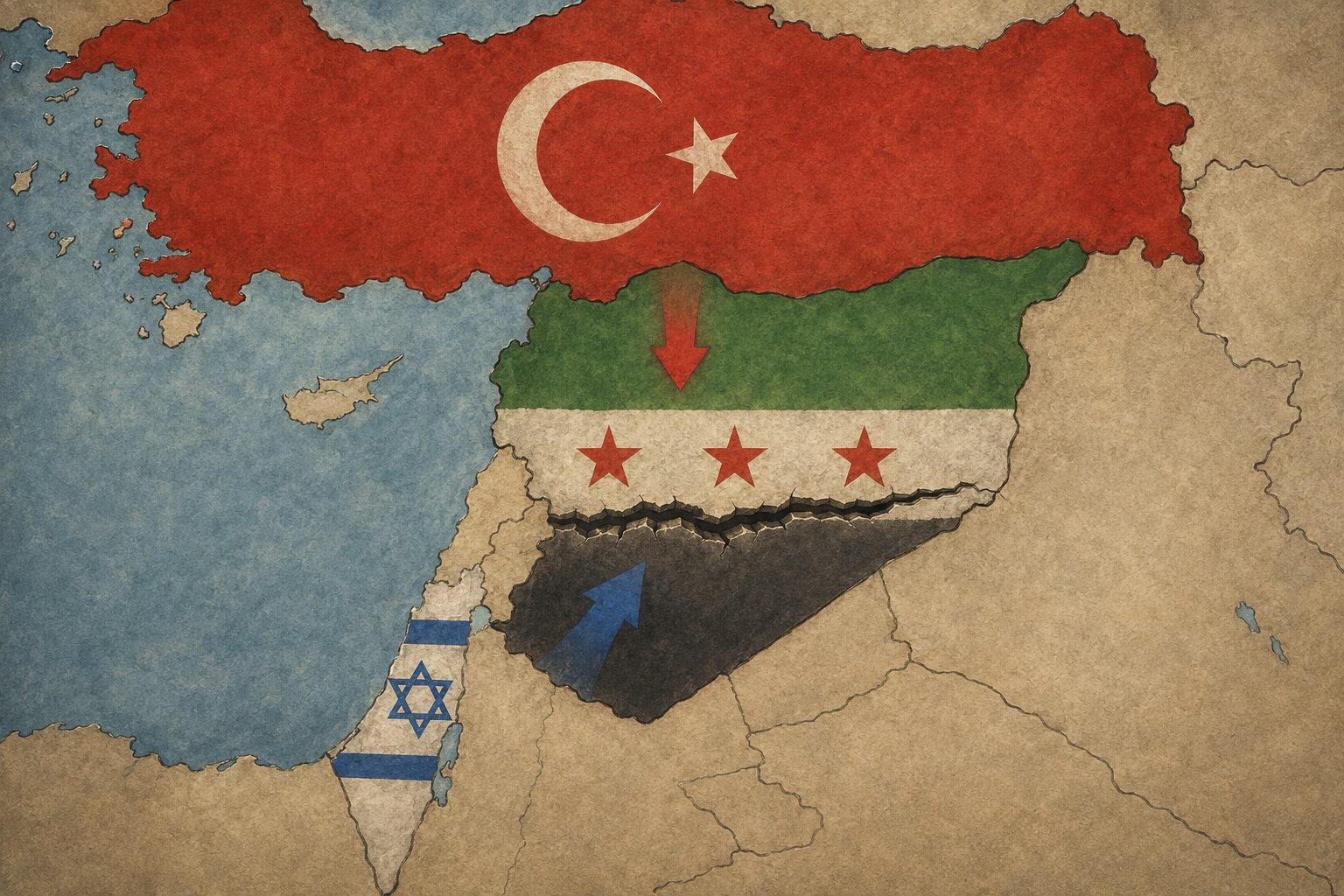
Israel’s August 18 airstrikes on the Abu al-Duhur military airbase in northwestern Syria have pushed an already challenging relationship with Türkiye into a new and potentially dangerous phase. Israel said the strikes were intended to prevent the establishment of a Turkish military presence at the facility, while Ankara and Damascus denied that a permanent Turkish base was being set up.
The United States has since attempted to establish a de-escalation mechanism involving Israel, Türkiye and Syria. Yet the significance of the incident extends well beyond the damage to the airbase: it points to a deeper contest over the future of post-Assad Syria and, more broadly, the shape of the emerging Middle Eastern security architecture.
For the past decade, Israel’s military calculations in Syria were understood predominantly through the prism of Iran, with its strikes generally aimed at preventing Iranian forces and their networks from establishing positions strategically close to Israel. The fall of Bashar al-Assad has altered that equation, with Türkiye emerging as one of the principal external powers shaping Syria’s political and security trajectory while maintaining close ties with the new Syrian government.
Israel appears increasingly concerned that Turkish military influence could acquire a permanent character. The Abu al-Duhur strike therefore suggests that Israeli strategic aims are expanding from containing Iranian entrenchment to preventing another powerful regional military actor from establishing a lasting presence in Syria.
This is significant because Türkiye is not merely another regional actor: it is a major military power, a Nato member and a country with established interests in northern Syria. Ankara’s aims include securing its borders, influencing the post-Assad political order and preventing developments that could threaten its regional position.
Israel, by contrast, seeks to ensure that Syria does not host hostile military infrastructure, whether Iranian or Turkish. These competing positions do not make war inevitable, but they create a layered dispute in which isolating one issue is difficult and confidence-building measures can easily be derailed.
The resulting strategic environment is considerably more complex than the traditional Israel-Iran binary. Türkiye and Iran remain competitors for influence in Syria and the wider Middle East, even as both oppose aspects of Israeli regional policy.
The emerging alignment should therefore not be read as a straightforward Israeli confrontation with a unified Turkish-Iranian bloc. It instead reflects a fluid, multipolar Middle Eastern order in which states compete and cooperate simultaneously.
The United States occupies one of the most difficult positions in this equation. Washington is at once Israel’s principal strategic partner, Türkiye’s Nato ally and an important partner of the Gulf states.
It is also endeavouring to support Syria’s stabilization and prevent renewed regional conflict. The criticism voiced by Tom Barrack, the US special envoy to Syria and ambassador to Türkiye, is telling in this regard.
Barrack described the Israeli strike as an unnecessary escalation and criticized what he said was the lack of adequate American warning. Israel disputed that account and maintained that the operation was based on credible intelligence.
The American conundrum extends beyond preventing an Israel-Türkiye war. Washington would be dealing with a possible escalation between two states that occupy very different but important positions within the US-led security system.
Nato membership would not automatically trigger collective defence in response to an Israeli strike on Turkish-linked infrastructure in Syria. However, a direct confrontation between Türkiye and Israel would create a serious political problem within the Western alliance system, forcing Washington to reassure a Nato ally while maintaining its strategic commitment to Israel.
The evolving Saudi Arabia-Türkiye-Pakistan defence relationship adds another layer to this equation. Saudi Arabia and Pakistan concluded a Strategic Mutual Defence Agreement in September 2025, under which aggression against one is treated as aggression against the other.
Türkiye later moved towards joining this structure, and the trilateral framework has emerged as an important new element in regional security politics. It should not, however, be described as an ‘Islamic Nato’, because it lacks Nato’s integrated command structures and institutional depth; its significance is political and strategic.
For Türkiye, the arrangement adds another layer of strategic depth precisely as relations with Israel deteriorate. This does not mean Saudi Arabia or Pakistan would automatically become involved in an Israeli-Turkish confrontation.
Its significance lies in the broader signal that Ankara is not dependent on a single security relationship. Türkiye can remain within Nato while simultaneously cultivating alternative regional security partnerships.
For Saudi Arabia, the pact reflects a parallel desire for greater strategic autonomy. Riyadh has traditionally depended on the United States for security, but recent regional crises have encouraged Gulf states to diversify their partnerships.
A security framework encompassing Türkiye and Pakistan gives Saudi Arabia access to two major military powers while allowing it to hedge against uncertainty over the American regional role. Pakistan contributes military experience and strategic weight, while Türkiye contributes conventional military capability and an increasingly independent defence industry.
However, this is not an anti-Israel alliance. Saudi Arabia has compelling reasons to prevent a direct confrontation with Israel, while Riyadh’s priorities remain economic transformation, regional stability and the expansion of its international partnerships.
The significance of the new arrangement therefore lies less in its immediate war-fighting implications than in what it reveals about the changing architecture of regional security. Middle Eastern states are increasingly seeking mechanisms to manage their security without relying exclusively on Washington.
That development should concern Israel strategically, even if it does not constitute an immediate military threat. Israel now faces a Türkiye with substantial military capabilities, Nato membership and a growing network of relationships with Saudi Arabia and Pakistan, meaning the prospect of Turkish military entrenchment in Syria must be assessed in a wider regional context.
Iran presents a paradox. Tehran may benefit from an Israeli-Turkish conflict if it diverts Israeli attention and resources away from Iran, but expanding Turkish influence in Syria is scarcely in Iranian interests.
Ankara and Tehran compete for regional influence, particularly in Syria and Iraq. Iran may therefore welcome friction between Israel and Türkiye while remaining wary of the Turkish strategic expansion that such a confrontation could produce.
Domestic politics further complicates the picture. With Israel approaching elections, Barrack has suggested that the strike in Syria may have been politically motivated and linked to Netanyahu’s electoral calculations.
Israeli officials rejected that allegation, maintaining that the operation was driven by genuine security concerns. A similar logic applies in Türkiye, where the president, Recep Tayyip Erdoğan, has little strategic interest in an actual war with Israel but can use a forceful response to reinforce Ankara’s image as an independent regional power and a defender of Syrian sovereignty.
This domestic dimension must be given due weight in any assessment of the regional calculations.
For Syria, this is an unfortunate development. The post-Assad government is struggling to rebuild state institutions while navigating the competing interests of Israel, Türkiye, Iran, the United States and the Gulf states.
Syria consequently risks once again becoming less than an autonomous regional actor. Damascus’s ability to preserve sovereignty over its military infrastructure will be a critical test of the post-Assad order.
The most likely near-term outcome is controlled confrontation rather than open war. Türkiye and Israel both have strong reasons to avoid direct military conflict, while Washington has a powerful incentive to restore channels of communication.
Yet the longer-term danger is the institutionalization of an Israeli-Turkish strategic rivalry in Syria. The Abu al-Duhur strike should therefore be understood as more than another Israeli operation in the country.
It is an early test of a changing regional order. The old Middle Eastern equation, dominated by the Israel-Iran confrontation and underwritten by American power, is giving way to a more fragmented system involving Israel, Türkiye, Iran, Saudi Arabia, Pakistan, the United States and an increasingly consequential post-Assad Syria.
Disclaimer: The views expressed in the article are the author’s own and don’t necessarily reflect the views of India Sentinels.
Follow us on social media for quick updates, new photos, videos, and more.
X: https://x.com/indiasentinels
Facebook: https://facebook.com/indiasentinels
Instagram: https://instagram.com/indiasentinels
YouTube: https://youtube.com/indiasentinels
© India Sentinels 2026-27